From repetitive tasks to intelligent automation: Where AI agents deliver immediate ROI
The Hidden Cost of Manual Operations
Almost every enterprise leader has the same problem.
Teams spending hours on work that doesn’t require human intelligence.
- Data entry
- Invoice processing
- Report generation
- Email routing.
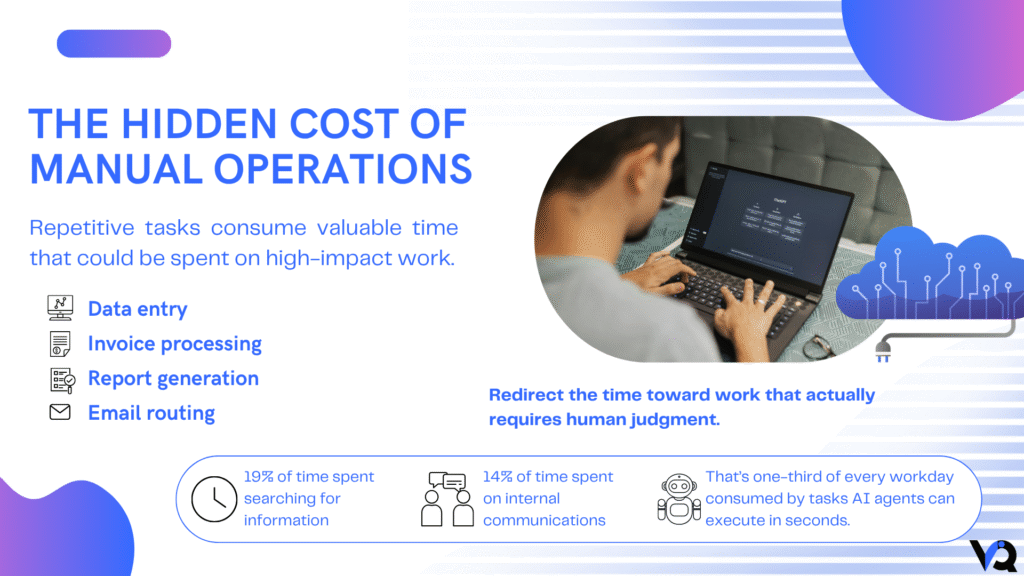
According to McKinsey, knowledge workers spend 19% of their time searching for information and 14% on internal communications that could be automated. That’s one-third of every workday consumed by tasks AI agents can execute in seconds.
This is not about replacing people. It is about redirecting their time toward work that actually requires human judgment.
Beyond Automation: What AI Agents Really Do
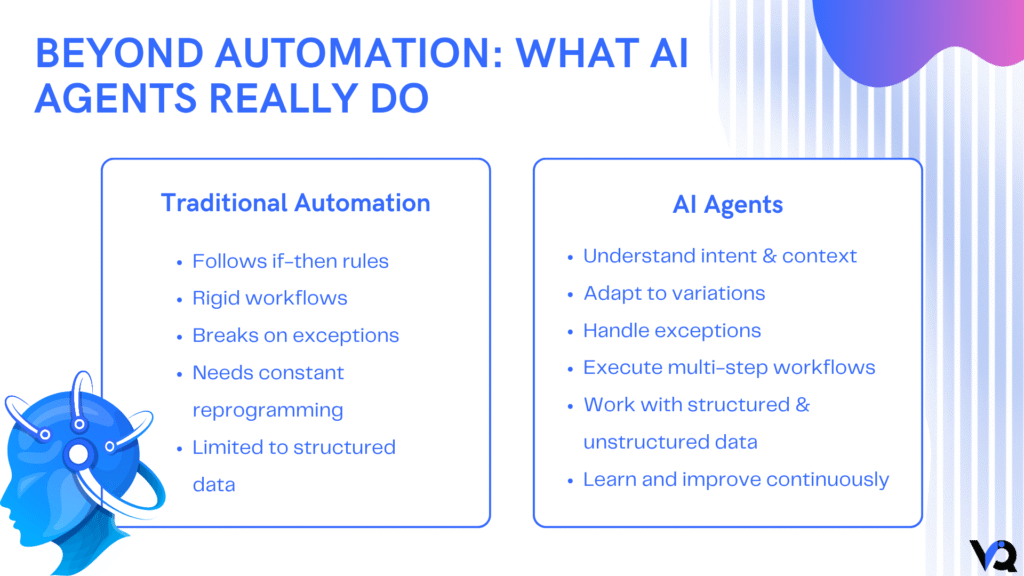
AI agents are not just chatbots with better PR. They are autonomous systems that understand context, make decisions, execute multi-step workflows, and integrate with your existing tech stack.
The difference? Traditional automation follows if-then rules. AI agents understand intent, adapt to variations, and handle exceptions.
Where AI Agents Deliver Immediate Business Value
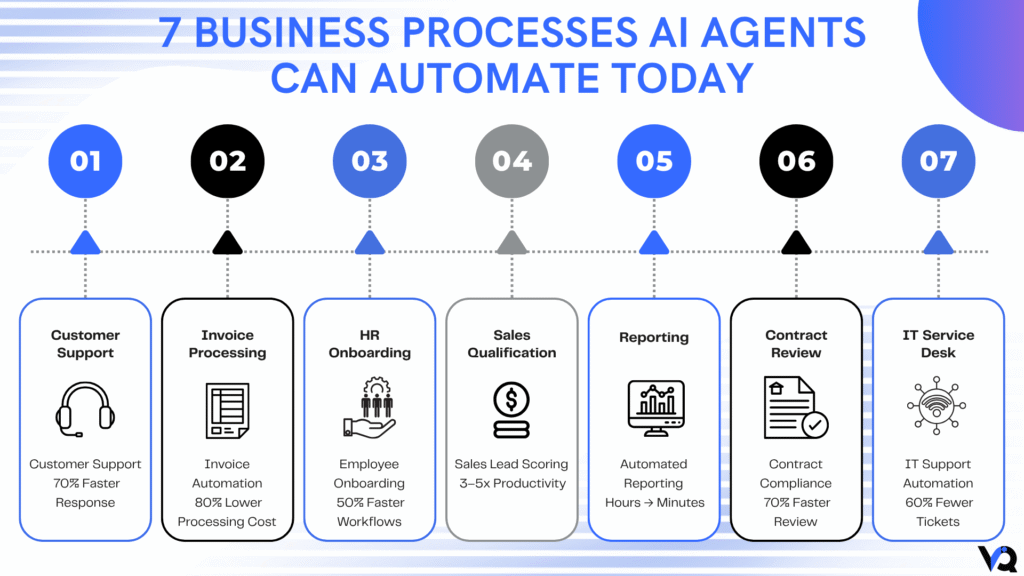
1. Customer Support Ticket Classification and Routing
Support teams manually read every ticket, categorize issues, assign priorities, and route to departments.
AI agents analyze ticket content in real time, detect urgency, pull customer context from CRM, and route automatically. First response time drops by 60-70%. One enterprise reduced routing time from 45 minutes to under 2 minutes.
2. Invoice Processing and Accounts Payable
Finance teams manually extract vendor details from emails, PDFs, and scans. Then comes verification, approval routing, and ERP data entry.
AI agents extract data regardless of format, validate against purchase orders, flag discrepancies, and push verified invoices into accounting systems. Processing time cuts from days to hours. Enterprises report 80% cost reduction.
3. Employee Onboarding and HR Documentation
HR teams manually coordinate orientation, send multiple emails, track forms, provision access, and follow up on incomplete tasks.
AI agents orchestrate the entire sequence. They send personalized communications, track completions, provision access after compliance checks, and answer common questions. Onboarding cycle time drops 40-50%.
4. Sales Lead Qualification and Follow-Up
Sales teams manually research leads, assess fit, prioritize outreach, send emails, and log CRM activities.
AI agents qualify leads instantly. They enrich data, score against ideal profiles, trigger outreach sequences, and surface high-intent prospects. Organizations report 3-5x improvement in sales productivity.
5. Report Generation and Data Summarization
Analysts spend hours compiling data, building Excel reports, creating slide decks, and distributing updates.
AI agents pull data from multiple sources automatically, generate natural language summaries, create visualizations, and distribute on schedules. Report generation drops from hours to minutes.
6. Contract Review and Compliance Checking
Legal teams manually review every contract for non-standard clauses, verify compliance, flag risks, and document deviations.
AI agents scan contracts, extract key terms, identify deviations, flag high-risk clauses, and route only exceptions for legal review. Contract review cycle time cuts by 60-70%.
7. IT Service Desk and Access Management
IT teams manually handle password resets, software access, system provisioning, and troubleshooting.
AI agents authenticate users, execute password resets, provision software, guide troubleshooting, and escalate only complex issues. IT ticket volume reduces by 40-60%. Support costs drop 30-50%.
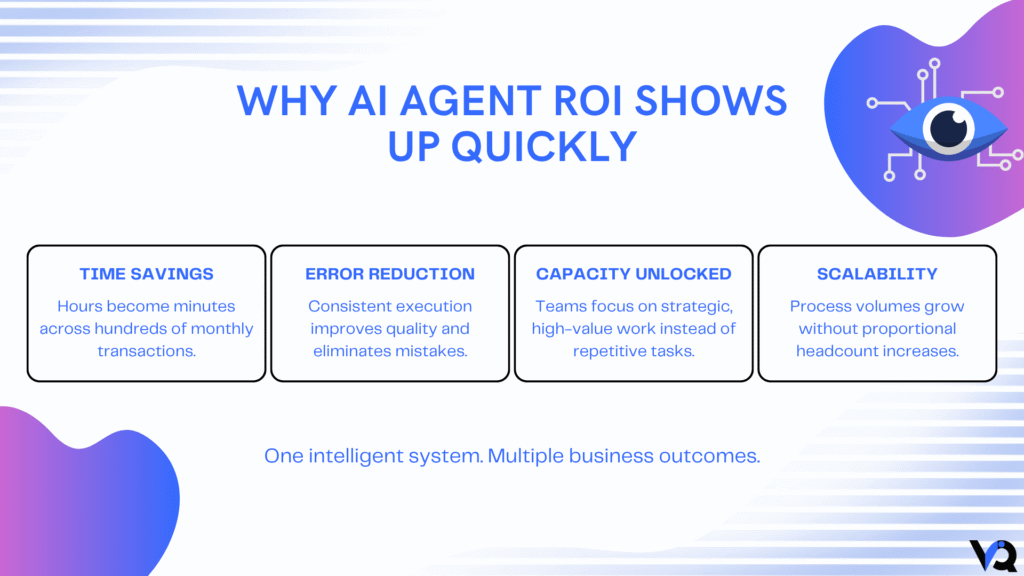
Every successful AI agent implementation follows the same value creation pattern:
Time Savings: Hours become minutes across hundreds of monthly transactions.
Error Reduction: Quality improves through consistency. AI agents don’t misread data or skip steps.
Capacity Unlocked: Teams redirect effort from repetitive tasks toward strategic work.
Scalability: Process volumes grow without proportional headcount increases.
The Shift From Rules-Based Automation to Intelligent Systems
Traditional automation has been around for years. AI agents are different because they understand context from unstructured data, handle exceptions without breaking workflows, use natural language interfaces, and improve continuously from your data.
Modern AI agents integrate with existing systems through APIs. No rip-and-replace required.
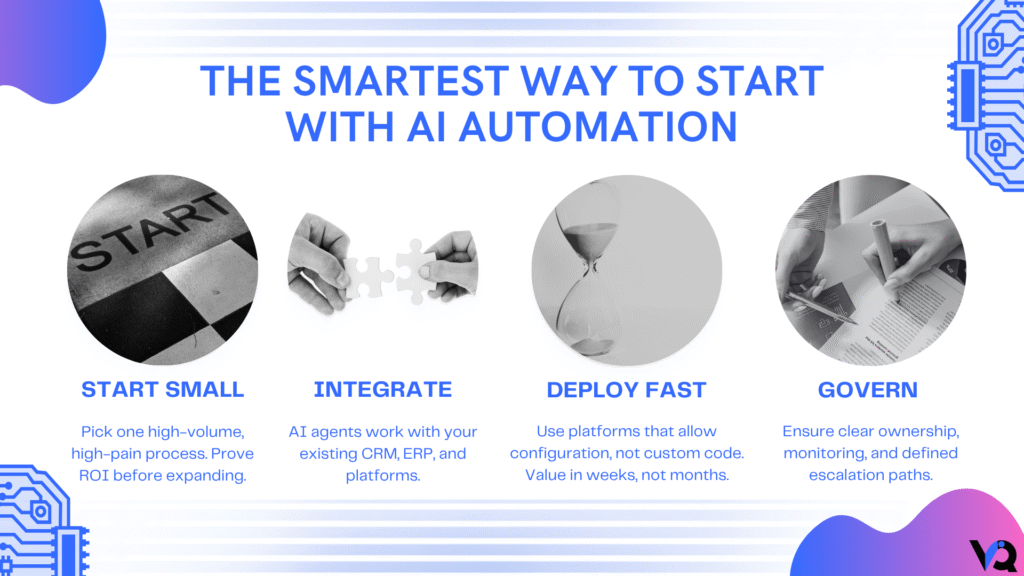
The Smartest Way to Start With AI Automation
- Start small. Pick one high-volume, high-pain process. Prove ROI before expanding.
- Integrate, don’t replace. AI agents work with your existing CRM, ERP, and communication platforms.
- Deploy fast. The right platforms allow configuration, not custom development. Time to value measures in weeks, not months.
- Govern properly. AI agents require clear ownership, monitoring, and defined escalation paths.
The Shift Toward Intelligent Operations
Five years ago, the question was whether AI could handle these workflows. Today, the question is why you’re still running them manually.
The technology works. The ROI is measurable. The deployment timeline is weeks.
What’s missing isn’t capability. It’s organizational willingness to change how work gets done.
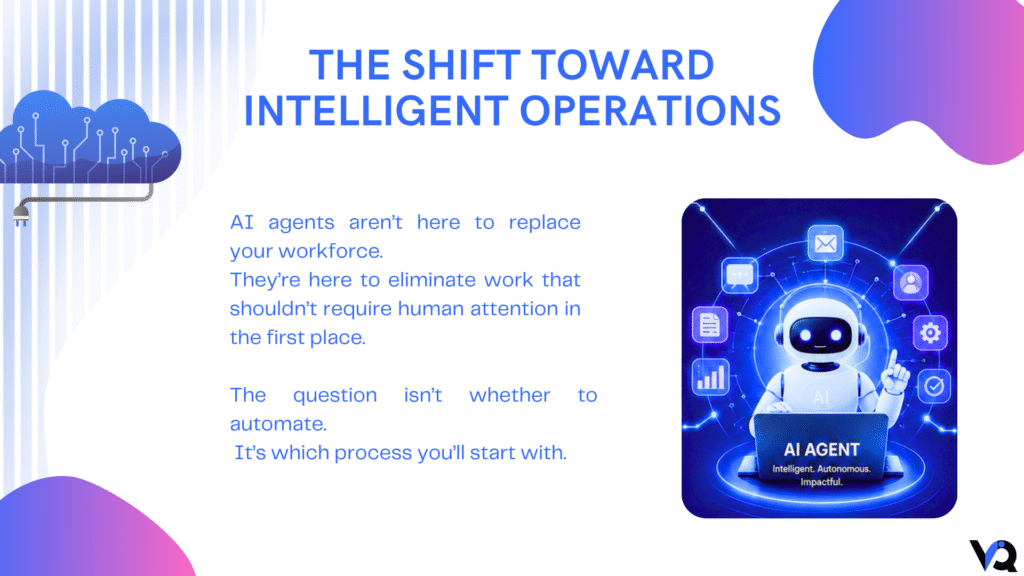
AI agents aren’t here to replace your workforce. They’re here to eliminate work that shouldn’t require human attention in the first place.
At VantageIQ Technologies, we help enterprises identify automation opportunities, deploy AI agent solutions, and measure real business outcomes. Because the future of work isn’t about doing more manually. It’s about letting intelligent systems handle what they do best.
The question isn’t whether to automate. It’s which process you’ll start with.