

Understanding the hidden crisis costing tech leaders time, money, and momentum
Tech companies don’t have a talent shortage. What they’re really missing are people who can turn skills into real execution and results.
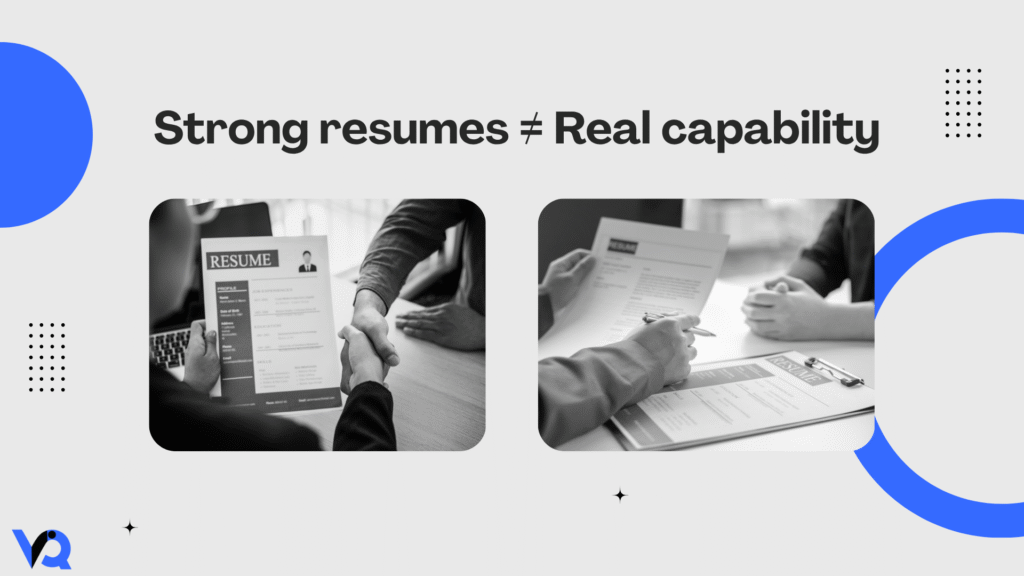
On paper, the market looks stronger than ever, candidates bring impressive resumes, strong academic backgrounds, and experience across modern tech stacks. In reality, hiring outcomes are becoming harder to predict.
The Talent Paradox in Tech Hiring
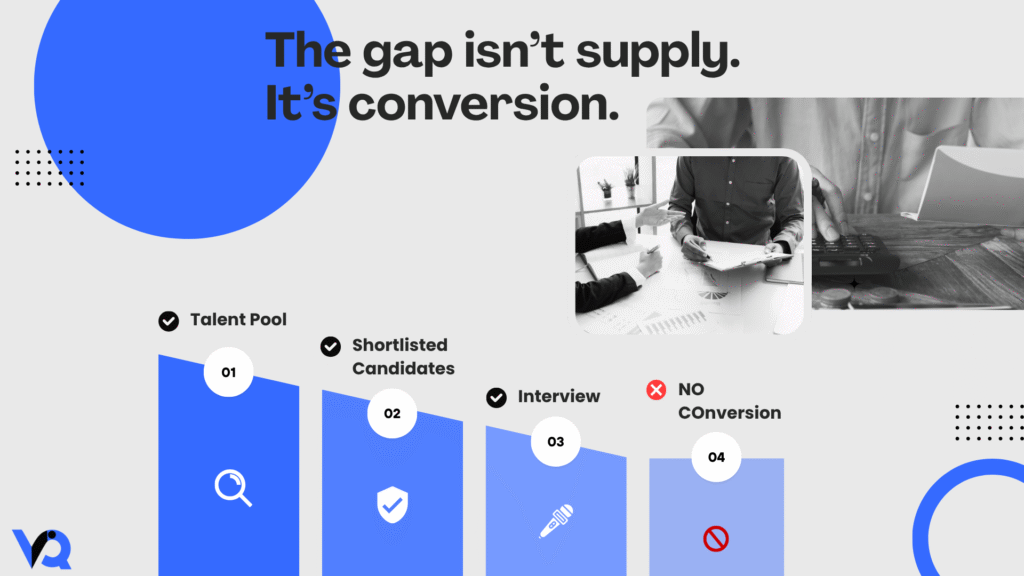
- Roles stay open longer than expected.
- Interview pipelines fail to convert.
- Even after hiring, performance doesn’t always match expectations.
What appears to be a talent-rich market is often a shortage of usable capability.
According to LinkedIn, the average time to hire for many tech roles now stretches beyond 40-60 days and even longer for specialized positions. A study by McKinsey & Company found that 87% of companies are already experiencing skill gaps or expect them soon.
The issue is no longer access to talent. It’s the growing gap between how talent is represented and how capability actually shows up in execution.
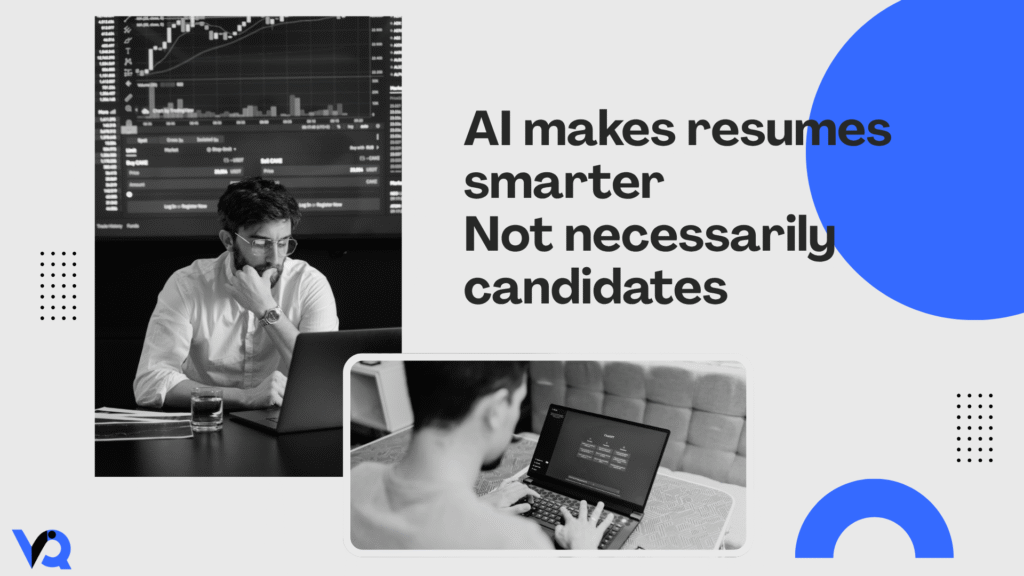
The rise of AI has added a new layer to this challenge. Today, candidates are increasingly using tools like ChatGPT and other generative AI platforms to optimize their resumes for applicant tracking systems and keyword-based screening.
On the surface, this creates stronger, more polished profiles:
- Skills are articulated more convincingly
- Projects are framed more strategically
- Keywords align perfectly with job descriptions
But this introduces a new risk. Resumes are no longer just a reflection of experience, they are often AI-enhanced representations. And in many cases, the depth of understanding behind those skills doesn’t match the way they are presented.
This makes it significantly harder to distinguish between:
- Candidates who can describe work well
- And those who can actually do the work
The gap between perceived capability and real execution continues to widen.
The Real Cost of Getting Talent Wrong
Hiring today directly shapes business outcomes.
Every engineering hire influences:
- Product timelines
- System reliability
- Team velocity
- Delivery confidence
When a hire doesn’t meet expectations, the impact compounds quickly:
- Projects slow down
- Teams stretch to compensate
- Leadership shifts from building to fixing
- Hiring cycles restart under pressure
According to the U.S. Department of Labor, a bad hire can cost up to 30% of the employee’s annual salary, excluding indirect losses like delayed execution and lost productivity.
A single mis-hire doesn’t just cost compensation. It disrupts momentum and introduces execution risk across the organization.
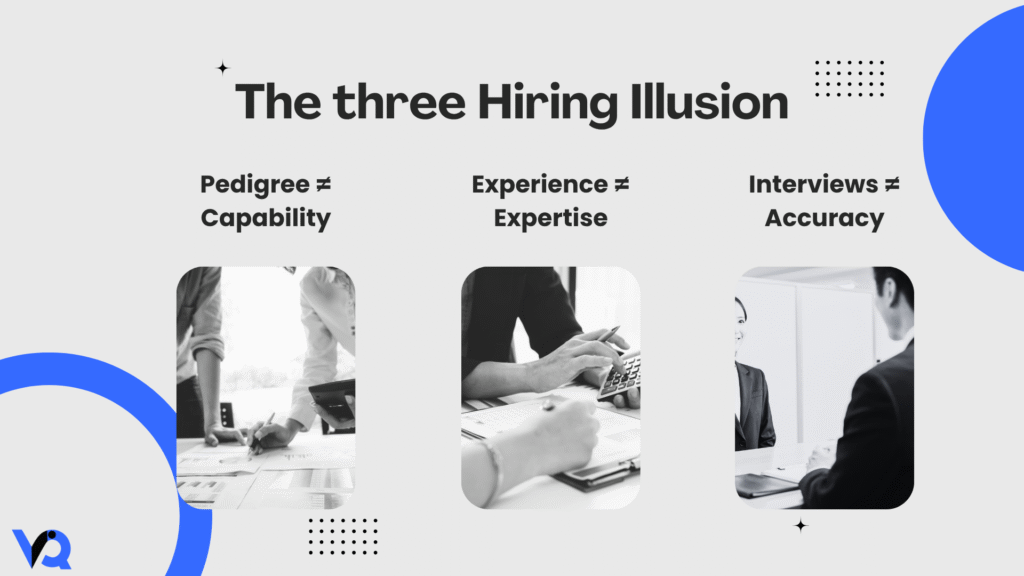
The Three Illusions in Tech Hiring
1. Pedigree Equals Capability
A strong academic background or a well-known company name used to be a reliable signal. Today, it isn’t. Candidates may come from top firms but their depth of contribution varies widely. Some have built systems end-to-end. Others have worked in narrow, low-ownership roles. Resumes rarely show that distinction. Hiring decisions often still rely on them.
2. Experience Equals Expertise
Years of experience are often used as a proxy for capability. But time spent is not the same as depth gained. In many cases, experience reflects repetition, not strong fundamentals. Without that foundation, problem-solving becomes limited to familiar scenarios.
3. More Interviews Equals Better Decisions
When hiring outcomes don’t improve, companies often add more interview rounds. But longer processes don’t guarantee better decisions. If interviews don’t test real thinking how candidates approach ambiguity, break down problems, or reason through systems they end up measuring preparation, not capability. What appears rigorous often becomes structured inefficiency.
The Multi-Offer Reality
Even when companies find strong candidates, conversion is increasingly unpredictable.
Candidates today often:
- Hold multiple offers
- Delay decisions
- Optimize primarily for compensation
Insights from Gartner highlight rising offer declines and candidate drop-offs.
This creates friction:
- Teams invest in candidates who may never join
- Offer acceptance rates decline
- Hiring timelines stretch
Over time, hiring starts to feel less like selection and more like negotiation.
A Pattern Emerging Across Organizations
Across technology-driven companies, a consistent pattern is emerging:
Candidates with strong resumes often struggle with foundational concepts.Even those who clear interviews don’t always convert.
The issue isn’t a lack of talent. It’s the gap between perceived capability and real-world execution.
Why This Is No Longer Just an HR Problem
These challenges directly impact business outcomes:
- CTOs → delays in product and engineering execution
- CEOs → slower growth and missed opportunities
- CFOs → rising cost of inefficiency
At this level, hiring is not about filling roles. It’s about ensuring the organization has the capability to execute its strategy.
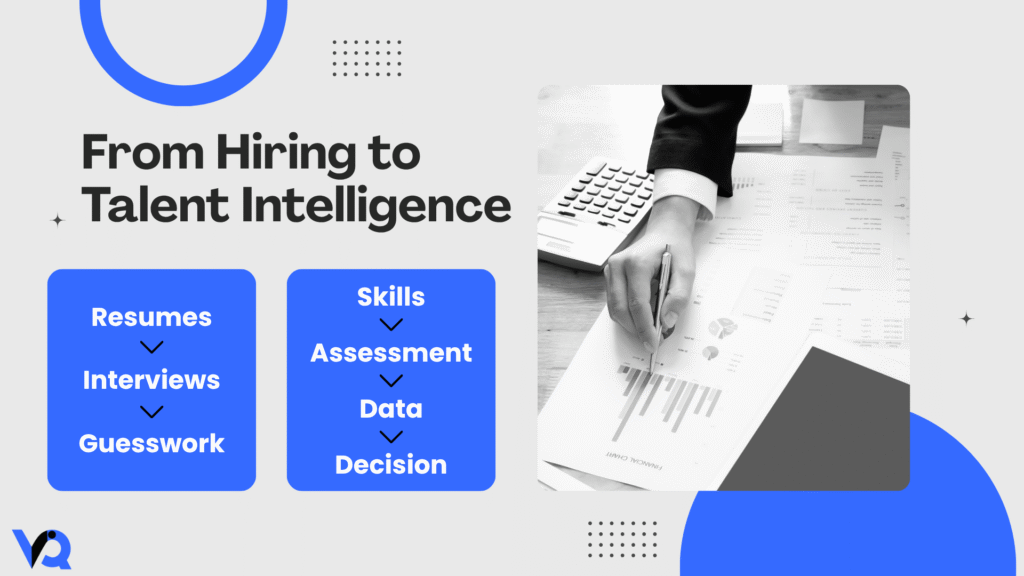
The Shift: From Hiring to Talent Intelligence
Forward-thinking organizations are changing their approach. Instead of reacting to open roles, they are building systems around talent intelligence:
- Mapping where relevant talent exists
- Evaluating capability beyond resumes
- Designing assessments that test fundamentals and thinking
- Building early pipelines instead of last-minute sourcing
The focus shifts from:
“How quickly can we hire?”
to
“How accurately can we identify and secure the right capability?”
At VantageIQ Technologies, we are building platforms like KAUSHALL to enable this shift, bringing a unified skills intelligence layer that maps workforce capability against real role requirements. By combining AI-led assessments, role-based skill mapping, and continuous upskilling pathways, KAUSHALL helps organizations move beyond resume-based hiring to a more structured, data-backed understanding of execution readiness.
What This Means Going Forward
If your organization is experiencing:
- Strong resumes but weak interview performance
- Low offer acceptance rates
- Delays in critical hiring
- Increasing leadership time spent in interviews
This isn’t a temporary hiring challenge. It’s a signal that the approach needs to evolve. Because hiring more people doesn’t solve the problem. Hiring the right capability does.
If you’re involved in hiring in any capacity and this resonates with you, it’s worth asking:
If your hiring process cannot clearly distinguish between perceived talent and actual capability:
are you building a competitive advantage, or simply scaling inefficiency?
About VantageIQ Technologies
At VantageIQ Technologies, we work closely with organizations to address complex talent challenges through structured talent mapping, in-depth capability assessment, and strategic hiring advisory.
We combine domain expertise with thoughtful evaluation frameworks to help companies look beyond resumes and focus on what truly matters is real, on-the-job impact.
If you’re rethinking how your organization identifies and hires true capability, it may be time to move beyond traditional hiring approaches and adopt a more structured, insight-driven way of understanding talent.