

Talent strategies nowadays are built on a flawed assumption:
If you hire well and train periodically, capability will take care of itself.
That assumption is breaking down.
Across industries, leaders are facing a new kind of talent problem, not shortage, not hiring inefficiency, but capability uncertainty.
- You have people.
- You have roles.
- You have learning programs.
But you don’t have a clear answer to one simple question:
What can your workforce actually do today and what will it be able to do tomorrow?
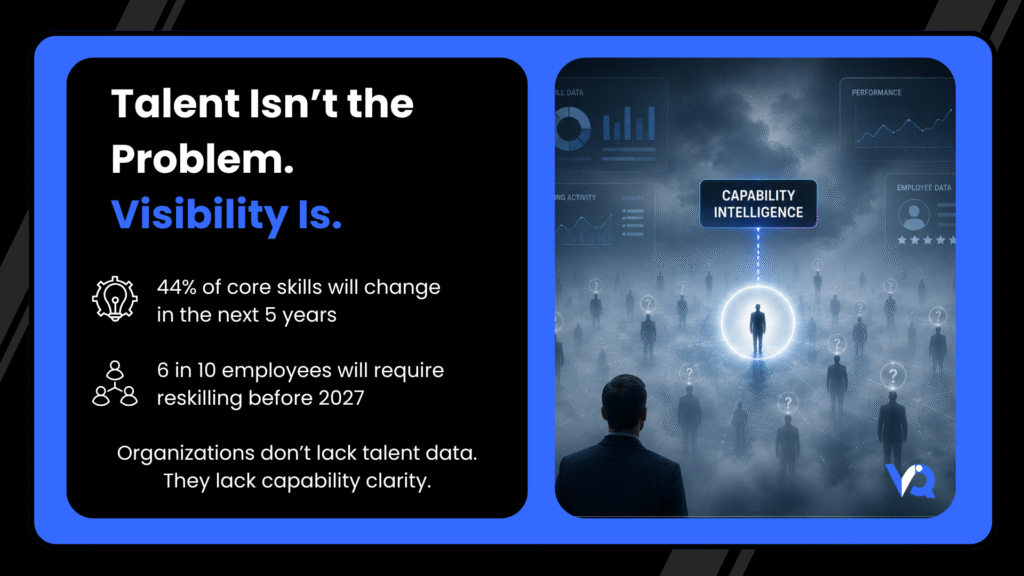
Talent Is not the Problem Anymore. Visibility Is The Problem.
Over the last few years, the conversation has moved from hiring to skills but most organizations haven’t operationalized it.
Reports from World Economic Forum and McKinsey & Company point to the same trend:
- ~44% of core skills are expected to change within the next 5 years
- 6 out of 10 employees will require reskilling before 2027
- Skills gaps are now a top barrier to transformation
At the same time:
- AI is compressing skill lifecycles
- Roles are becoming fluid
- Experience is becoming a weak signal
Today, the real challenge isn’t the availability of talent, it’s the ability to clearly identify the right capability.
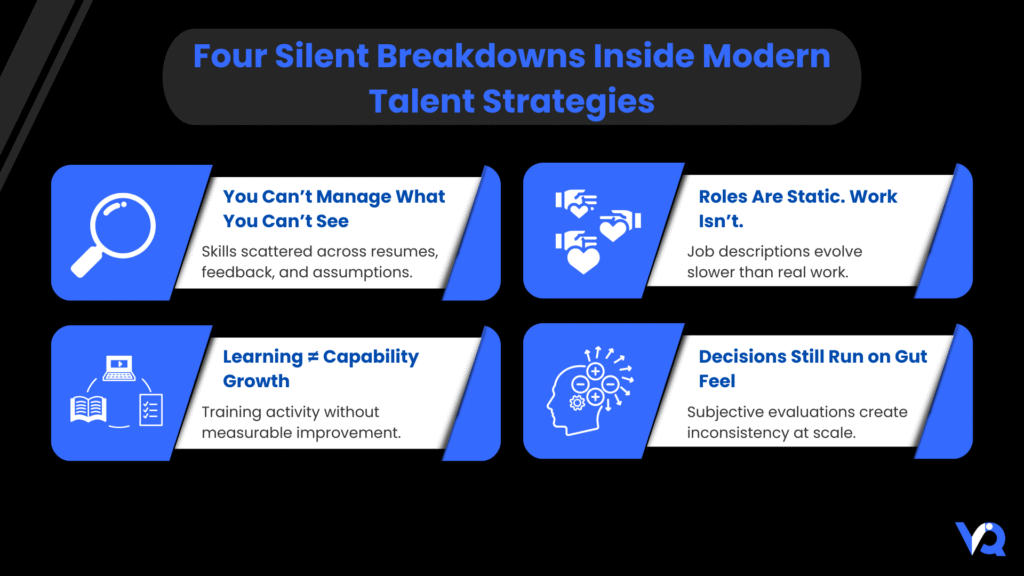
1. You Can’t Manage What You Can’t See
Skills are scattered across resumes, feedback, and assumptions.
- No unified skill map
- No standard measurement
- No real baseline
Outcome: Decisions without visibility.
2. Roles Are Static, Work Isn’t.
Job descriptions don’t reflect how work actually happens.
- Roles evolve but JDs don’t
- Hiring targets outdated expectations
- Internal movement becomes inconsistent
Outcome: Misaligned hiring and promotions.
3. Learning is happening but the capability is not improving.
According to LinkedIn insights:
- Learning investments are rising
- Impact remains unclear
Because:
- Training is generic
- No link to actual skill gaps
- No measurable outcomes
Outcome: Activity without progress.
4. Decisions Still Run on Gut Feeling
Even today, most talent decisions rely on:
- Interview performance
- Manager judgment
- Past experience
Outcome: Inconsistency at scale and avoidable mistakes.
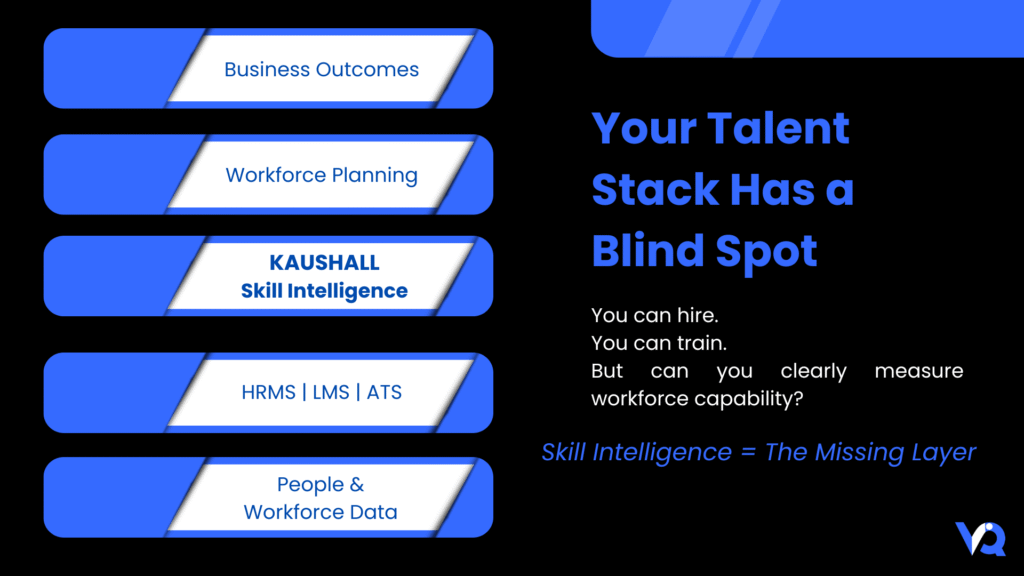
The Stack Is Complete, Except for One Missing Layer
Most organizations already have:
- Systems to hire
- Systems to manage
- Systems to train
But none of them answer:
- What skills actually exist?
- At what level?
- Compared to what’s needed?
- And how fast they’re evolving?
That missing layer is skill intelligence.
Skill Intelligence Isn’t a Feature. It’s infrastructure.
Skill intelligence is not about tracking skills.
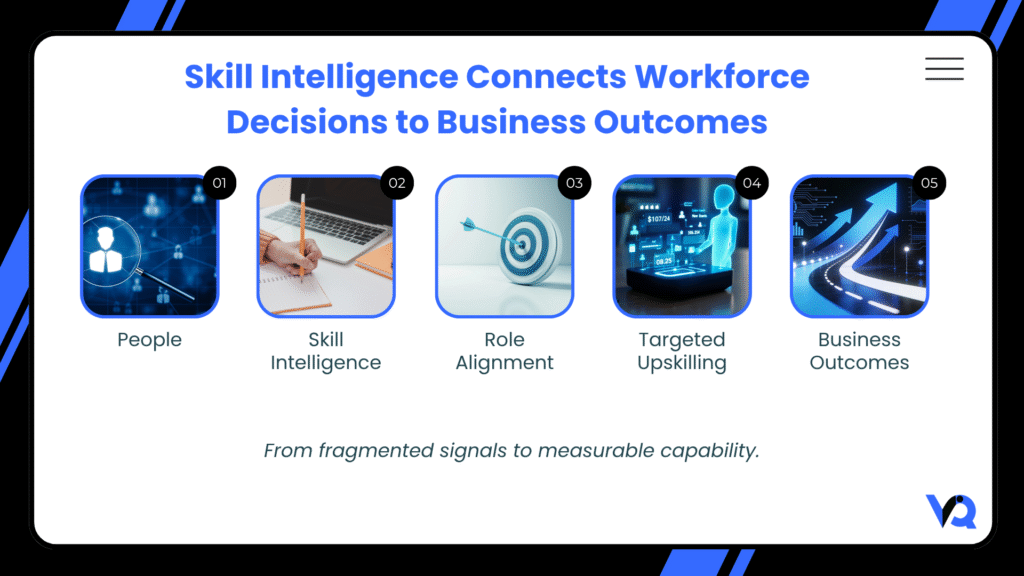
It’s about connecting:
People → Skills → Roles → Outcomes
It enables organizations to:
- Measure capabilities objectively
- Align roles with real skill requirements
- Identify gaps before they become risks
- Drive targeted development
This is where talent strategy becomes operational.
KAUSHALL: Turning Skills Into a System
KAUSHALL is built to operationalize this layer consistently, at scale.
1. Multi-Source Capability Mapping (Not Single-Input Guesswork)
Combines:
- AI-led assessments
- Manager and peer inputs
- CV analysis
- Role context
Output: A structured, reliable skill matrix.
2. Role Clarity, Not Job Description Ambiguity
Transforms job descriptions into:
- Standardized skill requirements
- Defined proficiency levels
- Comparable role benchmarks
Outcome: Alignment between expectation and reality.
3. Gap Detection Before It Becomes a Hiring Problem
Maps current skills against role requirements to identify:
- Capability gaps
- Readiness risks
- Misalignment
- High-potential talent
All visible, not assumed.
4. Learning That Starts With Reality (Not Catalogs)
KAUSHALL connects insights directly to action:
- Personalized, role-based recommendations
- Integrations with Coursera, Udemy, etc.
- Learning driven by actual gaps
- Progress tracked over time
Outcome: Measurable capability growth.
5. From Periodic Reviews to Continuous Intelligence
Enables:
- Ongoing skill tracking
- Structured assessment cycles
- Real-time workforce insights
Shift: From static snapshots → dynamic capability view.
Why skill Intelligence Becomes Non-Negotiable Now
Skill Intelligence is not a future problem.
- AI is redefining roles faster than hiring cycles
- Skill half-life is shrinking
- Workforce planning is becoming dynamic
Without skill intelligence:
- Hiring stays reactive
- Learning stays inefficient
- Decisions stay subjective
With it:
- Capability becomes measurable
- Talent strategy becomes predictable
- Organizations become adaptable
The Real Competitive Advantage Isn’t Talent. It’s Understanding Talent.
The organizations gaining the most momentum today are not simply investing more in hiring or learning.
They are building better visibility into workforce capability:
- Understanding what skills exist today
- Identifying where gaps are emerging
- And creating structured pathways for growth and adaptation
That shift enables talent strategy to become more proactive, measurable, and aligned with business outcomes.
As workforce expectations continue to evolve, one question becomes increasingly important:
Do you have a clear, measurable understanding of your organization’s capabilities today and how they need to evolve tomorrow?
If skill intelligence and workforce capability visibility are priorities for your organization, connect with us. We’d love to explore how organizations are approaching capability management, workforce planning, and AI-driven skill intelligence at scale.