

From proof-of-concept to production paralysis: Understanding the AI implementation gap
The AI Deployment Challenge
Enterprise AI adoption continues to accelerate across industries. According to McKinsey’s State of AI Report, 78% of organizations now use AI in at least one business function, but scaling those initiatives into production remains a major challenge for many enterprises.
The pattern repeats across industries: exciting AI proof-of-concept, promising machine learning demo, executive buy-in, then silence. AI projects stall between pilot success and enterprise AI production.
This isn’t just wasted AI investment. It’s about missed digital transformation opportunities and competitive advantage lost while organizations remain stuck in pilot purgatory.
The Gap Between AI POC and Production
Most enterprise AI pilots begin with momentum.
A specific AI use case is identified. An AI vendor is selected. Within weeks, there’s a working AI prototype demonstrating clear business value.
Then reality hits. What worked in a controlled pilot environment becomes complex when scaling AI to production. The challenge isn’t the AI technology, it’s enterprise AI implementation at scale.
Five Critical AI Production Failure Patterns
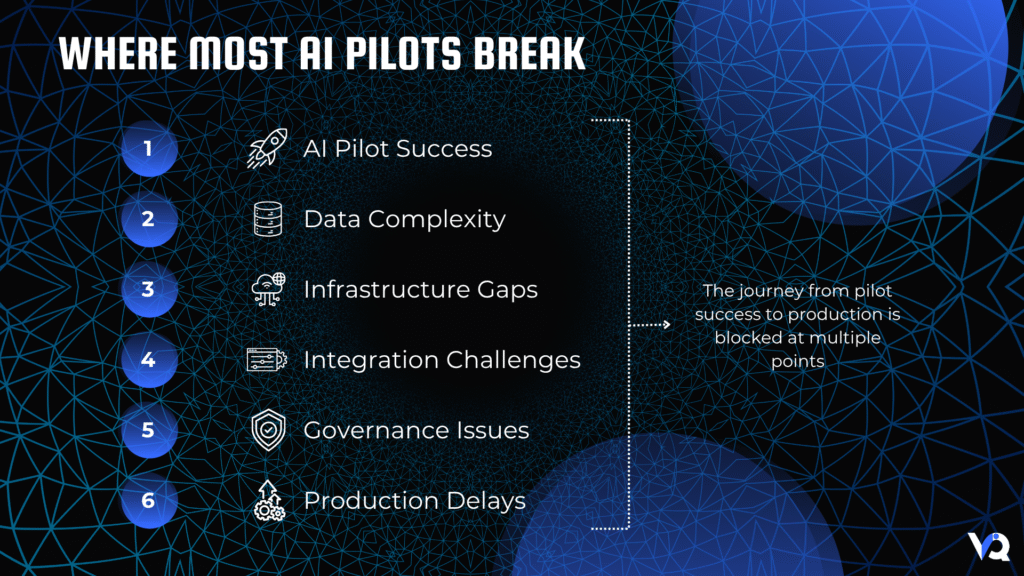
1. Enterprise Data Quality Issues
In AI pilots, data is curated and clean. Production AI systems face messy enterprise data:
- Legacy data formats and inconsistent mappings
- Missing values and real-time data quality issues
- Unstructured data that breaks machine learning models
AI data preparation for production requires robust data engineering pipelines, not sample datasets.
2. AI Infrastructure Gaps
ML models need specialized infrastructure most enterprises lack:
- GPU-enabled cloud infrastructure for AI inference
- Real-time data pipelines with low latency
- MLOps for model versioning and monitoring
- AI model deployment architecture for scale
Enterprise cloud migration and AI infrastructure modernization weren’t planned during the pilot.
3. Complex AI System Integration
Production AI integration means connecting to ERP systems, CRM platforms, and legacy applications, each adding complexity that compounds exponentially. API integration, data synchronization, and workflow automation become critical bottlenecks.
4. AI Governance and Compliance
Scaling AI requires enterprise AI governance:
- Model performance monitoring and audit trails
- AI compliance frameworks for regulated industries
- Explainable AI for transparent decision-making
- AI risk management and data privacy protocols
Building responsible AI governance takes months and cross-functional stakeholder alignment.
5. Organizational Change Management
The team building AI pilots rarely runs production systems. Scaling requires:
- AI operations training for IT teams
- Business intelligence integration for end users
- AI center of excellence for knowledge transfer
- Executive AI strategy alignment
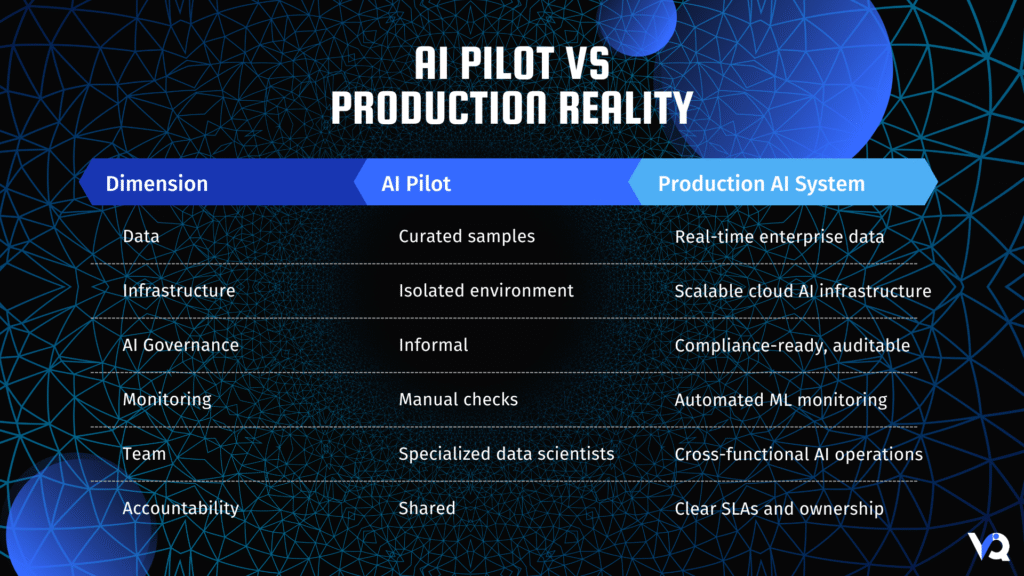
Each dimension requires strategic AI implementation planning and resource allocation.
The Hidden Cost of Failed AI Projects
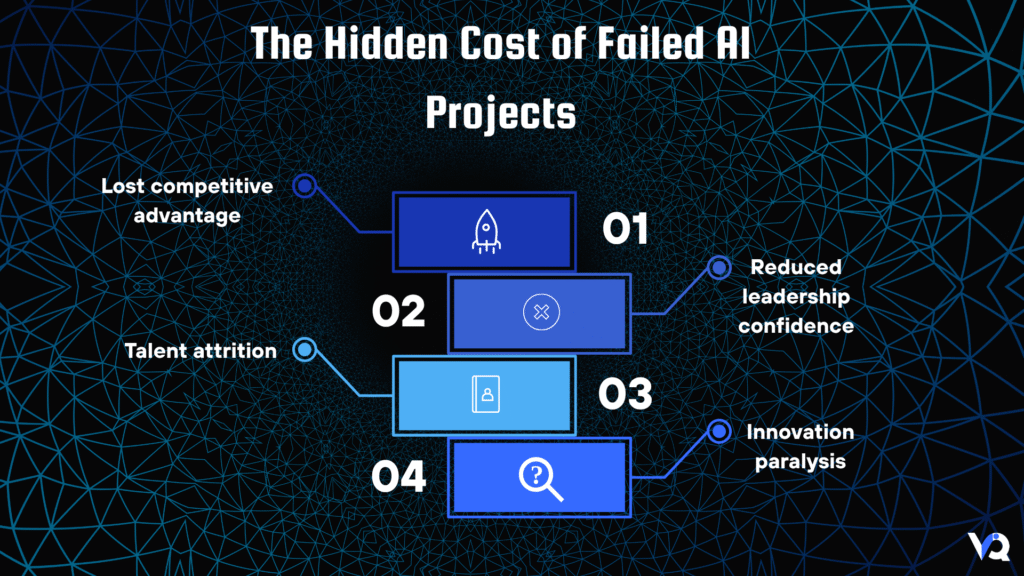
When AI initiatives fail to scale, organizations experience:
- Lost competitive advantage in AI-driven markets
- Reduced AI investment confidence among leadership
- AI talent retention issues as skilled teams seek impact
- Innovation paralysis blocking future AI transformation
The biggest cost is not the failed AI pilot itself, but the next five AI initiatives that never get the green light because of it.
Production-Ready AI: Planning for Scale
Organizations achieving successful AI deployment approach pilots with production in mind:
Enterprise AI Strategy Questions:
- What cloud infrastructure and MLOps will this require?
- Who owns this AI system long-term?
- How will we monitor AI model performance at scale?
- What AI governance framework do we need pre-launch?
- How does this integrate with existing business processes?
These questions shape AI roadmap planning, not just post-pilot fixes.
Building Scalable AI Systems From Day One
AI Data Strategy
- Use production-like data including edge cases
- Implement data quality monitoring and lineage
- Establish data governance for AI compliance
AI Infrastructure Architecture
- Design cloud-native AI deployment early
- Prototype enterprise system integration points
- Allocate AI infrastructure budget upfront
AI Governance Framework
- Define clear ownership and AI accountability
- Create business-relevant AI KPIs
- Build explainability and compliance into design
Organizational AI Readiness
- Involve operations teams in pilot validation
- Provide AI training before production launch
- Establish AI support and escalation processes
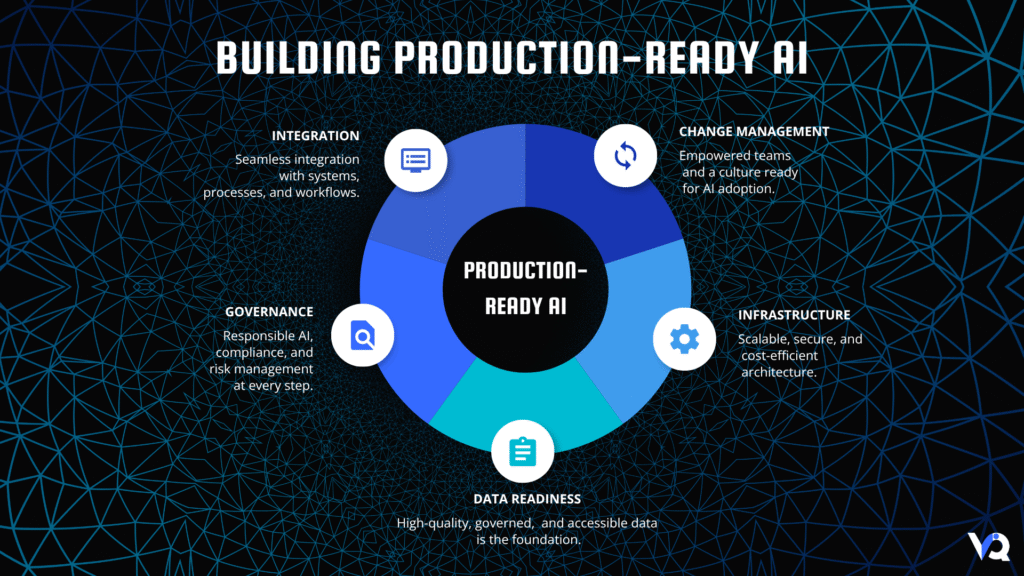
Bridging the AI Production Gap
The enterprise AI conversation has focused heavily on experimentation, but the real challenge is operationalization at scale.
Success is not determined by whether an AI model performs well in a pilot environment. It depends on whether organizations can deploy, integrate, govern, and sustain AI systems in real-world enterprise conditions.
Bridging the gap between AI pilots and production requires:
- planning for scale from the beginning
- building infrastructure and governance early
- aligning operations, technology, and business teams
- measuring success through real business impact
Moving AI from pilot to production requires more than a working model. At VantageIQ Technologies, we help enterprises build AI systems designed for real-world scale and long-term impact.