

Why calling them both “AI” is costing you real business outcomes.
Every enterprise has tried a chatbot. Most are still trying to make it work.
And yet, boardrooms across industries are now buzzing about AI agents. The terms get used interchangeably. That’s the first mistake and it’s an expensive one.
If your organisation is planning an AI strategy, understanding the difference between AI agents and traditional chatbots isn’t just semantics. It’s the difference between a tool that answers questions and one that actually gets work done.
The Chatbot Trap
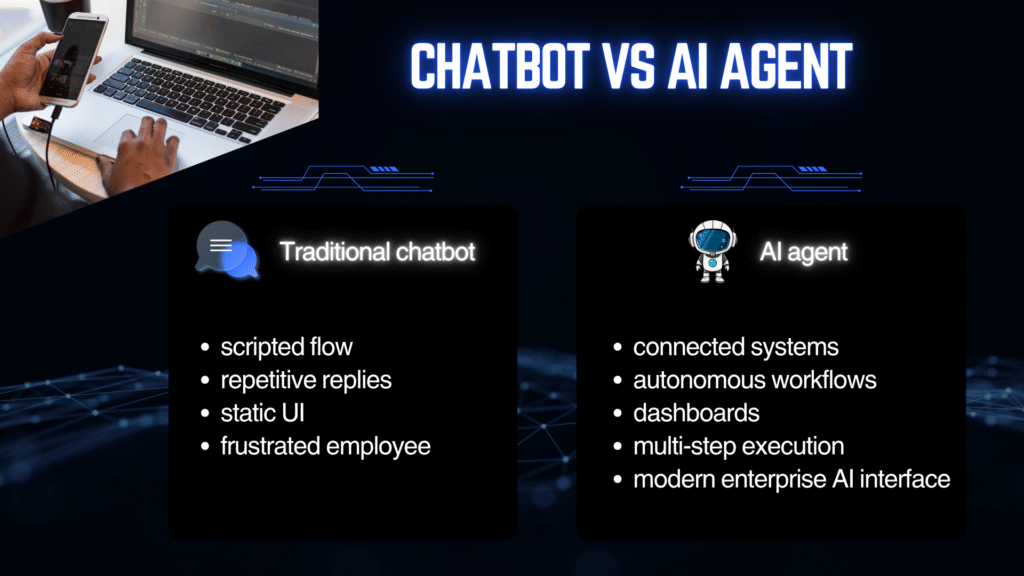
Traditional chatbots are reactive. They wait. They respond. They follow a script.
You type a query. The chatbot matches it to a predefined flow. If your question fits the template, you get an answer. If it doesn’t, you get “I didn’t understand that. Please try again.”
Sound familiar?
Most enterprise chatbots deployed between 2018 and 2023 live here. They were built to deflect support tickets. They succeeded at that narrowly. But they were never built to think, decide, or act.
That’s not a failure of ambition. It’s a structural limitation. Traditional chatbots don’t have memory across sessions. They don’t access live systems. They don’t take action on your behalf.
They respond. That’s all.
So What Is an AI Agent, Really?
An AI agent is a system that perceives context, reasons through a problem, and takes autonomous action to complete a goal.
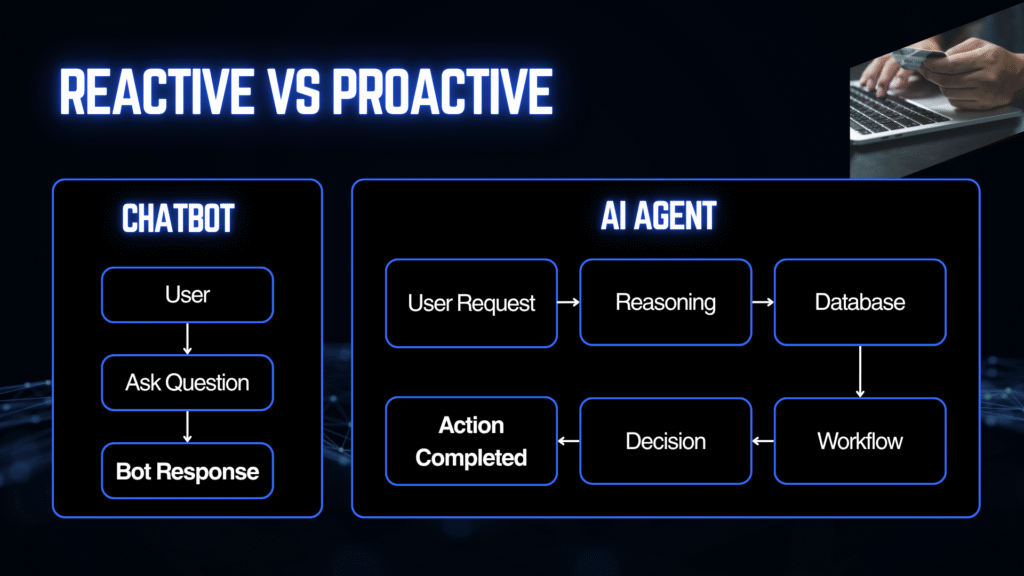
It doesn’t just answer “What’s the status of claim #4821?” It retrieves the claim record, checks for missing documents, flags a compliance issue, and drafts a response without a human walking it through each step.
That’s the shift. From reactive to proactive. From scripted to reasoning-based. From single-turn responses to multi-step execution.
AI agents can:
- Access live tools and systems – CRMs, ERPs, databases, APIs
- Remember context across a conversation or session
- Make decisions based on incomplete or ambiguous information
- Trigger workflows and hand off tasks to other systems or agents
- Learn and adapt based on feedback loops
Traditional chatbots do none of this by default.
The Three Mistakes Enterprises Keep Making
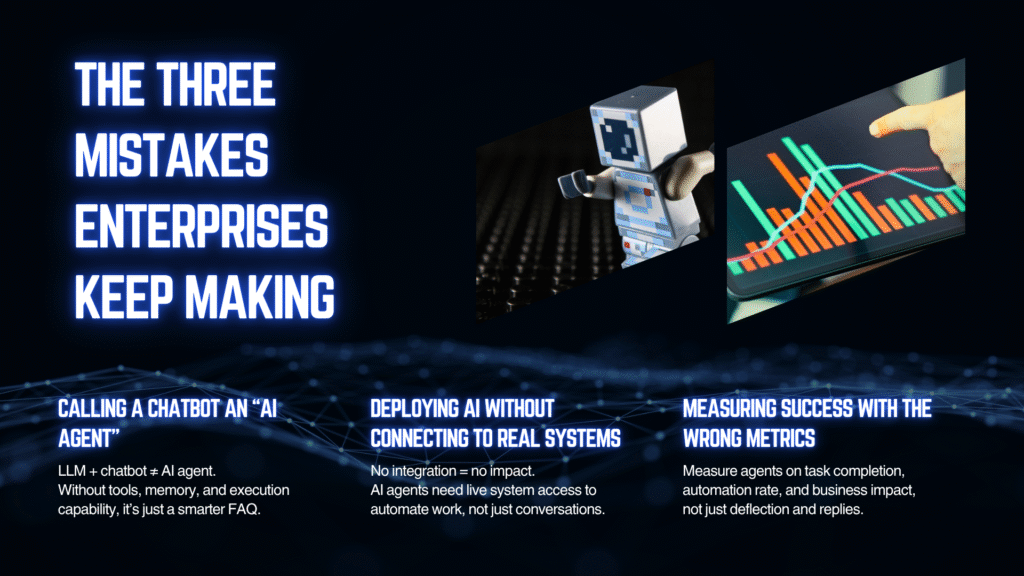
1. Calling a Chatbot an “AI Agent” and Expecting Agent Results
This is the most common mistake. Enterprises buy a chatbot, wrap it in GenAI branding, and wonder why adoption is low and outcomes are shallow.
A chatbot with a large language model (LLM) bolted on is still a chatbot. Without the ability to access tools, manage state, and execute multi-step tasks, it’s just a smarter FAQ page.
Real enterprise AI agents are built around reasoning frameworks: ReAct, Plan-and-Execute, or multi-agent orchestration. That’s a fundamentally different architecture.
2. Deploying AI Without Connecting It to Real Systems
Chatbots typically work on static knowledge bases. They’re trained on documents and FAQs. They can’t touch your live data.
AI agents need system integration to deliver value. They need read/write access to your CRM, ITSM, claims management platform, or HR system. Without that, you’re automating conversation not work.
Enterprises that skip this step end up with agents that sound impressive in demos but can’t close a ticket, update a record, or escalate a case without human intervention.
3. Measuring Success with the Wrong Metrics
Traditional chatbots are measured on deflection rates and resolution time. These are fine metrics for chatbots.
AI agents should be measured on task completion, workflow automation rate, downstream process impact, and cost per outcome.
When you measure an AI agent like a chatbot, you undervalue it. Worse, you end up optimising for the wrong things.
Where AI Agents Actually Win for Enterprises
AI agents deliver disproportionate value in high-volume, multi-step, decision-heavy workflows. Think:
- Insurance claims processing – triaging documents, flagging non-medical expenses, routing for review
- IT operations – diagnosing incidents, running runbooks, auto-escalating based on severity
- Finance and compliance – reconciling transactions, generating audit trails, flagging anomalies
- HR and talent – screening candidates, scheduling, summarising interviews, drafting offer letters
These aren’t tasks chatbots can handle. They require judgement, tool access, and the ability to act across systems.
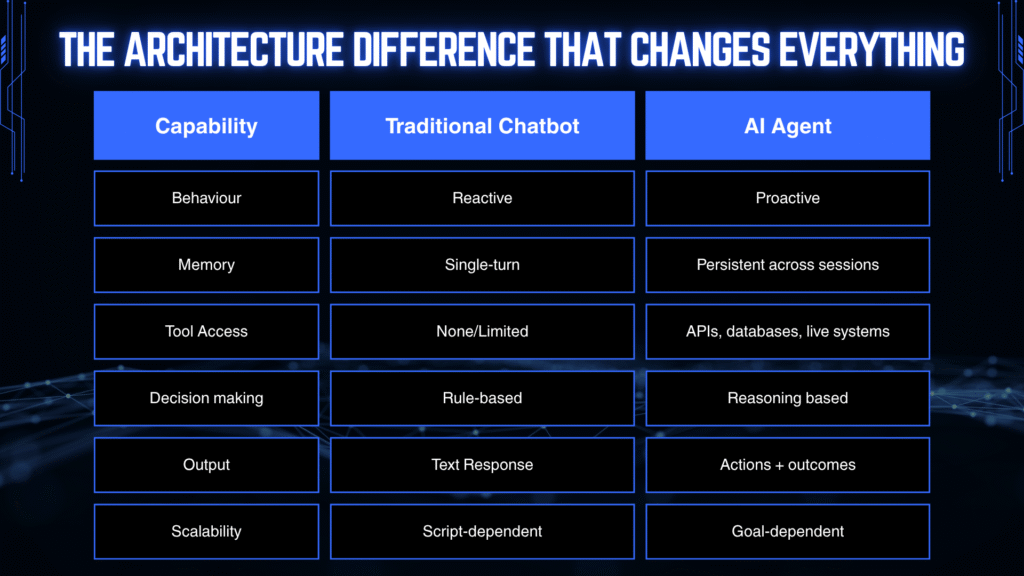
The table above isn’t just technical. It describes two completely different ROI profiles.
The Shift From Rules-Based Automation to Intelligent Systems
Traditional automation has been around for years. AI agents are different because they understand context from unstructured data, handle exceptions without breaking workflows, use natural language interfaces, and improve continuously from your data.
Modern AI agents integrate with existing systems through APIs. No rip-and-replace required.
What This Means for Your AI Roadmap
If you’re still evaluating chatbot vendors for enterprise automation, pause.
Ask whether the solution can access your live systems. Ask whether it can take action not just respond. Ask whether it can orchestrate tasks across multiple tools.
If the answer is no, you’re building yesterday’s solution for tomorrow’s problems.
AI agents aren’t a chatbot upgrade. They’re a different category entirely. The enterprises that understand this distinction early are the ones building durable competitive advantage not just better FAQ pages.
VantageIQ Technologies helps enterprises design and deploy intelligent agent solutions that go beyond conversation and deliver real operational outcomes. Talk to our team to explore what AI agents can do for your business.
The Shift Toward Intelligent Operations
Five years ago, the question was whether AI could handle these workflows. Today, the question is why you’re still running them manually.
The technology works. The ROI is measurable. The deployment timeline is weeks.
What’s missing isn’t capability. It’s organizational willingness to change how work gets done.
AI agents aren’t here to replace your workforce. They’re here to eliminate work that shouldn’t require human attention in the first place.
At VantageIQ Technologies, we help enterprises identify automation opportunities, deploy AI agent solutions, and measure real business outcomes. Because the future of work isn’t about doing more manually. It’s about letting intelligent systems handle what they do best.
The question isn’t whether to automate. It’s which process you’ll start with.