

In the cutthroat world of startups, speed is the ultimate currency. You need to ship features yesterday, impress investors tomorrow, and outpace legacy competitors today. In this frantic race, foundational cloud infrastructure is frequently treated as an afterthought. It is shockingly easy to spin up a few massive servers on AWS, Azure, or GCP, click “approve,” and keep moving. “We’ll optimize it when we scale” becomes the collective engineering mantra.
But here is the hard truth: poor cloud architecture does not wait for you to scale before it starts costing you serious money. Long before your startup hits a massive traffic surge, an un-optimized cloud is quietly bleeding your runway dry. According to the Flexera State of the Cloud Report, managing cloud spend remains the number one operational challenge for 85% of tech leaders, with organizations admitting that a staggering 29% of their public cloud spend is completely wasted. For startup CTOs and VPs of Engineering, identifying these invisible structural drains is the difference between extending your runway and facing a premature operational shutdown.
1. The "Just-in-Case" Provisioning Tax
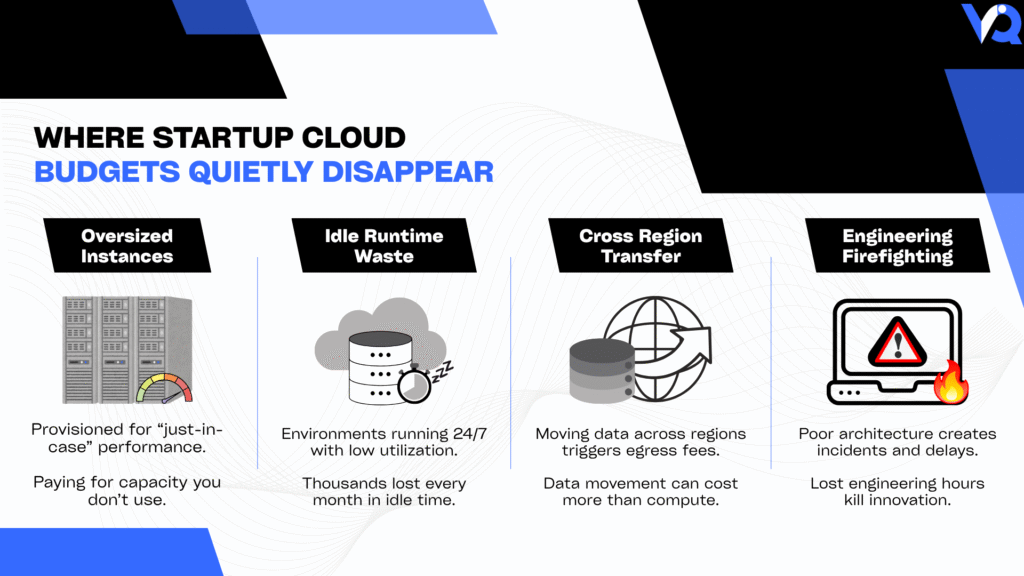
When building at breakneck speed, deep architectural planning often takes a backseat to convenience. Engineers, eager to avoid performance bottlenecks during critical product demos, frequently over-provision resources. Data from Datadog’s State of Cloud Costs Report reveals that a shocking 83% of container costs are associated with idle resources, caused directly by over-provisioning cluster infrastructure.
The Commercial Reality: Consider a mid-stage startup running 10 idle Standard_D8s_v5 virtual machines in a Microsoft Azure staging environment 24/7. At roughly $0.384 per hour on-demand in the East US region, that single non-production environment costs about $2,760 a month. By implementing automated scheduling policies to shut down these instances outside of working hours (reducing weekly runtime from 168 hours to 50 hours), that bill plummets to under $820. Failing to make this minor architectural adjustment wastes over $23,000 annually on just one idle environment.
2. The Invisible Network Egress Leak
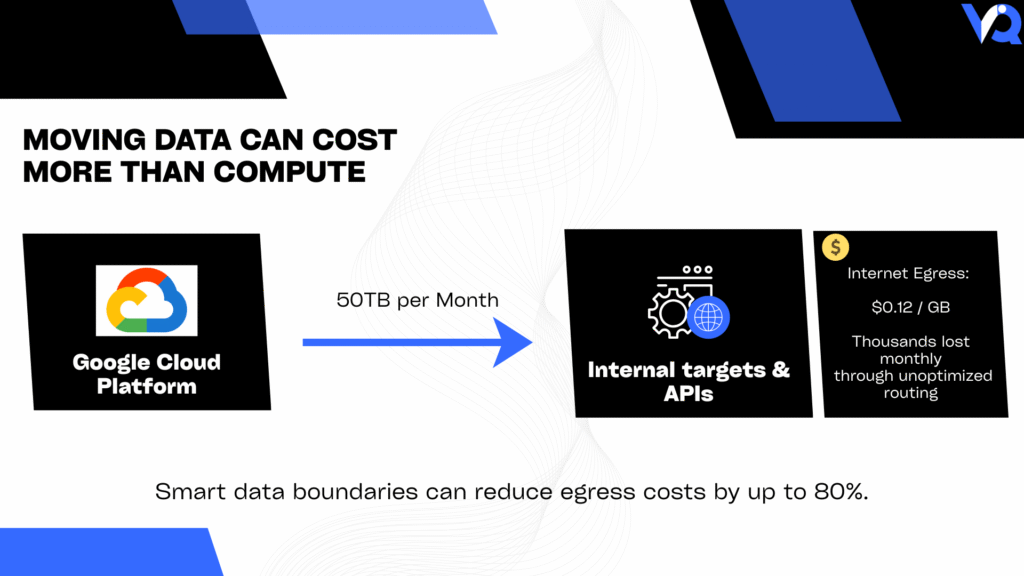
Startups often treat data architecture like a local hard drive, moving files across the cloud without a strategic map. With the explosion of data-heavy analytics and generative AI workloads, routing traffic incorrectly across unaligned boundaries can trigger astronomical line items via data egress fees.
The Commercial Reality: Let’s say your startup runs its core microservices on Google Cloud Platform (GCP). Your primary web servers are processing requests, but due to an un-optimized architectural setup, data frequently leaves your cloud network to standard internet targets or unaligned external APIs. At a standard internet egress rate of $0.12 per GB for the first 10 TB, transferring 50 TB of uncompressed files or raw log outputs out of your network monthly slams you with thousands in monthly network usage charges alone. Architecting smart data boundaries or utilizing localized private peering networks can slice these network usage bills down by up to 80%, instantly saving you tens of thousands of dollars annually.
3. The Firefighting Penalty
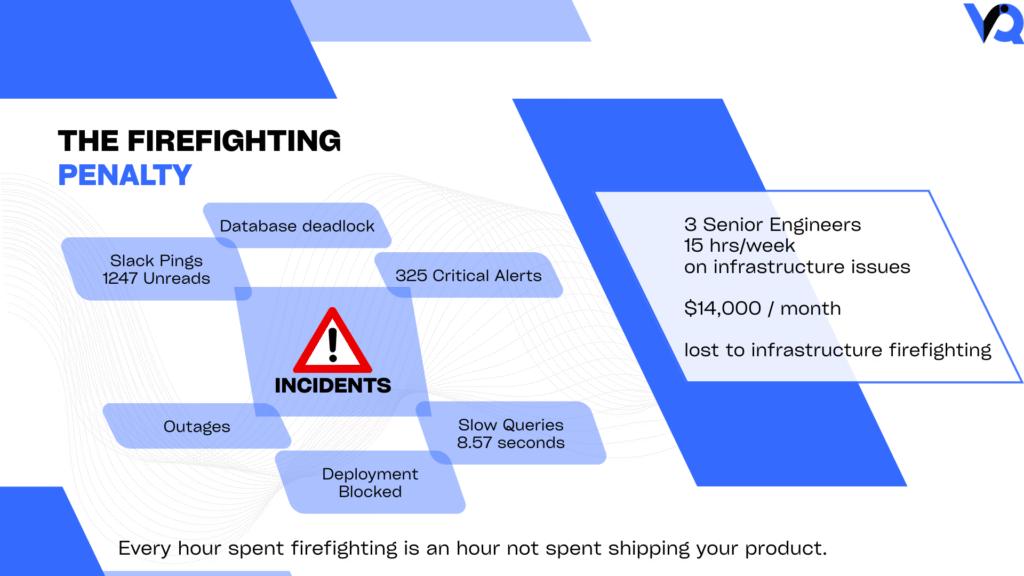
The most damaging cost of poor cloud architecture isn’t infrastructure bills, it’s the human capital efficiency loss. When your environment setup is fragile, it creates a toxic culture of perpetual engineering firefighting.
The Commercial Reality: Imagine your AWS setup has a poorly structured Amazon EKS (Kubernetes) and Amazon RDS microservices mesh that causes frequent production deadlocks. If this architecture forces three senior engineers (with an average salary of $160,000 each) to spend 15 hours a week diagnosing infrastructure glitches instead of shipping code, you are losing 45 hours of pure engineering velocity every week. Financially, you are throwing away roughly $3,500 every single week or $14,000 a month on maintenance rather than building your core IP. You are paying a premium to keep your smartest people frustrated.
4. Shifting from "Just Building" to "Smart Architecting"
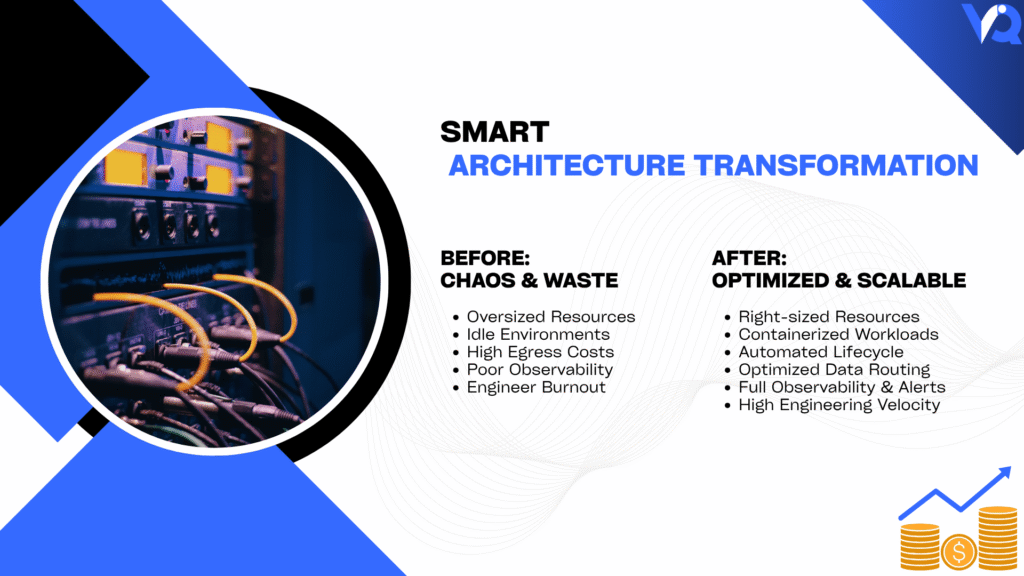
So, how do startup tech leaders fix this without halting product development entirely? Focus on high-impact architectural adjustments:
- Rightsize via Containerization: Leverage lightweight container orchestration to eliminate the 83% idle waste identified by industry benchmarks.
- Modernize Compute Tiers: Audit infrastructure to migrate away from expensive, previous-generation instances to modern architectures (like Arm-based Graviton on AWS or Ampere on Azure/GCP) which offer up to 40% better price-performance.
- Adopt Cost Observability: Implement automated tag policies and cost anomaly alerts to catch runaway cloud bills before the end of the billing cycle.
At VantageIQ Technologies, we believe that clouds should think, not just run up tabs. Building a resilient, future-ready architecture requires balancing rapid innovation with long-term financial sustainability. Our expert cloud consulting teams specialize in helping startups design and optimize scalable ecosystems across AWS, Azure, and GCP, frequently slashing infrastructure costs by up to 60% while maintaining rock-solid 99.9% uptime.
Don’t let invisible architectural flaws drain your startup’s runway. Let’s optimize your digital future today.