AI agents have become the latest obsession in enterprise technology. Boardrooms want autonomous workflows that can think, plan, and execute multi-step tasks with minimal human intervention. On paper, it sounds like operational paradise. In reality, deploying autonomous agents without the proper foundations is like dropping a V8 engine into a golf cart. It looks impressive until you try to hit the highway.
For CIOs and Enterprise Operations leaders, the pressure to show immediate AI value is intense. But the initial hype cycle is beginning to fade, and many organizations are discovering that moving fast can be extraordinarily expensive. Gartner predicts that at least 30% of generative AI projects will be abandoned after proof-of-concept due to poor data quality, inadequate controls, rising costs, or unclear business value.
The lesson is becoming clear: successful AI agents are rarely an AI problem. They are an architecture problem.
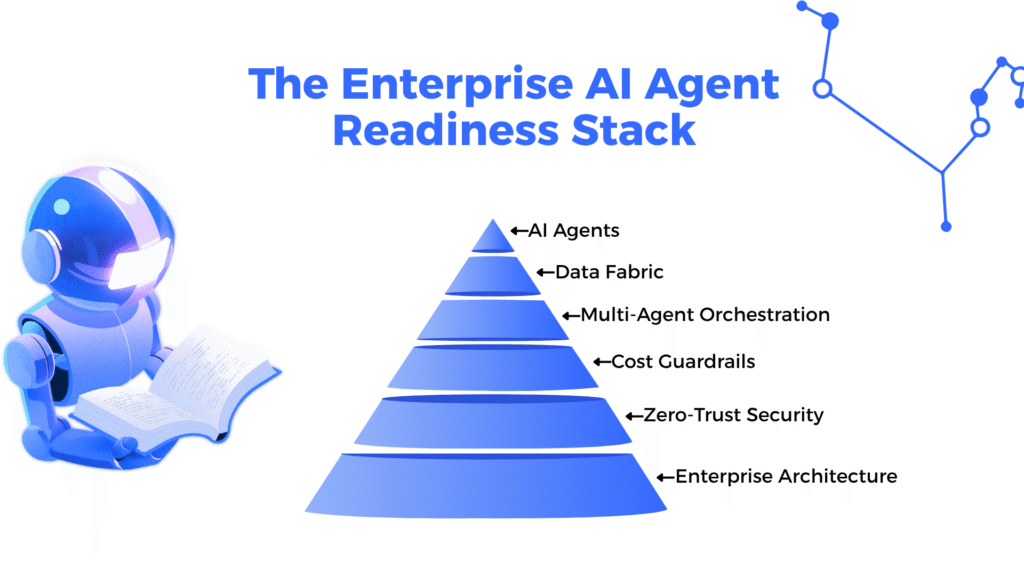
Before deploying production-grade agents that can safely scale across your organization, there are four structural capabilities you need to get right.
1. Data Fabrics, Not Data Lakes
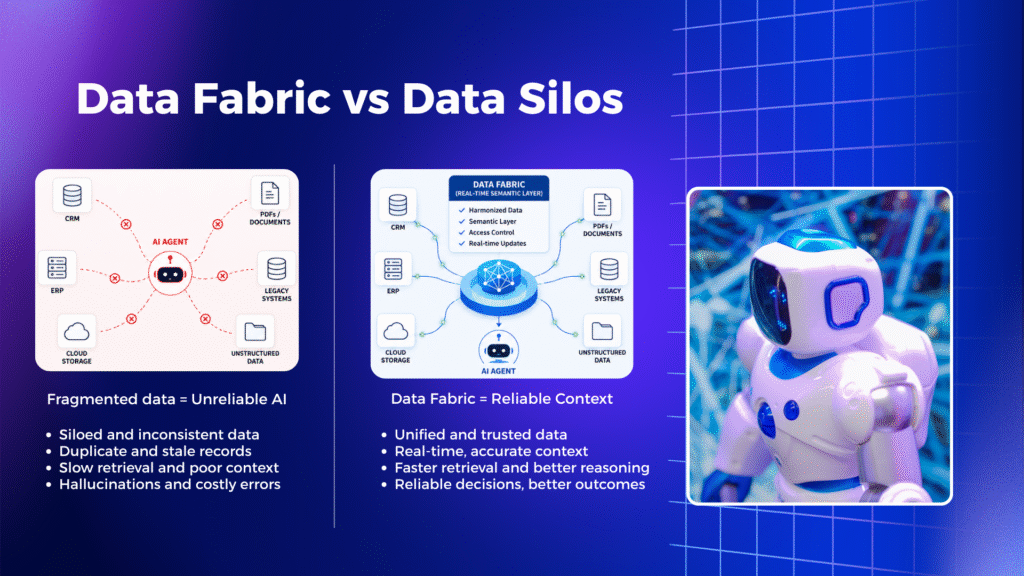
An AI agent is only as reliable as the context it can access. If your enterprise data remains trapped in isolated, inconsistent silos, your agents will hallucinate, stall, or make costly operational mistakes.
Traditional Retrieval-Augmented Generation (RAG) architectures often struggle with complex enterprise workflows because they pull information from fragmented repositories. When an agent has to search through outdated PDFs, duplicate CRM records, disconnected cloud drives, and legacy applications to answer a question, its reasoning chain quickly begins to break down.
What enterprises need is not another data lake. They need a Data Fabric or Data Mesh architecture that connects structured databases, ERP systems, cloud applications, and unstructured content into a unified semantic layer.
This transforms raw information into machine-readable enterprise knowledge that agents can query in real time.
Before handing an AI agent the keys to critical business processes, ask a simple question:
Can it trace a customer journey across five systems accurately, securely, and in real time?
If the answer is no, the infrastructure is not ready.
Gartner estimates that 60% of AI projects that lack AI-ready data will fail by 2026. The challenge is rarely the model itself. It is fragmented data spread across CRMs, ERPs, cloud platforms, and legacy systems. As organizations rush to deploy AI, many discover that poor data quality, inconsistent records, and disconnected systems prevent agents from accessing the context they need to make reliable decisions.
2. Multi-Agent Orchestration and Guardrails
One of the biggest misconceptions in enterprise AI is the idea that a single agent can do everything.
In practice, that approach usually creates a single point of failure.
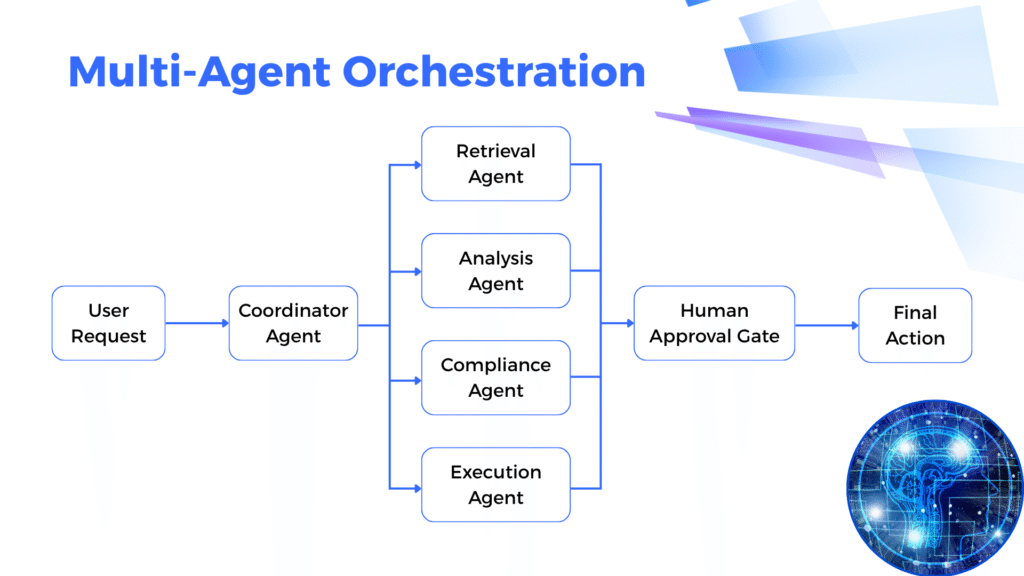
The most successful enterprise deployments use specialized agents working together under strict supervision. One agent retrieves information. Another performs analysis. A third validates compliance requirements. A fourth executes approved actions.
Managing this ecosystem requires orchestration frameworks such as LangGraph, AutoGen, CrewAI, or custom middleware capable of passing context, coordinating workflows, and handling exceptions. Just as importantly, organizations need Human-in-the-Loop (HITL) controls.
Financial approvals, regulatory decisions, customer-impacting actions, and other high-risk activities should never be fully autonomous. Production systems need checkpoints where agents pause and humans review critical decisions before execution. The objective is not to remove people from the process. It is to ensure human judgment is applied where it matters most.
Financial institutions provide a useful example. In a modern lending workflow, one AI system may gather customer documentation, another assess risk factors, and a third verify compliance requirements. However, the final approval remains with a human decision-maker. Organizations that successfully deploy AI at scale rarely rely on a single autonomous system. Instead, they design coordinated workflows where specialized agents operate within clearly defined boundaries.
3. Cost Guardrails: The Most Overlooked Part of Enterprise AI
The biggest challenge facing enterprise AI today is not model quality. It is economics.
AI agents behave very differently from traditional software. A chatbot answers a question and stops. An agent plans, reasons, validates its work, retrieves information, invokes tools, and often repeats the process multiple times before reaching a conclusion.
That behavior creates a new challenge: unpredictable consumption.
McKinsey’s latest research highlights a growing gap between AI adoption and AI value creation. While nearly 88% of organizations have integrated AI into at least part of their operations, only a small minority report capturing meaningful enterprise-wide value at scale. The barriers are rarely the models themselves. More often, organizations struggle with workflow redesign, governance, data readiness, and infrastructure that was never built for autonomous systems.
This challenge becomes particularly visible when AI moves from pilot projects into production.
A proof-of-concept might process hundreds of requests per day. A production-grade agent can generate thousands of API calls, reasoning cycles, retrieval operations, and workflow executions every hour. Without controls, operational costs can increase much faster than business outcomes.
Uber’s experience offers a useful cautionary tale.
In 2026, the company reportedly exhausted its annual budget for AI developer tooling within just four months after thousands of engineers adopted AI coding assistants such as Claude Code and Cursor. Leadership subsequently introduced tighter spending controls and usage governance after recognizing that measuring AI adoption was relatively easy, while connecting AI spending directly to customer value and business outcomes was significantly harder.
The lesson was not that AI failed. The lesson was that AI consumption scaled much faster than AI governance.
An even more dramatic example emerged when reports surfaced of a large enterprise that allegedly accumulated nearly $500 million in Claude AI usage within a single month after usage limits and spending controls were not properly configured. While the company was never publicly identified, the incident quickly became a cautionary tale throughout the AI industry.
The technology worked exactly as intended.
The governance did not.
There are similar examples emerging across industries. Organizations are discovering that unrestricted access to AI tools often leads to experimentation at scale before financial controls are established. The result is frequently a surge in token consumption, cloud spending, and software costs without a corresponding increase in measurable business value.
This is why enterprises deploying AI agents need hard financial guardrails from day one:
- Token quotas
- Budget thresholds
- Automated shutdown rules
- Timeout mechanisms
- Cost observability dashboards
- Approval workflows for high-cost actions
Without these controls, AI can become one of the fastest-growing line items in the technology budget.
4. Zero-Trust Security and Agent Governance
When an AI agent gains the ability to update records, execute transactions, send communications, or interact with external systems, it stops being a simple software tool.
It becomes an operational actor.
That fundamentally changes the security model.
Traditional Identity and Access Management (IAM) frameworks were designed around human users and predictable software applications. Autonomous agents introduce a different challenge because they can make decisions, invoke tools, and interact with multiple systems independently.
For this reason, enterprises should adopt a Zero-Trust approach specifically designed for AI systems.
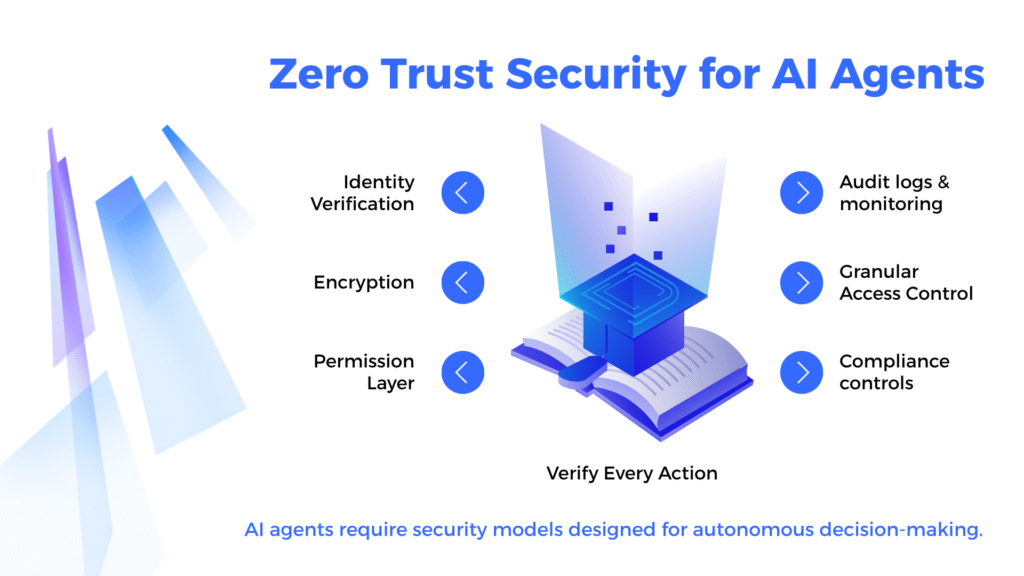
Agents need verifiable identities, granular permissions, time-bound access controls, encrypted communications, and continuous monitoring.
- Every action should be logged.
- Every decision should be traceable.
- Every permission should be justified.
Most importantly, organizations must design architectures that limit the blast radius of any failure. If an agent behaves unexpectedly, access should be automatically restricted before it can affect other systems, business units, or sensitive data assets.
The risks are no longer theoretical. In 2024, Air Canada was ordered to compensate a customer after its chatbot provided incorrect information about the airline’s bereavement fare policy. When the customer relied on the chatbot’s guidance, the airline initially argued that the chatbot was effectively responsible for its own responses. The tribunal rejected that argument and ruled that Air Canada remained accountable for information provided through its AI systems. The company was ordered to pay compensation, establishing an important precedent for AI governance and accountability.
As AI agents gain access to systems, customer interactions, and operational workflows, organizations cannot treat them as independent actors. Accountability remains with the enterprise deploying them.
Governance is not simply just a compliance exercise but It is the mechanism that allows enterprises to scale AI safely.
The Reality Check
The organizations generating measurable value from AI are not necessarily the ones deploying the most agents.
They are the ones investing in the foundations that allow those agents to operate safely, reliably, and economically.
Data readiness, orchestration, cost controls, and security frameworks may not generate the same excitement as a new AI agent launch. Yet these capabilities consistently separate successful enterprise deployments from expensive experiments.
At VantageIQ Technologies, we help organizations build these foundations through responsible AI governance, modern data architectures, and scalable multi-agent frameworks designed for long-term business value.
The winners in enterprise AI will not be the organizations that deploy agents first.
They will be the organizations that build the foundations required to deploy them safely, economically, and at scale.
The question is not whether AI agents can transform your business.
The question is whether your enterprise architecture is ready for that transformation.