

Precedent Search: A reusable enterprise AI accelerator that helps organizations surface historical decisions, reusable expertise, and institutional knowledge, enabling faster, more consistent decision-making across the enterprise.
Helping organizations learn from experience instead of starting from scratch.
Every organization accumulates valuable knowledge over time. Winning proposals, successful project strategies, legal opinions, risk assessments, technical decisions, and lessons learned collectively shape how the business evolves.
Yet much of this knowledge becomes increasingly difficult to access.
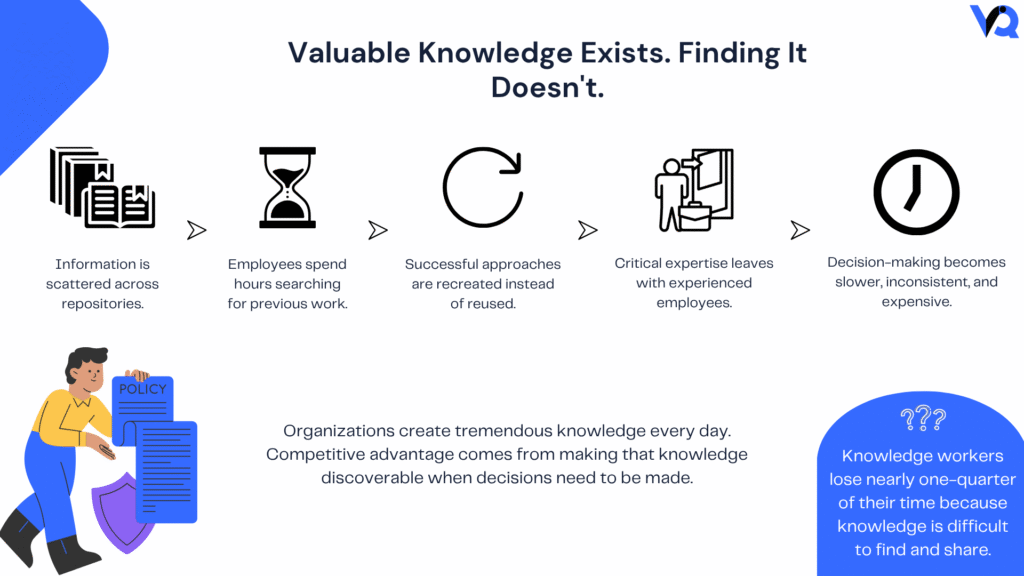
As organizations grow, information spreads across document management systems, shared drives, emails, collaboration platforms, and legacy repositories. Employees often know that similar work has been done before, but locating it takes hours, and sometimes it is never found.
The result is duplicated effort, slower decisions, and valuable expertise that remains hidden inside disconnected systems.
The competitive advantage today isn’t creating more knowledge. It’s making existing knowledge discoverable when it matters most.
Why Institutional Knowledge Is Becoming a Strategic Asset
Modern enterprises generate enormous volumes of information every day. Every customer engagement, compliance review, engineering project, procurement decision, and strategic initiative adds to an organization’s institutional memory.
However, traditional knowledge management approaches struggle to keep pace.
Folder structures depend on employees knowing where information is stored. Manual tagging quickly becomes outdated. Keyword searches often return thousands of irrelevant documents while overlooking the most valuable historical examples.
According to the Panopto Workplace Knowledge & Productivity Report, knowledge workers spend an average of 5.3 hours every week searching for information or recreating knowledge that already exists. APQC research also found that professionals frequently interrupt colleagues for information that has already been documented elsewhere.
As experienced employees retire or move on, organizations risk losing years of expertise unless institutional knowledge becomes searchable, reusable, and continuously accessible.
Turning Enterprise History into Actionable Intelligence
Precedent Search is a reusable enterprise AI accelerator that helps organizations transform historical records into an intelligent knowledge resource for everyday decision-making.
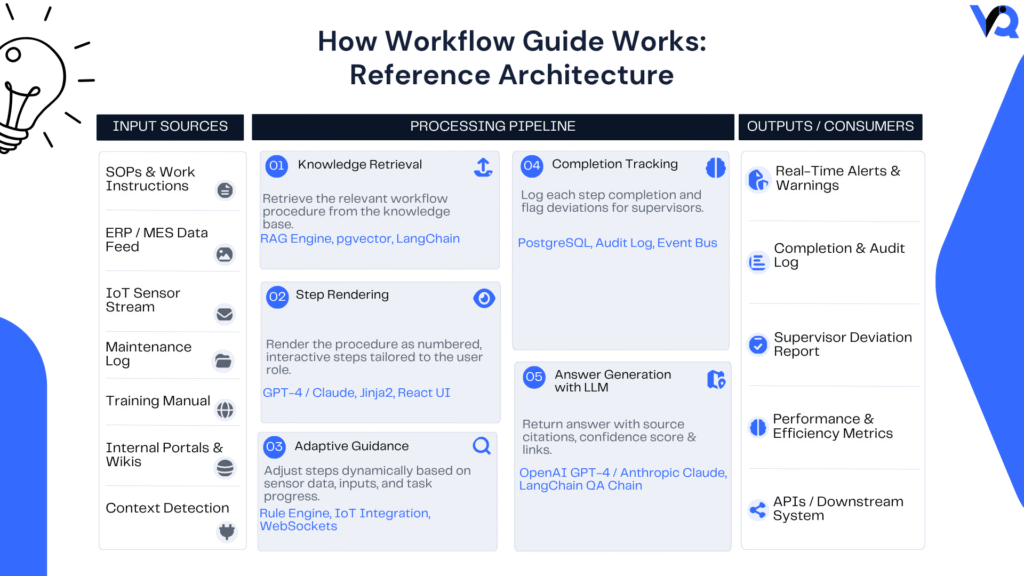
Rather than building enterprise search capabilities from scratch, the accelerator provides reusable implementation frameworks, semantic retrieval patterns, governance controls, citation mechanisms, and secure search architectures that can be adapted across industries and business functions.
Operating within VantageIQ’s Knowledge Engine layer, Precedent Search enables employees to discover previous decisions, project outcomes, technical approaches, and organizational best practices through natural language conversations while maintaining existing security permissions and source traceability.
What the Accelerator Enables
Precedent Search provides a reusable foundation for enterprise knowledge discovery.
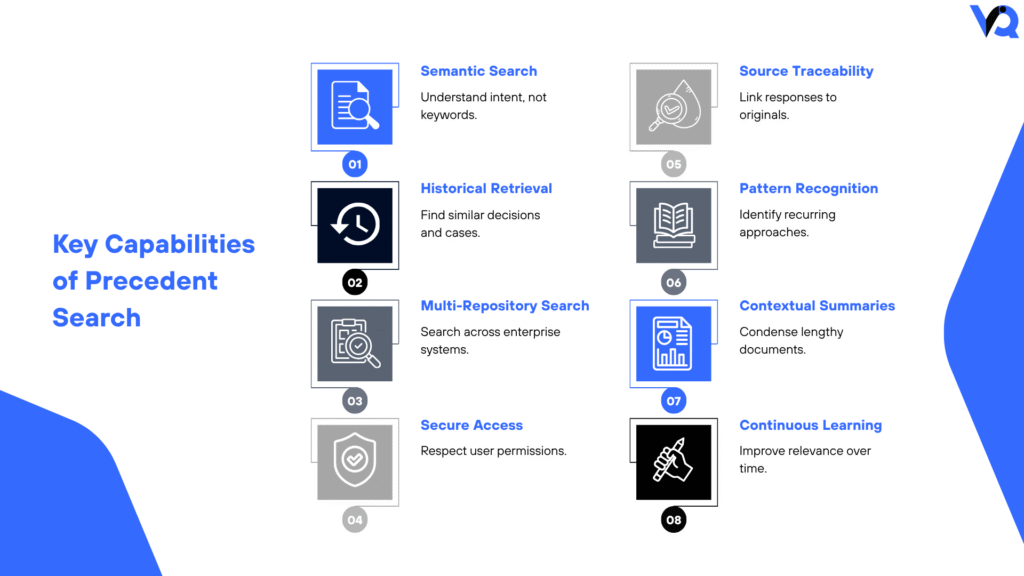
Key Capabilities
- Semantic Search — Understand user intent beyond keywords.
- Historical Decision Retrieval — Surface similar cases, decisions, and prior work.
- Multi-Repository Discovery — Search across disconnected enterprise systems.
- Privilege-Aware Access — Respect existing roles and security boundaries.
- Source Traceability — Link every response back to original documents.
- Pattern Recognition — Identify recurring approaches and organizational trends.
- Contextual Summarization — Condense lengthy documents into actionable insights.
- Continuous Learning — Improve search relevance through user feedback.
Where Institutional Knowledge Creates Business Value
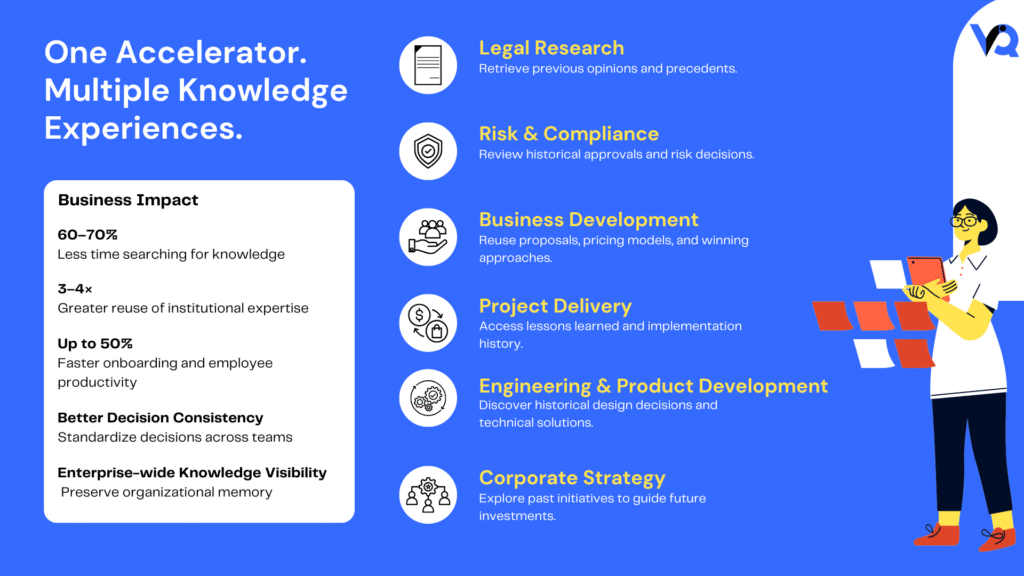
Because every enterprise builds knowledge over time, the accelerator supports a broad range of business functions.
Legal Research
Legal teams quickly retrieve previous opinions, contracts, litigation strategies, and internal precedents, reducing research effort while improving consistency.
Risk & Compliance
Risk managers review how similar situations were previously evaluated, ensuring more consistent approvals and better governance across the organization.
Business Development
Sales and consulting teams reuse successful proposals, pricing models, delivery approaches, and win themes instead of recreating them for every opportunity.
Project Delivery
Program managers access lessons learned, technical decisions, and post-implementation reviews to improve delivery quality and reduce repeated mistakes.
Engineering & Product Development
Development teams identify historical design decisions, architecture discussions, and implementation approaches before starting new initiatives.
Corporate Strategy
Leadership teams explore historical business decisions, transformation initiatives, and investment outcomes to support future planning.
The Measurable Outcomes
Organizations implementing enterprise knowledge discovery capabilities often focus on improving decision quality while reducing duplicated effort.
Typical outcomes include:
Metric | Typical Improvement |
Time spent searching for institutional knowledge | 60–70% reduction |
Reuse of previous work and expertise | 3–4× increase |
New employee time-to-productivity | Up to 50% faster |
Decision consistency | Significantly improved |
Knowledge accessibility | Enterprise-wide visibility |
Beyond productivity gains, the greatest benefit is preserving organizational memory. Every completed project, decision, and lesson learned becomes part of a continuously growing knowledge base that supports future work.
Industries Where Organizational Memory Matters Most
Precedent Search is valuable for any organization that relies on accumulated expertise and historical decision-making.
- Legal Services — Case research, legal opinions, and contract precedents.
- Financial Services — Credit approvals, risk assessments, and regulatory decisions.
- Professional Services & Consulting — Proposal libraries, methodologies, and client delivery assets.
- Engineering & Manufacturing — Design history, technical documentation, and root-cause investigations.
- Healthcare — Clinical guidelines, treatment protocols, and operational knowledge.
- Public Sector — Policy history, administrative decisions, and institutional records.
Building a Smarter Enterprise Through Institutional Memory
Organizations that consistently make better decisions rarely rely on individual expertise alone. They create systems that preserve knowledge, connect past experience with present challenges, and make organizational learning available to everyone.
Precedent Search provides the reusable foundation for building those capabilities faster. By transforming historical information into searchable institutional intelligence, organizations reduce duplicated work, accelerate decision-making, and ensure valuable expertise remains accessible long after projects are completed.
As enterprise knowledge continues to grow, the ability to learn from previous experience will become one of the defining capabilities of high-performing organizations.