


In Chapter 1, we walked through the funeral of the legacy “back office”, that cozy 1990s world where Western enterprises shipped repetitive tasks to India, collected their 60% labor arbitrage, and pretended the time difference wasn’t breaking their software builds.
That model is dead. But as C-suite executives rush to build their next-generation hubs in India, many fall into a brand-new trap: Confusing physical size with strategic significance.
There’s an old corporate reflex that assumes a 10,000-person offshore site is inherently “more mature” than a 30-person engineering lab. But in today’s landscape, measuring a center’s value purely by its real estate footprint is like measuring a tech startup’s worth by how many office coffee machines it owns.
If you want to build an Indian presence that actually moves global revenue rather than just eating up corporate overhead, you need to understand the Modern GCC Taxonomy of Scale.
The Death of Vanity Metrics
India currently hosts over 2,100 active GCCs, generating nearly $98 billion in economic value. But the real story isn’t the sheer volume of desks; it’s the total collapse of old performance metrics.
For decades, site managers justified their existence using internal vanity metrics: How many support tickets did we clear this quarter? How fast did we grow headcount year-over-year? How many dollars did we save compared to hiring in London or New York?
Today’s top-performing centers couldn’t care less about ticket clearing speeds. Their KPIs are directly linked to global business survival and growth:
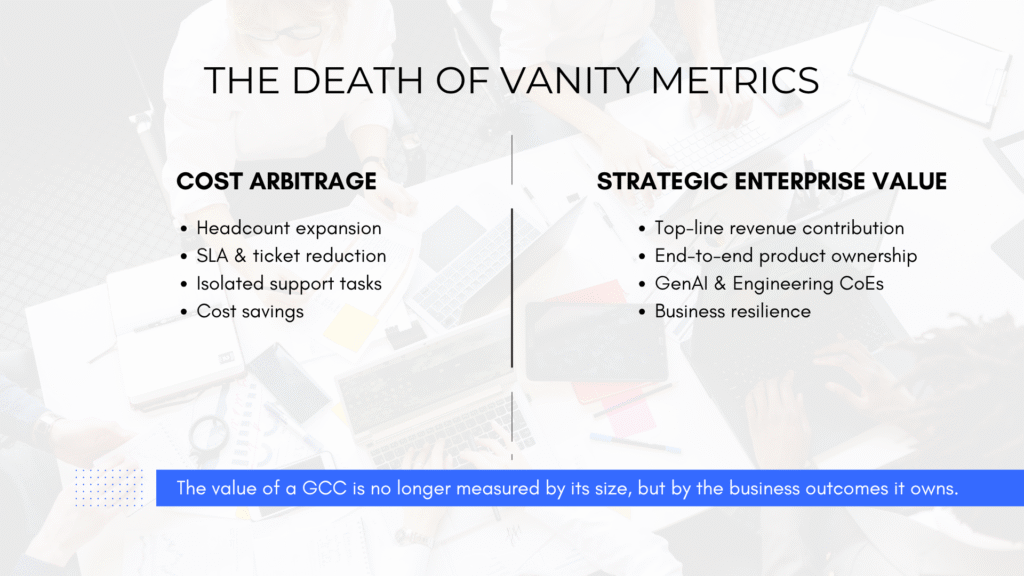
When an Indian team owns the code for your entire global checkout engine or designs the AI models predicting your supply chain bottlenecks, headcount becomes secondary to domain complexity.
The Four Tiers of the Modern GCC Taxonomy
To navigate this landscape, global enterprises structure their Indian operations around four distinct operational tiers. Each tier serves a specific strategic mandate and requires a completely different management playbook.
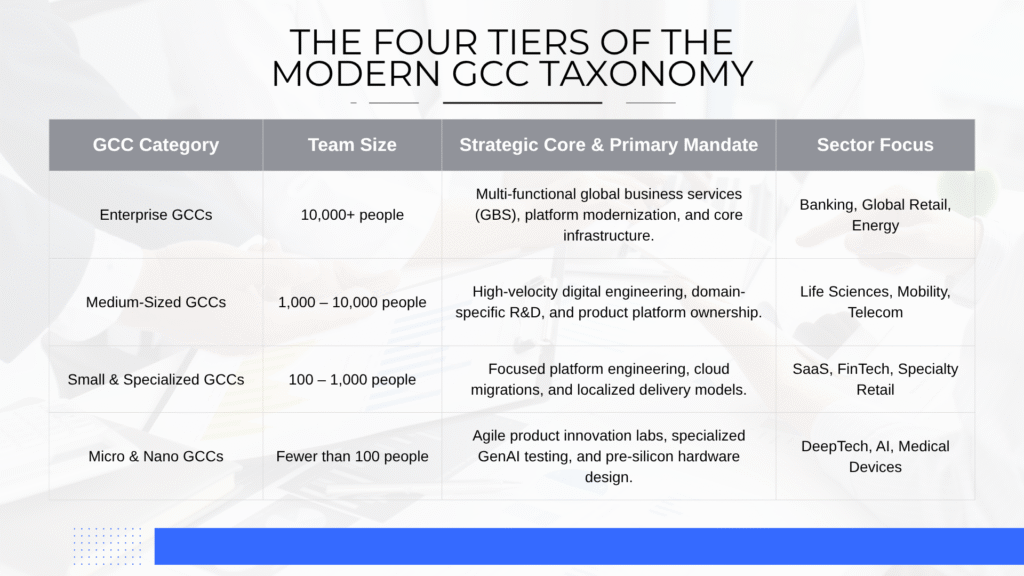
1. Enterprise GCCs (10,000+ People): The Global Engines
These are multi-functional operational behemoths. They run global business services (GBS), manage multi-cloud infrastructure, and execute cross-border compliance for Fortune 100 giants. They aren’t remote outposts—they operate as co-equal global co-headquarters.
2. Medium-Sized GCCs (1,000 – 10,000 People): High-Velocity Innovation
This is the sweet spot for high-stakes digital engineering, sector-specific R&D, and core product platform ownership. These centers balance deep domain talent with organizational agility, avoiding the red tape that often bogs down 20,000-person sites.
3. Small & Specialized GCCs (100 – 1,000 People): Domain Depth
Small centers prove that massive enterprise impact doesn’t require thousands of cubicles. These hubs focus on specific technical capabilities—like cloud modernizations, specialized cybersecurity operations, or custom platform refactoring—where domain depth beats headcount every single time.
4. Micro & Nano GCCs (Fewer than 100 People): The Hyper-Specialists
The fastest-growing segment in the GCC market isn’t the mega-campus. It’s the Micro GCC: agile pods of 15 to 90 specialist engineers. These hyper-focused teams allow scaleups and mid-market firms to run high-end GenAI experimentation, pre-silicon chip validation, or edge analytics without building massive corporate overhead.
Mandate Trumps Scale
The key takeaway for any global executive is simple: Size is an outcome, not a strategy.
A 30-person team in India that owns your firm’s custom LLM training pipeline or proprietary algorithmic trading engine creates far more enterprise moat than a 2,000-person center that spends its day handling outsourced L1 IT helpdesk calls.
Before picking a city, renting real estate, or hiring HR leads, you must ask: Which tier does our technology mandate actually belong in?
What Scale Fits Your Enterprise Vision?
Choosing the right operational scale, talent hierarchy, and domain mandate is the most critical decision in your expansion strategy. At VantageIQ Technologies, we help executive teams evaluate their technology needs, design right-sized GCC operating models, and hire transformational site leadership.
Ready to architect your India capability strategy? Connect with the VantageIQ Technologies advisory team today.