

You Raised the Round. Now the Real Problems Start.
Congratulations. The round closed. The wire hit your account.
Here’s the uncomfortable truth nobody tells you at the closing dinner: money doesn’t fix broken systems. It amplifies them.
Capital doesn’t patch your codebase that already had cracks before funding. It builds a bigger, more expensive structure right on top.
It’s all math. Roughly 90% of startups still fail, and 70% of them go down between year two and year five, well after the funding high. Venture-backed shutdowns jumped 56.2% in 2024 alone, according to Carta’s cap table data.
So before you spend that round, here are the seven traps that catch funded startups off guard, with real examples of who’s hit them, and who’s dodged them.
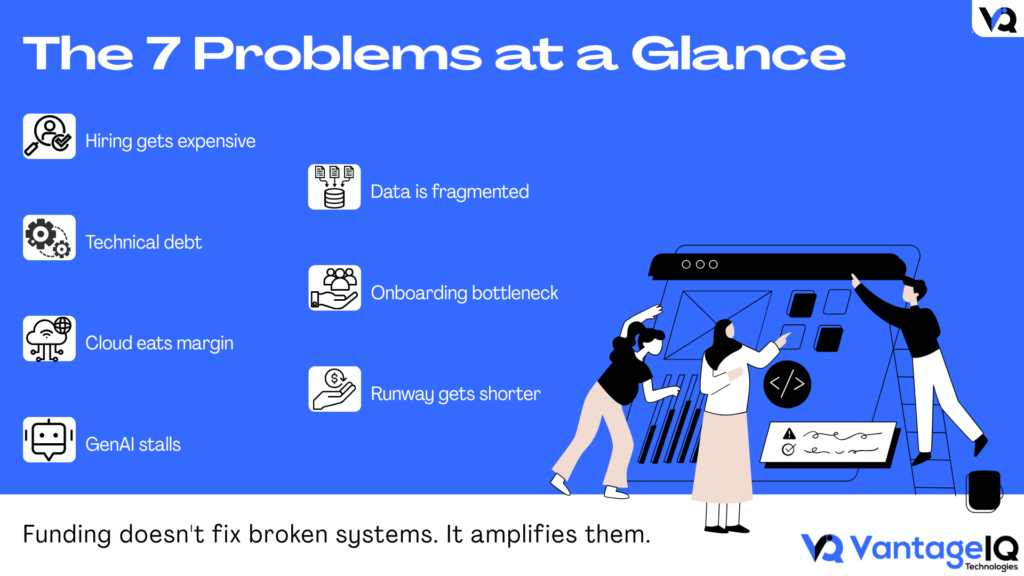
1. Your hiring plan just got a lot more expensive
Everyone budgets for new hires post-raise. Few budget for how long it actually takes.
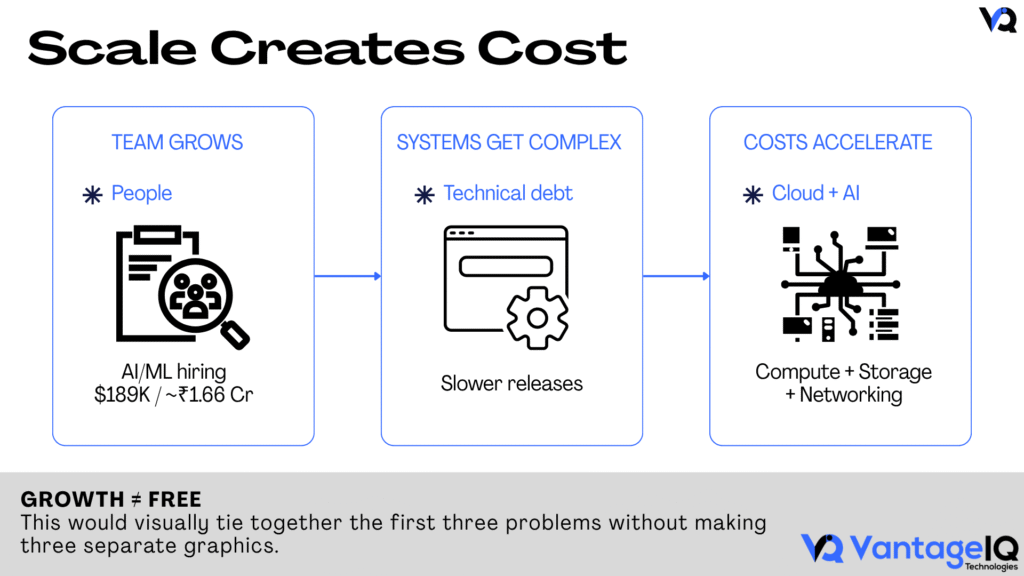
Senior technical roles can take several months to close, and the competition gets even tougher for AI and ML talent. As of June 2025, the average salary for new engineering hires at startups on Carta was about $189,000 (roughly ₹1.66 crore), with AI/ML salaries continuing to rise as demand increases.AI and ML specialists now command a 43% to 56% salary premium over generalist engineers.
The receipts: Startups offering under $200,000 base for senior AI talent face an average time-to-fill of 114 days, more than double the 52 days for standard tech roles. Meanwhile, OpenAI reportedly extends offers within 72 hours to candidates with the right experience. A funded startup simply can’t out-wait that.
Fix it: Keep core IP hiring in-house. Use staff augmentation or a technology partner to fill capacity gaps fast, without inflating fixed payroll while you close the “right” hire.
2. Technical debt was hiding. Now it's expensive.
That codebase you shipped fast in the early days? It’s still there, and it’s getting more expensive every sprint.
Technical debt costs US enterprises $2.4 trillion a year. Engineers lose 23% to 42% of their week just managing it, feature delivery runs 25% to 50% slower than debt-free competitors.
The receipts: Shopify runs one of the largest Rails monoliths in the world. Rather than a risky full rewrite, its engineers identified the small set of “god object” modules causing most incidents and deployment delays, and modernised just those, a targeted 80/20 fix instead of a company-wide freeze.
Fix it: Block out 15-25% of every sprint purely for refactoring. Find your highest-friction modules first, you don’t need to fix everything at once.
3. Your cloud bill is quietly eating your margin
Nobody notices cloud spend creep until it’s a board-meeting problem.
In mature SaaS companies, cloud infrastructure can eat 75% to 80% of Cost of Goods Sold. Andreessen Horowitz found this drag suppresses market value across public software companies by $100 billion to $500 billion.
The receipts: Dropbox’s own S-1 filing shows it saved nearly $75 million over two years by moving core storage off AWS into its own colocation facilities, gross margin climbed from 33% to 67% ahead of its IPO. Not every startup needs to repatriate. But it proves unmanaged cloud spend is a margin problem hiding as a convenience.But AI is adding another layer to the infrastructure bill: organizations are spending more on compute, storage and networking to support AI workloads, while rising demand for memory and storage infrastructure is adding further cost pressure.
Fix it: Tag every resource. Set spend alerts on day one, not after the invoice shock. Move predictable workloads to reserved or spot instances before repatriation is even on the table.
4. Your GenAI feature might die in the demo stage
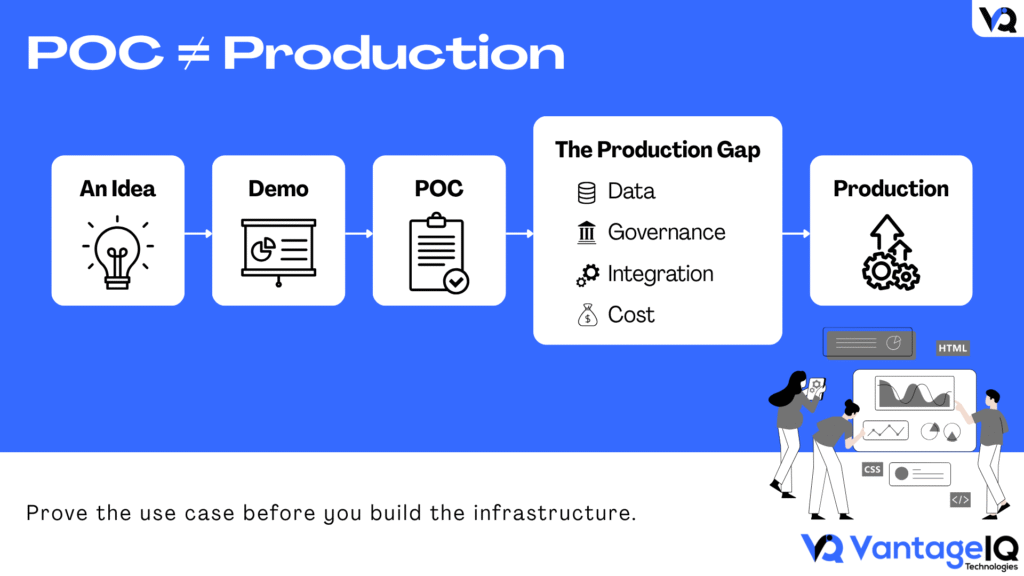
Everyone’s shipping an AI feature right now. Most stall before production.
Gartner predicts 30% of GenAI projects get abandoned after proof-of-concept by end of 2025, usually thanks to bad data pipelines, missing governance, or inference costs nobody modelled.
The receipts: One financial-services team building fraud detection cut its build time from months to weeks by using AWS Bedrock’s managed foundation models instead of training a custom model from scratch, the same shortcut that keeps smaller teams out of GPU-cost spirals.
Fix it: Use managed foundation models unless fine-tuning genuinely protects your IP. Ship on someone else’s infrastructure first; build your own once the use case is proven.
5. Your data lives in five places that don't talk to each other
Customer data in one tool. Usage data in another. A spreadsheet holding it together with duct tape.
This fragmentation is a major reason AI and automation initiatives fail before they start poor data quality alone drives a majority of abandoned AI projects.
The receipts: Klaviyo hit this wall as customer data ballooned post-funding. It rebuilt analytics on a 192-node ClickHouse cluster, sharded by customer and user profile, to unify records into one real-time platform enabling low-latency personalisation across hundreds of millions of profiles ahead of its IPO.
Fix it: Centralise early. A lakehouse architecture with automated ETL/ELT sounds like overkill at 20 people until you’re doing it under pressure at 80.
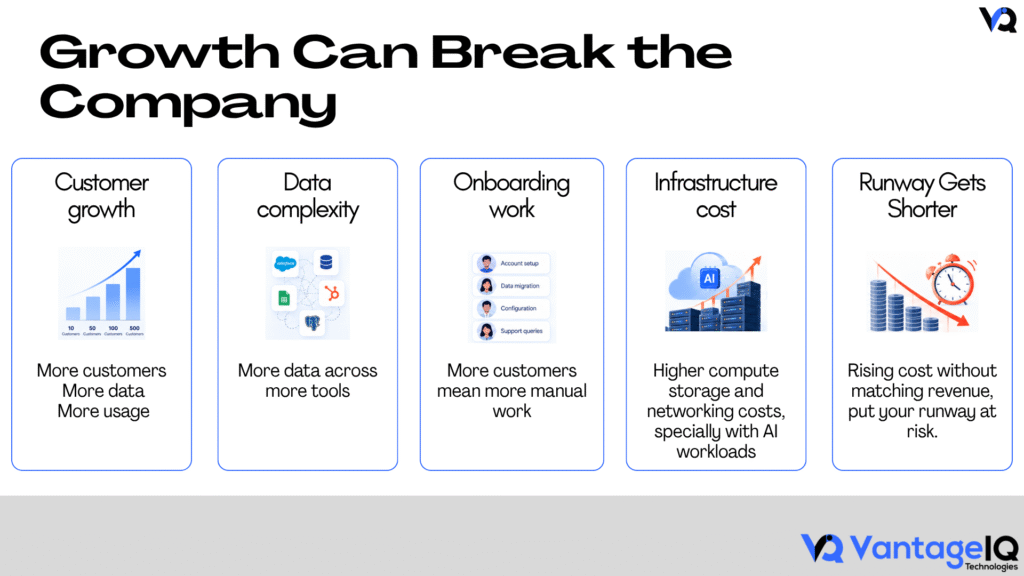
6. New customers are showing up faster than you can onboard them
Growth is good. Growth without a repeatable onboarding motion is a support bottleneck in disguise.
The receipts: Average SaaS time-to-value runs three to six months when onboarding stays manual and person-dependent long enough for early accounts to churn before they ever see real value.
Fix it: Build self-service onboarding, public APIs, and webhook integrations before the volume spike hits not during it.
7. You're spending like a Series C company on Series A traction
This is the one that actually kills companies. Running out of cash causes 29% of startup failures more than almost any other single cause.
The receipts: Fast, a checkout startup, raised $124 million, including a $102 million round led by Stripe. It burned roughly $10 million a month while generating just $600,000 in annual revenue, spending on marketing stunts before it had proven the product justified the spend. It shut down in April 2022. Most of its engineers were hired by Affirm the same week.
Fix it: Validate LTV:CAC above 3:1 and CAC payback under 18 months before you expand go-to-market headcount. Growth that outruns your unit economics isn’t traction it’s a countdown.
The pattern behind all seven
None of these problems are really about technology. They’re about what happens when speed outpaces infrastructure.
The startups that survive past Series B are the ones that turned the capital into systems that hold up under pressure without burning through hiring runway trying to build it all in-house, alone, from scratch.
That’s the gap a technology partner is built to close: augmenting your team on the pieces that don’t need to be reinvented in-house, so your core team stays focused on the product only you can build.
Just raised a round and figuring out what to build, hire, or fix first? Let’s talk.
Talk to VantageIQ Technologies
Next up: our 90-day post-funding action framework, what to actually do about all this.