You’ve read the list of seven things that go wrong after funding closes. Now here’s the harder question: what do you actually do about it?
Founders don’t fail after raising money because they lack ambition, but because they lack a clear plan.Everything feels urgent: hiring, shipping, fixing the codebase, courting enterprise customers and trying to do it all at once is how good teams burn a year without much to show the board.
Here’s a phased way through it, with real companies that got each phase right.
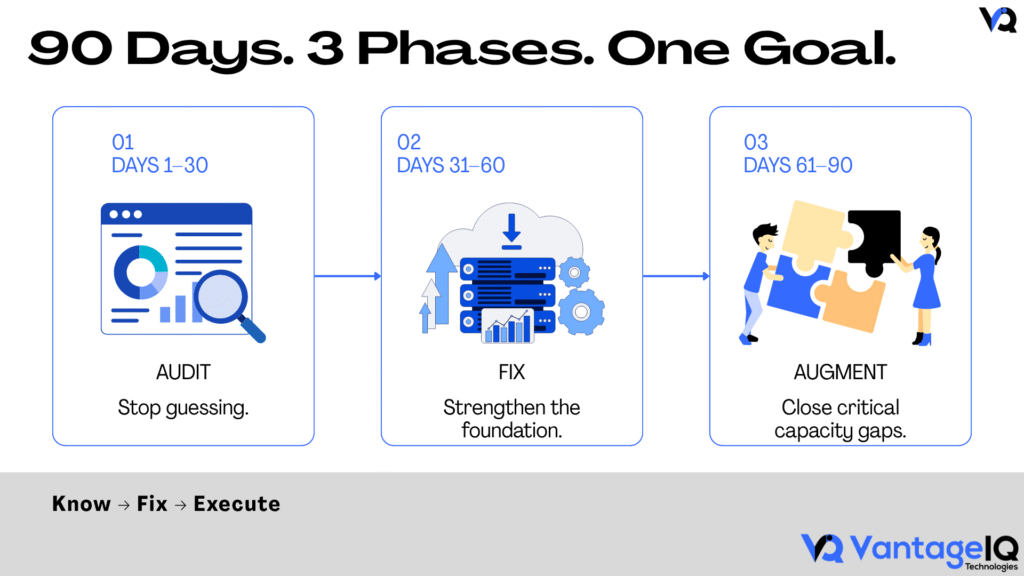
Days 1-30: Stop guessing, start auditing
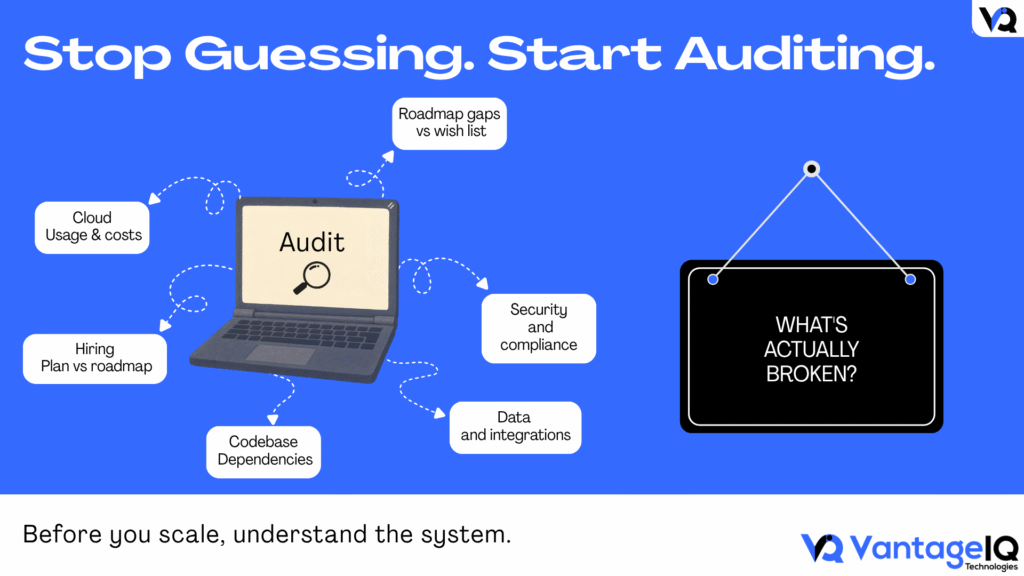
Before you spend a dollar of the new round, find out what you’re actually working with.
Run a full technology and cloud-cost audit. Freeze speculative feature work. Map your hiring gaps against your actual roadmap, not your wish list. It may sound slow, but it’s the fastest way to avoid spending six months fixing decisions you made without enough insight.
The example: Cloud waste is rarely visible until someone looks for it. Industry benchmarks put unoptimised cloud spend at 10% to 20% of total operational cost in growth-stage companies, and over 30% of enterprise cloud spend is flat-out waste idle instances, unattached volumes, and forgotten staging environments. None of that shows up until you go looking in month one, before the new spend compounds it.
Solution: Tag every cloud resource. Set spend alerts before you scale usage, not after the invoice surprises you.
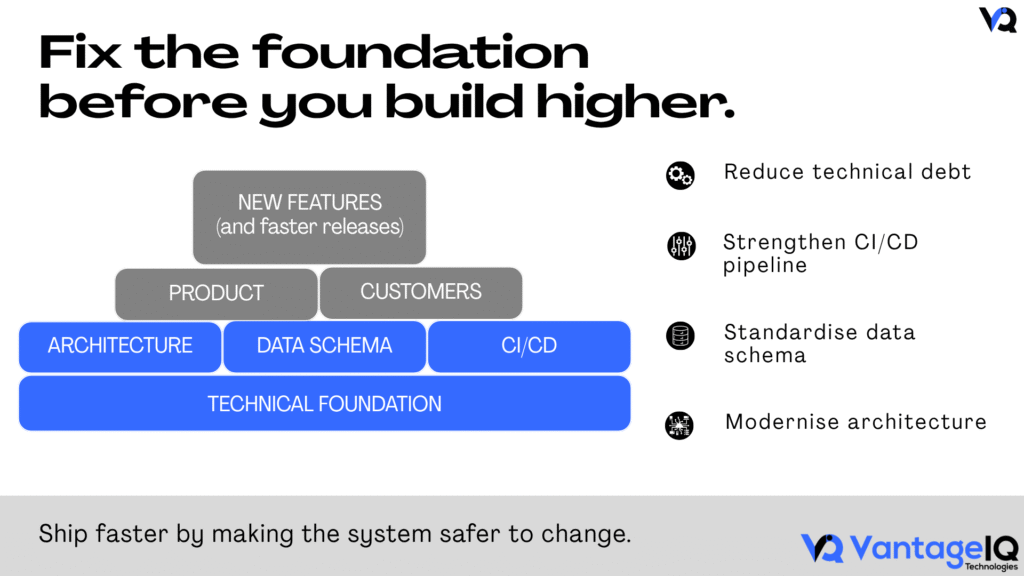
Days 31-60: Fix the foundation before you build higher
This is where most teams want to start shipping the big new features the round was supposed to fund. Resist it, for a few weeks longer.
Allocate real sprint capacity to technical debt. Tighten your CI/CD pipeline so deploys aren’t a weekly gamble. Start standardising your data schema before more systems get built on top of the mess.
The example: Monzo runs one of the largest microservices estates in banking, over 2,800 services. Instead of leaving migrations (library upgrades, framework changes) to individual teams, it centralised the work under one platform team, applied the 80/20 rule to automate the routine cases, and rolled changes out gradually to limit blast radius. That discipline, built early, is why Monzo can still ship safely at massive scale today.
Solution: Pick one migration or refactor that’s overdue. Centralise ownership of it. Automate what you can before you touch the edge cases by hand.
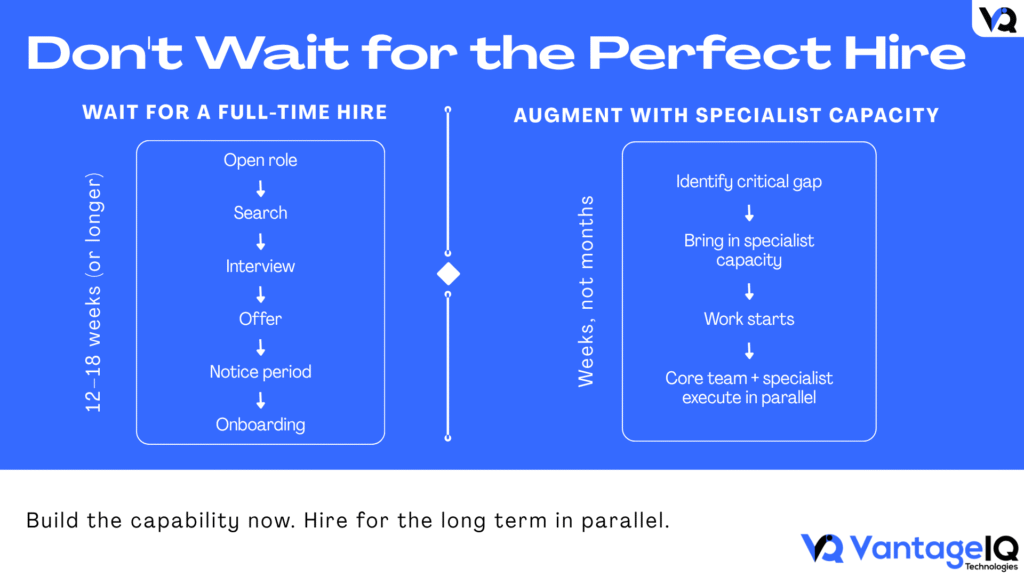
Days 61-90: Bring in backup, don't wait for a full team
By now you know your gaps. The instinct is to go hire for every one of them. Don’t rush..
Recruiting senior engineers takes 12 to 18 weeks on a good day, longer for anything AI-related. If you wait for full-time hires before you start the work, you’ll lose the quarter.
The example: Databricks had to rebuild its own internal monitoring infrastructure as usage exploded its systems now track over 5 billion live time-series metrics and ingest more than 10 trillion samples a day. That’s not a problem you staff up for from a standing start. It’s the kind of infrastructure sprint that needs specialised capacity fast, layered on top of a core team that already understands the system.
Solution: For the two or three gaps that are actually blocking revenue or reliability, bring in specialist capacity now, augmentation, contractors, or a technology partner, while your core hiring runs in parallel.
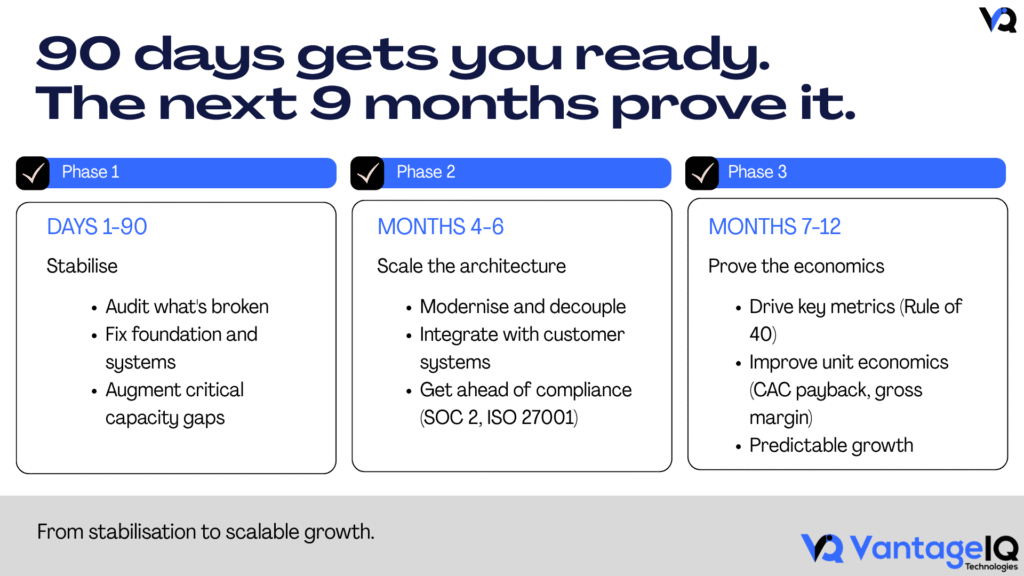
Months 4-6: Turn the monolith into something that bends
By month four, the quick fixes are done. Now it’s time to deal with the deeper architecture, the parts that were fine at your old scale and aren’t anymore.
Break the monolith into services that can be deployed independently. Get ahead of compliance work (SOC 2, ISO 27001) before an enterprise deal stalls waiting on it.
The example: Viz.ai had to get FDA-cleared AI algorithms working inside real hospital workflows, not just in a demo. Rather than force hospitals to rip out existing systems, it built its platform to integrate directly with the PACS and EHR software hospitals already had, sidestepping the IT onboarding delays that usually kill healthcare deployments. It’s now used across more than a thousand hospitals. The lesson generalises well past healthcare: modernisation that ignores what your customers already run rarely survives contact with them.
Solution: When you re-architect, design for the systems your customers already use, don’t assume they’ll adapt to you.
Months 7-12: Prove you can do more with less
This is the stretch where the board stops asking “are you building?” and starts asking “is it working?” Rule of 40. CAC payback. Gross margin. Predictable delivery.
The example: Tempus AI grew its precision-medicine platform by building direct clinical data pipelines with healthcare providers, rather than trying to buy every capability from scratch. When it needed to deepen its molecular diagnostics further, it moved decisively announcing a roughly $1.5-1.7 billion agreement to acquire Personalis in 2026 to fold their MRD technology directly into its existing data platform. The point isn’t the deal size. It’s the pattern: know exactly which capability gap is worth solving structurally, and go solve just that one.
Solution: Pick the one metric your next round depends on most. Build every Q3-Q4 decision around moving it, not around looking busy.
The founders who make it aren't the ones who do everything at once
Every example above has the same shape: focus on one real constraint at a time, bring in the right help at the right moment, and don’t try to rebuild everything before you’ve proven what’s actually broken.
That’s not a resourcing philosophy you build alone from zero, either. It’s exactly the kind of execution gap a technology partner exists to close filling the specific, time-boxed capacity gaps above so your core team stays focused on the product only they can build.
Just raised a round and figuring out what needs to happen in the next 90 days?
Talk to VantageIQ Technologies!
Next up: the build-vs-hire-vs-partner decision, and how to make that call without guessing.