The round closed. Your roadmap just doubled. And your engineering team is the same size it was last month.
Now comes the question that quietly shapes the next 18 months: who actually builds all this?
Hire everyone full-time and you’ll wait. Hand everything to freelancers and you risk losing control. Outsource everything and you risk handing over the thing that makes you unique.
There’s no single right answer. But there is a smart way to decide.
First, know what the wait really costs
Hiring feels like the “safe” default. It’s rarely the fastest one.
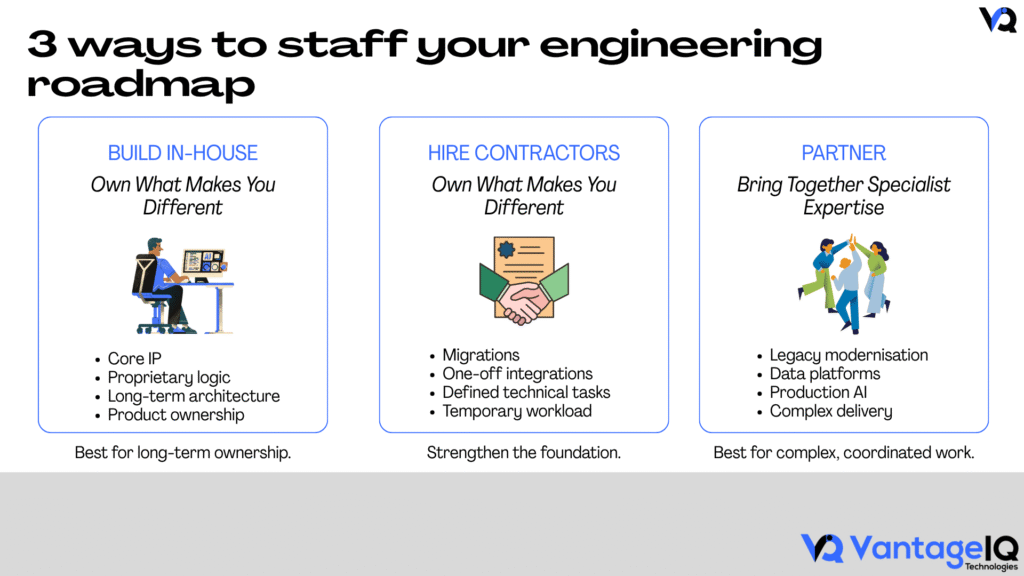
Sourcing a single specialised technical hire eats hours of founder and engineering-leadership time. Senior roles take 12 to 18 weeks to close. For specialised AI talent, the wait can be longer. Startups offering under $200,000 base face an average time-to-fill of 114 days, compared to 52 days for standard tech roles.
That’s a quarter of your runway spent waiting for one person to start.
You’re not alone in this. Deloitte’s 2024 Global Outsourcing Survey covered 500+ executives. It found that access to skilled talent and agility now sit alongside cost reduction as the main reasons companies look outside their own payroll.
A Quess Corp report found that Indian GCCs face a 43% supply gap in AI, data and analytics roles, and 38% in platform engineering. Pune is one of the three Tier-1 cities anchoring that hiring. TeamLease Digital puts the cloud skills gap at 55–60%, with GenAI at about 53%.
When supply is that thin, prices climb. Senior GenAI and MLOps talent in GCCs now earns ₹58–60 LPA, with raises above 18% a year. A funded startup is bidding against global firms with deeper pockets.
So the real question isn’t “should we ever look outside?” It’s “for what, and when?”
Option 1: Hire in-house for what makes you, you
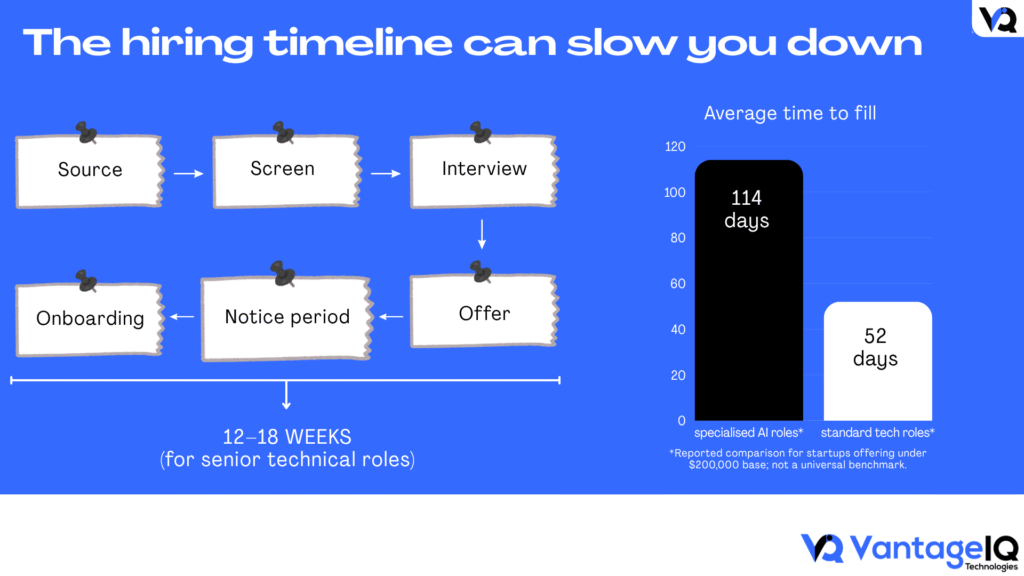
Full-time hires are the right call for your core. Your secret-sauce algorithms. Your proprietary logic. The architecture decisions that will outlive any single sprint.
These are the things competitors would pay to copy. They deserve long-term owners.
Example 1: Druva. The cloud data-protection company was founded in Pune in 2008. In an early interview, its team described a product developed entirely in Pune. The same interview flagged that finding “many more such people” was a significant challenge. That’s the pattern: the core stays in-house, and hiring pace becomes the bottleneck.
Example 2: Zerodha. The broker used vendors and partners until around 2014. Then it shifted the heavy lifting in-house. Its tech team is about 30 people, owning products in small groups of two to four developers. They’ve built the platform for India’s largest stock broker. The lesson isn’t “never use vendors.” It’s “use them until you know what’s core, then own it.”
Example 3: Dropbox. It treated storage infrastructure as a core differentiator. It moved the bulk of its workloads off AWS onto custom-built systems and saved nearly $75 million over two years. Gross margin climbed from 33% to 67% before its IPO. That kind of deep, multi-year engineering needs people who’ll own it.
Example 4: Monzo. The bank runs over 2,800 microservices. Rather than farm out the hard platform work, it centralised migrations under one in-house platform team. The team automated the routine cases and rolled changes out gradually. Institutional knowledge stayed inside the company, where it compounds.
The trade-off: High fixed payroll. Long hiring cycles. Hard to scale down if priorities shift.
Option 2: Use contractors for short, well-defined jobs
Contractors and staff augmentation work best when the task is clear and the timeline is short. A migration. A one-off integration. A temporary capacity surge.
They start fast, often in two to four weeks. They don’t bloat your headcount.
The catch: Someone on your team still has to direct the work. And when nobody does, things unravel quickly.
The cautionary tale: HealthCare.gov. It’s government-scale, not startup-scale, but the lesson travels. The US Government Accountability Office found that officials launched the site without effective planning or oversight of its contractors. Requirements kept changing. Nobody was clear on who could approve extra work. The site launched without verification that it met performance requirements. The build ultimately cost $840 million across dozens of contracts.
The contractors weren’t the root problem. The missing ownership was.
Think of contractors as extra hands. Great when you know exactly what needs doing. Risky when you’re hoping they’ll figure out what to do.
Option 3: Partner when the problem is bigger than a task
A technology partner isn’t just extra hands. It’s a team, with its own leadership, delivery process, and specialist depth.
That matters when you’re tackling something complex. Legacy modernisation. A data platform. A GenAI prototype heading for production. These need architects and specialists working together.
Example 1: Persistent Systems. It began as a small, Pune-based product engineering services firm. It crossed $1 billion in annualised revenue in 2022. Its model is building and engineering products alongside software companies. That a Pune-born partner reached that scale tells you how normal this model has become in India’s tech economy.
Example 2: Slack. Its founders had a rough, working prototype. They brought in design agency MetaLab, which says it designed the app from the ground up: the brand, web app, mobile apps and marketing site. The core team stayed on product vision and engineering. A specialist handled what they weren’t built to do.
Example 3: Your OneSource Solution. This company needed to move to AWS with limited cloud experience. Its client estimated it would have taken six months to learn and complete the migration. Partner ClearScale finished most of it within four weeks. It also trained the internal team along the way, so knowledge stayed in-house. (This is a vendor-published case study, so read it as a data point, not a benchmark.)
Example 4: Fraud detection on Bedrock. A financial-services team cut build time from months to weeks by working with specialists on AWS Bedrock’s managed foundation models, rather than training a custom model from scratch.
The trade-off: You need clear scope and decent vendor management. Deloitte’s survey is honest about this too. Benefits stall when governance and contracting aren’t done well. A good partner makes that easier. A bad one makes it worse.
A quick gut-check before you choose
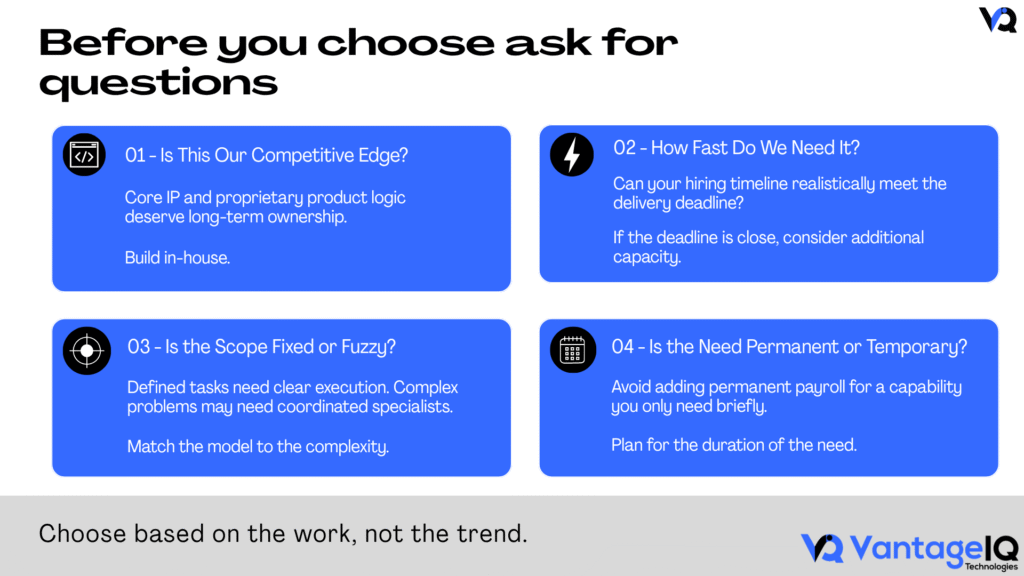
Ask yourself four things.
- Is this our competitive edge? If yes, build and hire in-house. Think Dropbox and its storage layer.
- How fast do we need it? If the answer is “this quarter,” a 12-week hiring cycle is already too slow.
- Is the scope fixed or fuzzy? Fixed work suits contractors. Fuzzy, complex work suits a partner with architects on the team. And whichever you choose, name one internal owner. HealthCare.gov is what happens when nobody does.
- Can we afford permanent payroll for a temporary problem? If the need shrinks once the work is done, don’t hire for it.
The smartest teams don't pick just one
Look at the examples above. None of those companies went all-in on a single model.
Dropbox and Monzo kept their core in-house. Slack kept product vision in-house and brought in specialists for design. The AWS migration client kept its team and borrowed a partner’s speed.
That’s the pattern. Keep your crown jewels close. Bring in help where speed and specialist depth matter more than adding permanent headcount.
VantageIQ Technologies helps businesses close engineering capacity gaps across application modernisation, cloud and DevOps, data platforms, and production AI, so internal teams can stay focused on the product only they can build.
Raised recently and deciding what to build, hire for, or bring in a partner to deliver? Talk to our team about a technology audit.