

AI Application Layer in India: Six Sectors. One Window. Build Now or Watch Others Do It
Published by VantageIQ Technologies | 8 min read
India’s AI story will not be decided in the race to build the most powerful large language models. The real opportunity lies in the AI application layer in India, where intelligence is embedded into real-world workflows, industries, and decision-making systems.
However, That battle is already capital-intensive, infrastructure-heavy, and dominated by a handful of global players.
In reality, India’s real opportunity lies one layer above in the AI application layer, where intelligence is embedded into real-world workflows, industries, and decision-making systems.
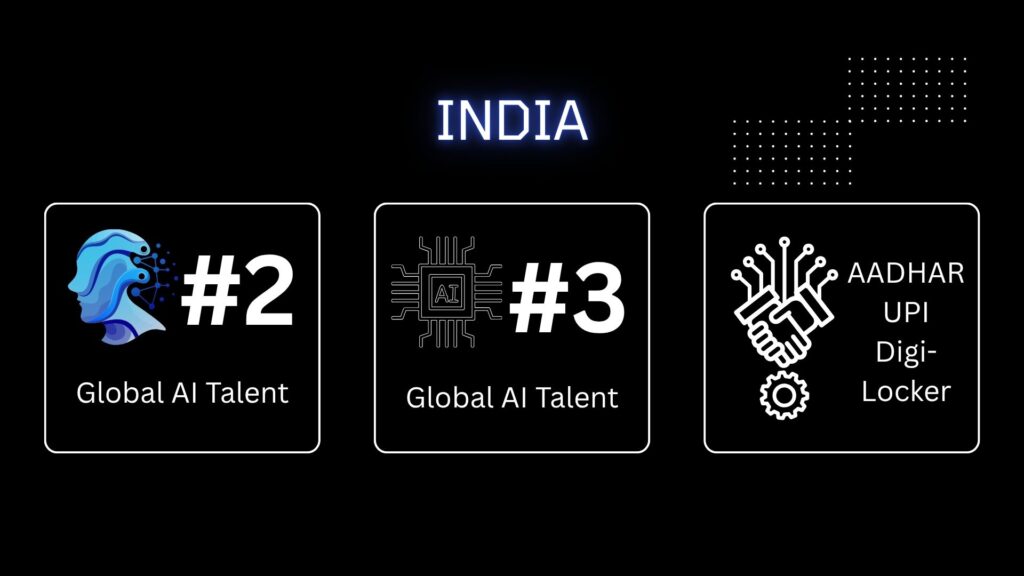
Structurally, India is uniquely positioned for this shift. The country ranks #2 globally in AI talent and #3 in AI vibrancy (Stanford HAI AI Index), while sitting on top of a world-leading digital public infrastructure stack, Aadhaar, UPI, DigiLocker that enables AI deployment at population scale.
This is not a theoretical advantage. It is execution leverage. This positions India as one of the fastest-growing ecosystems for AI adoption in India across industries.
The AI application layer is where:
- Business value is created
- Competitive moats are built
- Sector-specific dominance is established
And importantly, it is where India can win.
The AI Application Layer Is Not One Market. It Is Six Parallel Battlegrounds
The term “AI application layer” is often used as a catch-all. In reality, it represents multiple deeply specialized markets, each with its own data requirements, regulatory constraints, and workflow complexity.
A healthcare AI system diagnosing disease is fundamentally different from:
- A fintech AI model underwriting loans
- An agriculture AI system advising farmers
- A manufacturing AI engine optimizing production
Each sector operates on:
- Different data moats
- Different deployment challenges
- Different time-to-value cycles
This fragmentation is not a weakness, it is India’s strategic advantage. Because these markets reward local context, proprietary data, and workflow depth, they are difficult for global, generic AI solutions to penetrate.
This is why the AI application layer in India is emerging as a multi-sector opportunity, not a single market.
Healthcare AI in India: AI as a Structural Necessity, Not a Feature
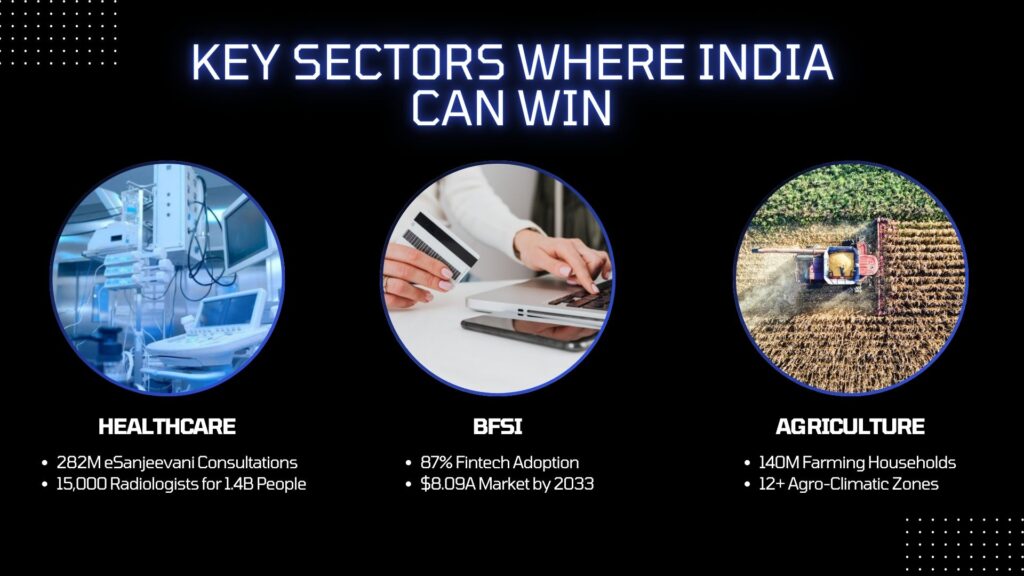
India’s healthcare system is constrained by scale, too few doctors, too many patients, and uneven access across geographies.
As as result, AI is not being deployed here as an enhancement.
It is being deployed as infrastructure.
From AI-assisted diagnostics to telemedicine platforms, the goal is simple:
- Extend clinical reach
- Improve diagnostic accuracy
- Enable non-specialists to deliver care
The moat in healthcare AI is not just algorithms.
It is India-specific clinical data + regulatory trust + deployment at scale.
This makes healthcare one of the most defensible AI application sectors in India.
BFSI AI in India: The Most Mature and Fastest-Moving AI Sector
Banking, Financial Services, and Insurance (BFSI) is currently the most advanced AI adoption sector in India.
AI is already deeply embedded in:
- AI-powered fraud detection systems in India
- AI-based credit scoring for thin-file users in India
- Customer service automation
- Risk modeling and compliance
With India’s fintech adoption at 87%, the sector is moving from experimentation to AI-native operations.
However, this also makes BFSI the most competitive battleground.
The opportunity is not horizontal AI tools.
It is verticalized AI applications solving specific workflows:
- KYC and onboarding
- Loan underwriting
- Collections and recovery optimization
- SME and informal credit scoring
The sharper the use case, the stronger the moat.
Agriculture AI in India: The Most Complex Problem with the Deepest Moat
India’s agriculture sector is unmatched in complexity:
- 140 million farming households
- 12+ agro-climatic zones
- Dozens of languages
- Highly localized decision-making
In contrast, AI in agriculture is not a software problem.
It is a data + distribution + context problem.
Successful applications are those that:
- Use hyperlocal data
- Deliver insights in regional languages
- Work in low-connectivity environments
This creates one of the strongest AI moats globally because it requires years of ground-level data accumulation.
Education AI in India: The Shift from Content to Personalization
India’s EdTech sector has moved past its hype cycle and is entering a more grounded phase, one that is far more aligned with AI.
The next wave of education is not about content libraries.
It is about personalized learning at scale.
AI enables:
- Adaptive learning paths
- Real-time feedback loops
- Multilingual tutoring
- Affordable access across income segments
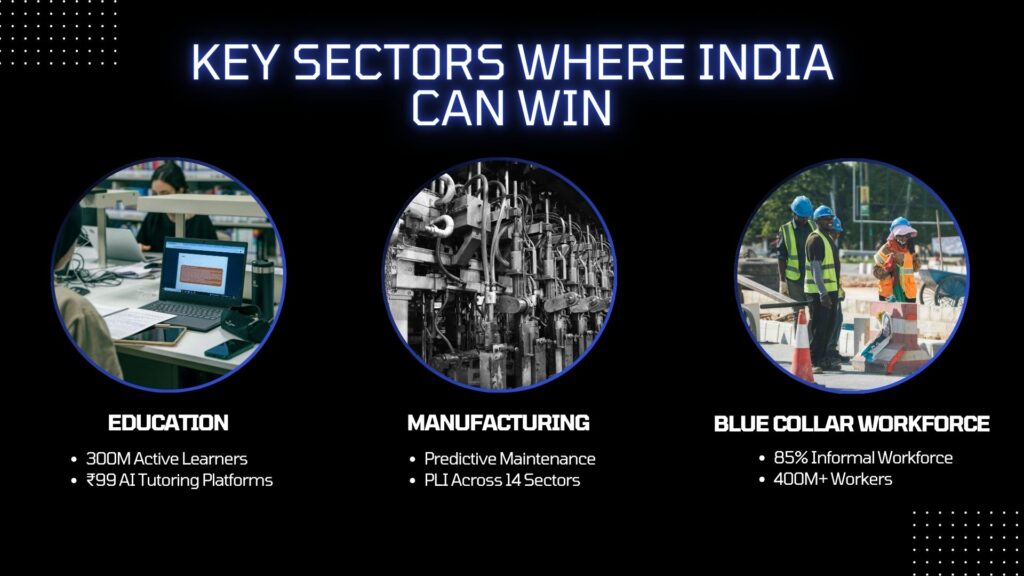
With over 300 million active learners, the opportunity lies in building:
- Low-cost, high-impact AI tutors
- Vernacular-first education platforms
- Skill and exam-focused learning systems
This is where AI transforms from a feature into a learning companion.
Manufacturing AI in India: A Late Adopter with Massive Headroom
Manufacturing in India is still early in its AI adoption journey, but the tailwinds are strong.
Government initiatives like the PLI scheme are accelerating industrial growth, creating demand for:
- Predictive maintenance using AI in India
- Computer vision for quality checks
- Supply chain optimization
- Energy efficiency systems
The constraint today is not demand, it is data readiness.
Most enterprises still lack structured, digitized operational data.
Which means:
- The first layer of opportunity is digitization
- The second layer is AI deployment
The companies that solve both will dominate this space.
Workforce AI in India: The Most Underserved AI Opportunity
Nearly 85% of India’s workforce operates in the informal sector, a segment largely ignored by traditional technology solutions.
This is where AI can create the highest societal and economic impact.
The applications here are fundamentally different:
- Voice-first interfaces
- Regional language support
- Low-cost, mobile-first delivery
Key use cases include:
- Skill development and training
- Job matching and credentialing
- Financial access for thin-file workers
- On-the-job AI assistance
This is not just a market gap.
It is a once-in-a-generation opportunity to build inclusive AI systems at scale.
The Common Thread: India’s Moat Is Context, Not Compute
Across all six sectors, one pattern is clear:
AI success in India depends on:
- Local data
- Workflow integration
- Domain-specific understanding
Not just model performance.
Global AI companies can build powerful models.
But without:- Indian datasets
- Regulatory alignment
- Distribution networks
They cannot easily compete at the application layer.
This is where India’s real moat lies.
At VantageIQ Technologies, we are actively building solutions across the AI application layer in India, helping enterprises move from experimentation to production-scale AI systems.
Conclusion: The Window Is Open, But Not for Long
India’s AI future will not be defined by who builds the best models, but by who leads the AI application layer in India.
The application layer is:
- Fragmented
- Competitive
- Deeply contextual
And that is exactly why it is defensible.
Over the next 18–36 months, category leaders will emerge across these six sectors.
As they do, the barriers to entry will rise sharply.
Because in the end:
AI advantage is not about access to intelligence.
It is about how deeply that intelligence is embedded into reality.