

Identifying and deducting non-payable items with semantic intelligence
The Hidden Leakage in Claims
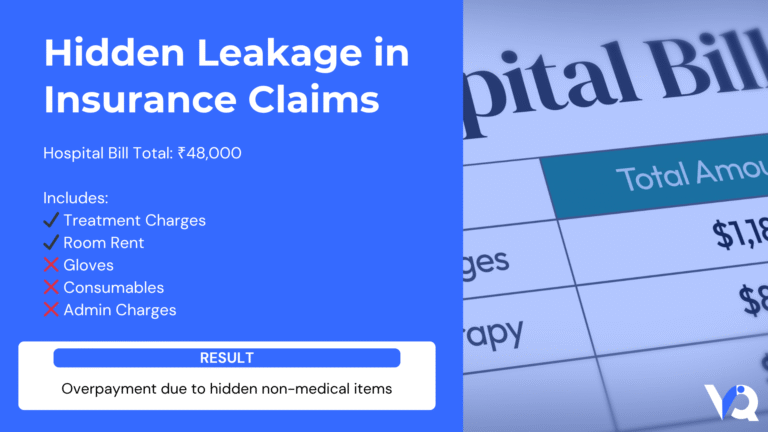
Not every item in a hospital bill is payable.
Across thousands of claims, small items like gloves, consumables, or administrative charges often get included but shouldn’t be reimbursed. These fall under Non-Medical Expenses (NMEs) as defined by IRDAI or insurer rules.
Individually, they don’t seem significant. At scale, they create a serious issue:
Incorrect payouts due to missed or inconsistent deductions
On paper, NME detection sounds simple, match bill items with a predefined list and deduct them. In reality, hospital bills are messy. The same item can appear in multiple ways:
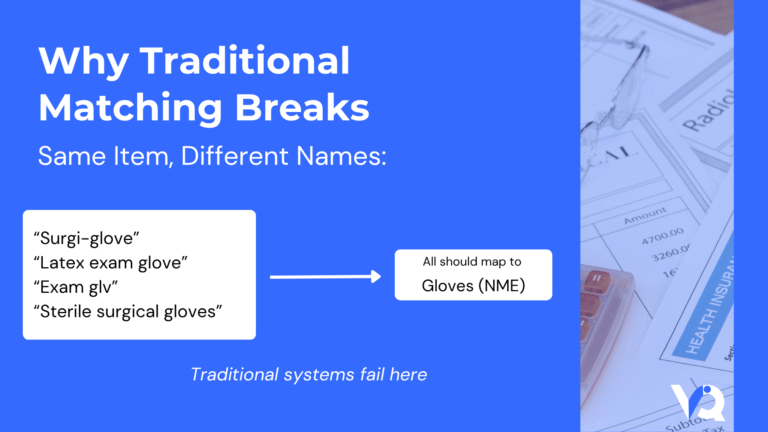
- “Surgi-glove”
- “Latex exam glove”
- “Sterile surgical gloves size 7”
Add to that:
- OCR errors
- Abbreviations
- Inconsistent formats
This makes exact matching unreliable. The challenge is not identifying words, it’s understanding what they mean.
Where Traditional Systems Fail
Most systems rely on keyword matching. If a line contains “glove,” it’s flagged. But this approach breaks quickly:
- Misses variations
- Requires constant updates
- Doesn’t handle noisy data
As a result, teams still rely heavily on manual review.
What Actually Works: Semantic Understanding
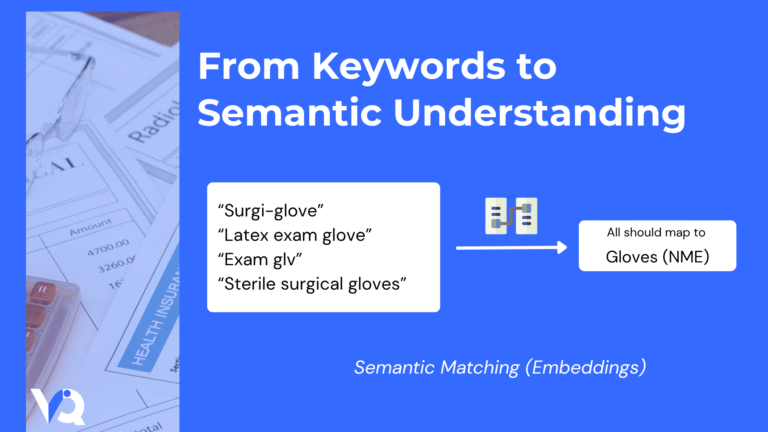
AI approaches this differently. Instead of looking for exact matches, it looks for semantic similarity, understanding that different phrases can represent the same concept. So whether the bill says:
- “Surgi-glove”
- “Exam glv”
The system maps both to a single category: “Gloves” (NME)
This is done using vector embeddings and similarity scoring, allowing the system to generalize across formats and variations.
How the System Works
The process is designed to be simple from the outside, even if the backend is sophisticated. A claim document is first converted into structured data using OCR and layout-aware extraction. Line items are then cleaned and normalized to reduce noise.
Each item is compared against a master NME list, not through keywords, but through semantic similarity. Once a match is found, the system checks whether the category is payable based on IRDAI or insurer rules. If it’s not payable, the amount is automatically deducted from the claim.
For example:
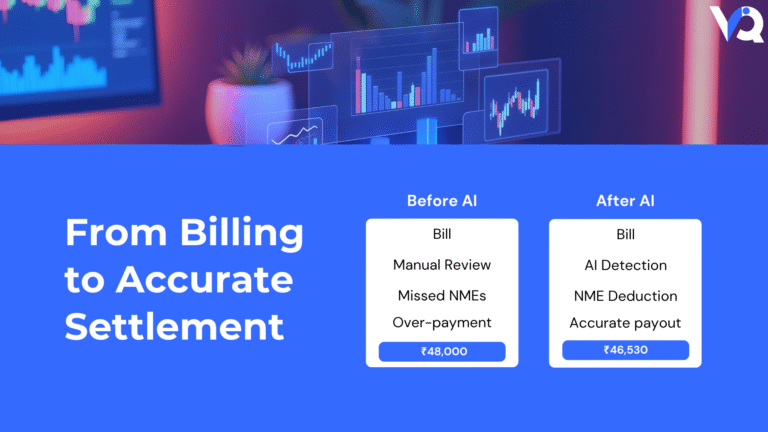
- Total claim: ₹48,000
- Identified NMEs: ₹1,470
Final payable: ₹46,530
This happens instantly, without manual intervention.
Making It Visible: Highlighting for Auditors
Automation alone isn’t enough, transparency matters.
The system uses document coordinates from OCR to visually highlight NME items directly in the bill. Auditors can see exactly:
- Which items were flagged
- Why they were deducted
This makes validation faster and builds trust in the system.
Why This Matters for TPAs
This step directly impacts financial accuracy and operational efficiency.
- Reduced leakage through accurate deductions
- Faster processing with minimal manual review
- Consistency across all claims
- Audit readiness with clear traceability
Even small improvements here can significantly reduce overall claim costs.
Where This Fits in the Bigger Picture
NME detection sits between data extraction and final decision-making. Once documents are structured and data is extracted, this layer ensures that only valid, payable items move forward.
Documents → Data → Financial Validation → Decisions
How This Is Being Built in Practice
At VantageIQ Technologies, this capability is implemented as part of a broader document intelligence system. It combines:
- OCR with layout-aware extraction
- Semantic matching using embeddings
- Policy-aware deduction logic
- Visual highlighting for validation
The focus is not just automation but accuracy, explainability, and scale
Final Thought
If data extraction structures information,
NME detection ensures financial correctness. It bridges the gap between what is billed and what should actually be paid.
For organizations investing in AI in health insurance claims, this is a critical step toward building a reliable and scalable claims processing system.