For two years, AI in Indian IT was mostly a story. Demos, hackathons, platform launches.
Now it’s a line item.
AI revenue in Indian IT is becoming measurable. TCS, Infosys and HCLTech are reporting substantial AI-related revenue, but the numbers tell different stories. Their definitions differ, their growth does not always translate into stronger overall revenue, and the economics of delivering technology services are changing.
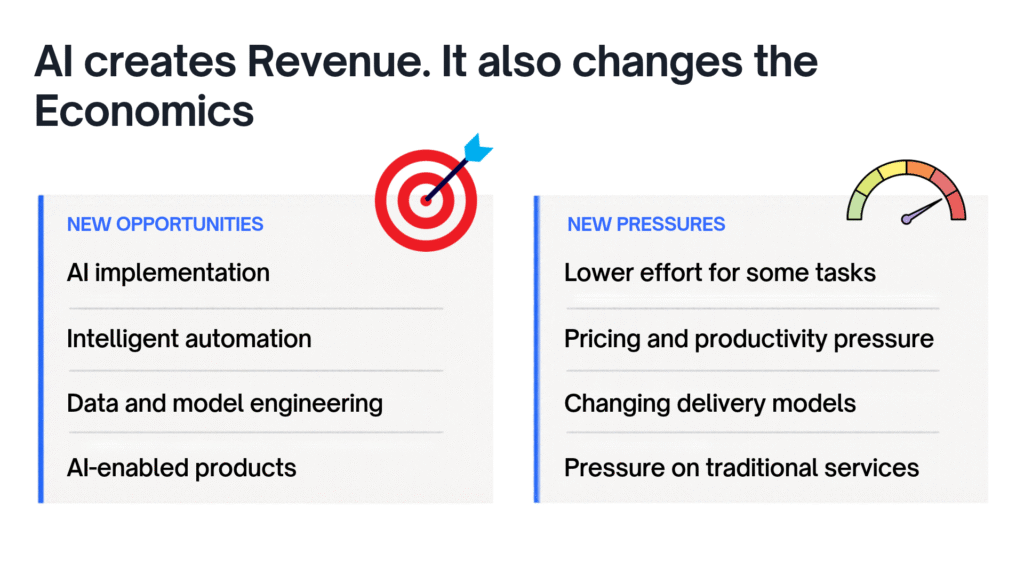
The real question is no longer whether Indian IT companies can sell AI. It is whether AI can generate enough new business to offset the pressure it puts on traditional services.
To understand that shift, you have to look beyond the headline numbers.
From promises to percentages
A year ago, of the three largest Indian IT firms, only HCLTech put a figure on it. In October 2025, it said its Advanced AI revenue had crossed $100 million in a quarter.
Then the others followed. TCS disclosed $1.8 billion in annualised AI revenue in January 2026. Next quarter it was $2.3 billion. Its latest results put it at $3.1 billion, above 10% of revenue.
Infosys’s first published AI share was 5.5%. It rose to 8.2% in Q1 FY27. On October 23 it reported 10.5%, up 29% quarter on quarter.
HCLTech’s latest is $219 million a quarter, up 78% year on year in constant currency. Wipro is the odd one out. It’s the only one of India’s top four that doesn’t disclose AI revenue.
Same label, different yardsticks
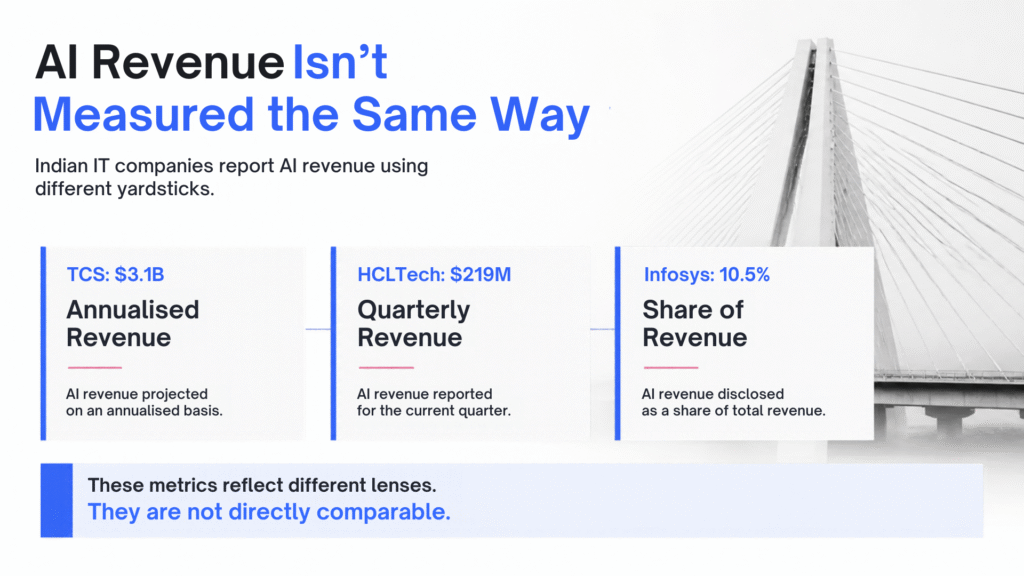
TCS says $3.1 billion. HCLTech’s figure works out to about $876 million a year. Infosys gives a percentage. They can’t be compared directly.
Different scope. TCS counts AI across its services. HCLTech limits its figure to advanced, agentic and product-led offerings.
Different timeframes. “Annualised” means a quarter’s AI revenue multiplied by four. When TCS’s AI additions slowed in one quarter, management pointed to the project-based nature of the work, with short-duration, non-recurring engagements. Annualised isn’t the same as recurring.
Different units. Dollars, run rates and percentages measure different things.
Narrow lens, richer margins
The narrow definition has a payoff. HCLTech’s CEO said the IP and platform part of Advanced AI can earn gross margins above 70%. The services part earns margins 7–10% higher than traditional services. Its CFO said Advanced AI contributed 32 basis points of a 131-basis-point jump in quarterly EBIT margin, to 18.2%.
TCS’s wide lens tells a different story. In our reading, it lets TCS present AI as the engine inside its large transformation deals, not a separate product line. Neither approach is wrong. They answer different questions.
When AI makes the old work cheaper
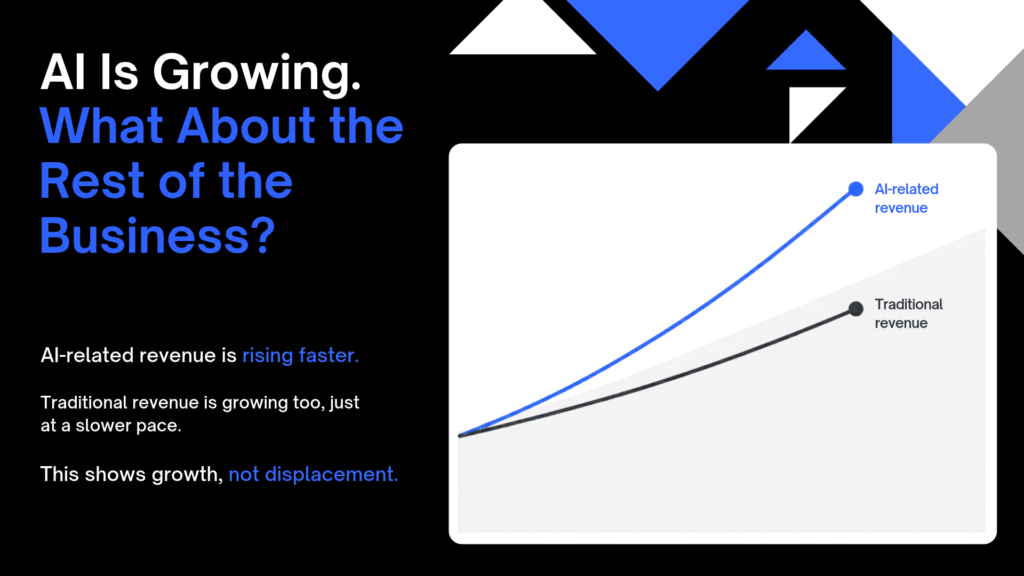
Here’s what headlines skip: overall growth.
TCS’s revenue rose 2.4% year on year in dollars. HCLTech grew 11.5% in rupees but 2.6% in constant currency. Infosys grew 1.5% in constant currency, then cut its full-year guidance to 1–2%, despite $5.2 billion in large deal wins.
Now the arithmetic. It’s ours, from reported and rounded figures, so read it as direction, not precision.
- TCS: Between Q4 FY26 and Q2 FY27, its AI run rate rose from $2.3 billion to $3.1 billion, about $200 million more AI revenue per quarter. Total quarterly revenue rose only about $20 million, from $7,621 million to $7,642 million. The rest of the business is roughly $180 million a quarter smaller.
- Infosys: AI revenue went from about $417 million (8.2% of $5,082 million) to about $540 million (10.5% of $5,145 million). Total revenue grew about $63 million. The rest is roughly $60 million smaller.
Important caveat: These are illustrative estimates, not proof that AI directly replaced existing revenue. They assume the reported AI figures can be compared across periods, even though definitions, project mix and revenue recognition may differ. The calculations suggest that growth in reported AI revenue has outpaced overall revenue growth, but they cannot establish how much traditional business AI has displaced.
Infosys says the AI revenue is net new and offsets AI-driven deflation in its older business. The guidance cut cited weaker US growth and deflationary pressure from AI.
Wipro shows the harder version. Its large-deal bookings fell 58.6% sequentially to $674 million, and IT services revenue was flat in constant currency. ICICI Securities noted that its revenue fell 1.6% in FY26 even as bookings rose 14%, pointing to AI-led deflation and share loss as possible reasons. Wipro’s CFO said contracts run two to 2.5 years, and the deflationary cycle is about 1.5 to two years old. Meanwhile its CTO says AI has delivered productivity equal to the output of 20,000 employees.
The productivity is real. The revenue to match isn’t guaranteed. DAM Capital’s Anmol Garg says AI-led deflation still outweighs AI-led revenue, calling AI a headwind at least for now.
The pyramid is bending, not breaking
The old model grew revenue by adding junior engineers. That’s changing, though less dramatically than headlines suggest.
Wipro’s headcount fell by 6,716, which management linked to no campus hiring and AI productivity. HCLTech added 6,450 people and grew revenue per employee just 2.4% year on year. TCS plans up to 8,900 forward-deployed engineers and Infosys about 6,000, who embed with clients to speed AI adoption.
The mix is shifting toward specialists. The pyramid is bending, not gone.
Why the savings don’t simply vanish
If AI makes work cheaper, why isn’t client spend collapsing? Two reasons.
First, building alone is hard. Accenture’s CEO has said many clients build a promising proof of concept themselves, then return because they can’t scale it.
Second, savings get reinvested. She also said clients redirect them into their next priorities. Look at where. Providers are betting on the data layer: Infosys, LTIMindtree, Cognizant, Accenture and KPMG have committed over $1.5 billion to Oracle’s AI Data Platform. And TCS is taking over Best Buy’s India capability centre to turn it into an AI-native hub.
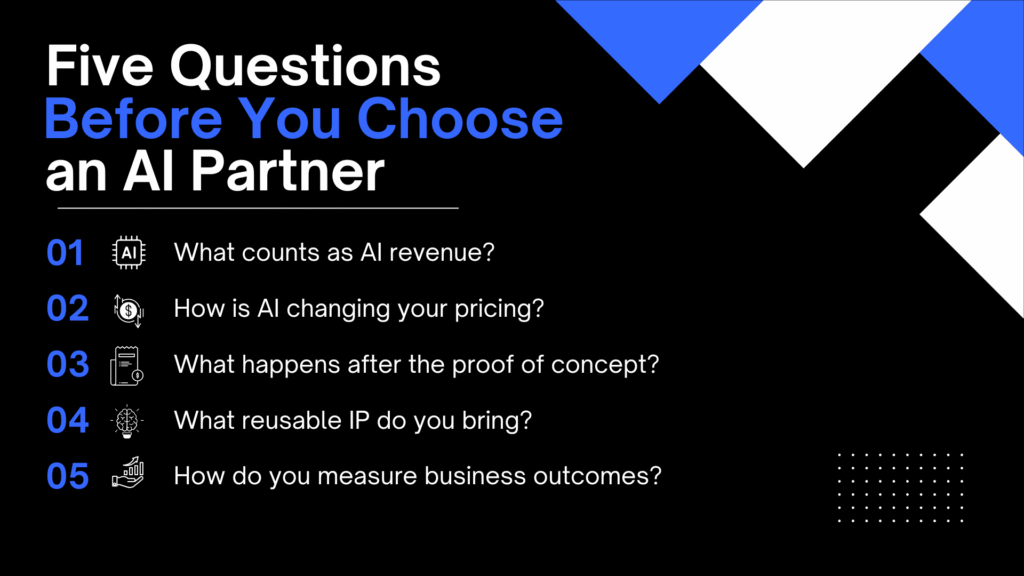
Five questions to ask your IT partner
Vendors are changing how they sell and how they price. If you buy technology services, ask:
- How do you define AI revenue, and how much of it recurs?
- As automation cuts hours, how will your pricing change? HCLTech already bills Advanced AI through a mix of fixed-price, time-and-materials and IP-linked contracts, and Wipro’s CTO argues the shift must be from productivity to outcomes.
- Is this AI work new scope, or existing scope relabelled?
- Can you help us scale past the proof of concept, including the data and integration work, not just the model?
- Is your delivery built on reusable IP and accelerators, or custom each time?
Clear answers signal a mature provider. Vague ones signal a label.
What it adds up to
Indian IT is no longer just talking about AI. It’s billing for it, and being squeezed by it. Value is moving from headcount toward platforms, data foundations and outcome-based deals. That backs the argument we made in India has no AI play: the value lies in helping the world adopt AI, not only in building models.
But “AI revenue” is a vendor-defined term. Read the definition before you read the number.
For businesses adopting AI, the challenge is no longer just choosing a model. It’s connecting that model to reliable data, existing systems and real workflows, then making it work at scale.
At VantageIQ Technologies, we see this as the critical step between AI experimentation and business value. We explore the challenges in Why Most Enterprise AI Pilots Never Reach Production.