

In Chapter 2 and Chapter 3, we established the Taxonomy of Scale, proving that whether you run a 15,000-person retail technology engine or a lean 20-person Generative AI pod, success is measured by the business complexity you own rather than raw headcount.
Now comes the hard operational pivot: How do you actually build it on the ground without running into legal, regulatory, or governance landmines?
Establishing an Indian hub is no longer a simple real estate procurement exercise or a quick trip to register a local business. From choosing between a Wholly-Owned Captive, an Employer of Record (EOR), or a Build-Operate-Transfer (BOT) partner, to navigating India’s 2026 transfer pricing safe harbours and modernized Labour Codes, your setup strategy dictates whether your center thrives or gets bogged down in bureaucratic friction.
Here is the strategic playbook for moving from legal incorporation to an empowered enterprise node.
Choosing Your Entry Vehicle: The Operational Matrix
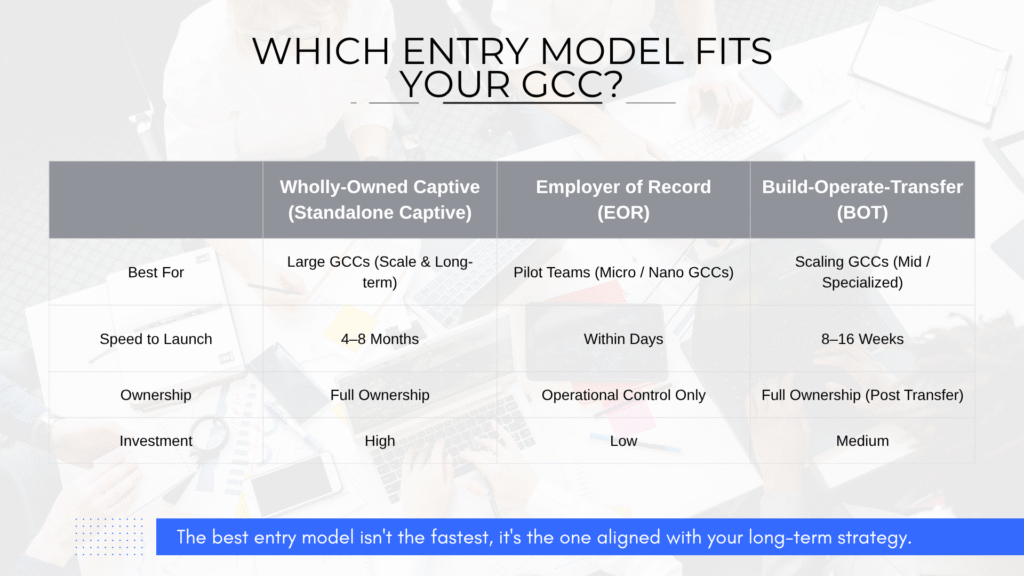
Every global enterprise entering India faces a core trade-off between speed-to-market, capital commitment, and IP control. There is no single “correct” model; the choice depends directly on your taxonomy tier and long-term mandate. The legal structure you choose doesn’t just determine incorporation timelines, it shapes governance, intellectual property ownership, hiring velocity, and long-term scalability.
| Wholly-Owned Subsidiary(Standalone Captive) | Employer of Record (EOR) | Build-Operate-Transfer (BOT) |
|---|---|---|
| • 100% IP & brand control | • Operational in days | • Partner builds & manages |
| • 4–8 month setup | • No local incorporation required | • Reduces operational risk |
| • Best for scaling GCCs (>100 employees) | • Best for micro or pilot teams | • Transfers ownership in 18–36 months |
Wholly-Owned Subsidiary (The Standalone Captive)
- How It Works: You establish a local Private Limited company under India’s Companies Act, securing complete ownership of capital, brand equity, and intellectual property.
- Best For: Enterprise (10,000+) and Mid-Sized (1,000–10,000) centers planning long-term investments exceeding 100 employees.
- Trade-Offs: Maximum control and direct culture-building, but requires navigating local incorporation, board mandates, physical leasing, and tax registrations—typically taking 4 to 8 months before full operational kickoff.
Employer of Record (EOR / Hosted Model)
- How It Works: A specialized local partner legally employs your Indian team on their existing entity while you maintain full day-to-day operational control and technical direction over their work.
- Best For: Micro & Nano GCCs (<100 staff) testing new AI pipelines, specialized R&D pods, or growth-stage firms needing immediate talent access.
- Trade-Offs: Speed-to-market is measured in days (24 to 48 hours to onboard) rather than months, with zero upfront capital outlay for corporate setup. However, markup costs and co-employment limits make it less cost-effective at larger scales.
Build-Operate-Transfer (BOT)
- How It Works: An experienced partner handles initial incorporation, real estate, vendor procurement, and local talent acquisition under your brand guidelines. After a pre-agreed operational runway (typically 18 to 36 months), the entire infrastructure, team, and IP are formally transferred to your owned legal subsidiary.
- Best For: Mid-Sized and Small specialized centers that want deep operational control without taking on early regulatory or execution risks.
- Trade-Offs: De-risks initial execution and accelerates hiring velocity (launching in 8–16 weeks), but requires clear buyout valuation terms and transfer milestones up front to prevent friction down the road.
The Implementation Timeline: From Board Approval to Day 1
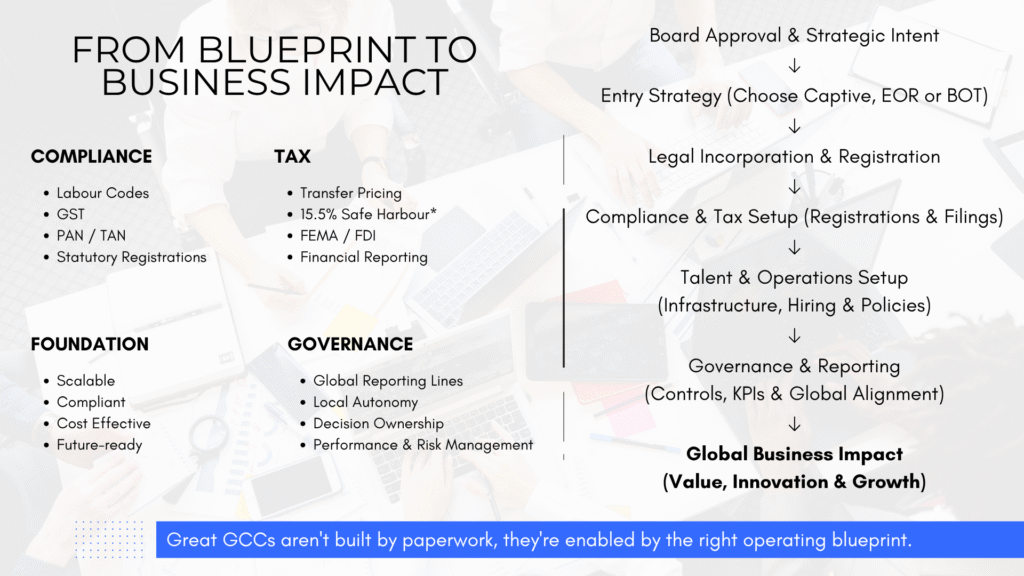
Setting up a standalone entity requires a clear operational sequence. Missing a regulatory step, such as permanent account numbers or foreign investment filings can delay hiring plans by months.
Phase 1: Feasibility & Design (Weeks 1 – 4)
├── Define functional mandate, city selection, and initial headcount curves
└── Finalize legal entry vehicle (DIY Captive vs. EOR vs. BOT)
Phase 2: Entity Incorporation & Compliance (Weeks 5 – 12)
├── Obtain Digital Signature Certificates (DSC) & Director Identification Numbers (DIN)
├── File SPICe+ form with Ministry of Corporate Affairs (MCA) for Private Limited incorporation
├── Issue Permanent Account Number (PAN) & Tax Deduction Account Number (TAN)
└── Register under India’s 4 Consolidated Labour Codes & GST framework
Phase 3: Capital Inflow & Banking (Weeks 12 – 16)
├── Open local corporate bank account with an authorized Reserve Bank of India (RBI) dealer
└── Execute Foreign Direct Investment (FDI) reporting (Form FC-GPR under FEMA regulations)
Phase 4: Real Estate, HR & Operations (Weeks 16 – 24)
├── Secure commercial leases (or managed space) & establish IT infrastructure
├── Execute Labour-Code-compliant employment contracts
└── Implement Transfer Pricing agreements & local intercompany service contracts
The C-Suite Playbook: Tax, Legal, and Compliance Rules
Navigating the regulatory landscape in India requires proactive planning across tax, legal, and operational compliance.
Transfer Pricing: The 2026 Safe Harbour Overhaul
Most GCCs operate as captive service providers to their overseas parent entities, making Transfer Pricing (TP) a primary regulatory focus.
- Cost-Plus Methodology: Indian tax authorities expect intercompany services to be priced using a “Cost-Plus” model—adding an arm’s-length mark-up to operating expenses incurred by the local entity.
- The 2026 Consolidated Safe Harbour: Under notified tax rules, India rationalized its transfer pricing safe harbour framework. A uniform 15.5% operating profit margin on operating expenses applies across a consolidated “IT Services” category (covering software development, ITeS, KPO, and contract R&D).
- Higher Eligibility Thresholds: The transaction value threshold for safe harbour eligibility sits at ₹2,000 Crore (~US$240M), opening safe harbour certainty to mid-market and enterprise GCCs for 5-year blocks through streamlined, rule-based electronic filings.
- Permanent Establishment (PE) Risk: To prevent unintended PE exposure or complex IP taxation claims, clear economic ownership of IP must remain with the foreign parent company through structured Master Service Agreements (MSAs).
Labor Laws & Modern Statutory Compliance
Register for applicable labour law and statutory compliance requirements, in line with India’s four consolidated Labour Codes (Code on Wages, Industrial Relations, Social Security, and Occupational Safety, Health & Working Conditions) and state-level implementation.
- Unified Statutory Filings: Employment contracts must align with updated rules on basic wage structures, overtime limits, and unified social security coverage (EPF, Gratuity, and ESIC).
- Mandatory Workplace Policies: Comprehensive policies covering the Prevention of Sexual Harassment (POSH), equal opportunity standards, and strict adherence to the Digital Personal Data Protection (DPDP) framework must be operational from Day 1.
Governance That Works: Aligning HQ with India
The root cause of underperformance in global capability centers is rarely technical talent; it is governance decay. When an Indian center is treated as a remote vendor clearing tickets rather than an empowered partner, top talent leaves and innovation stalls.
Winning organizations use a Matrixed Governance Framework:
- Direct Functional Reporting: Local platform heads report directly to global C-suite executives (e.g., Head of India Data Engineering reports directly to the Global VP of Data Platforms), eliminating intermediate bureaucratic layers.
- Global Leadership Presence: Global product managers, software architects, and strategy leaders are physically co-located within or regularly rotated through the Indian hubs to maintain shared operational context.
- Local Leadership Autonomy: Indian site leaders manage direct operational budgets, giving them the authority required to allocate local R&D resources, upgrade technical stacks, and execute strategic hiring.
Blueprints Drive Outcomes
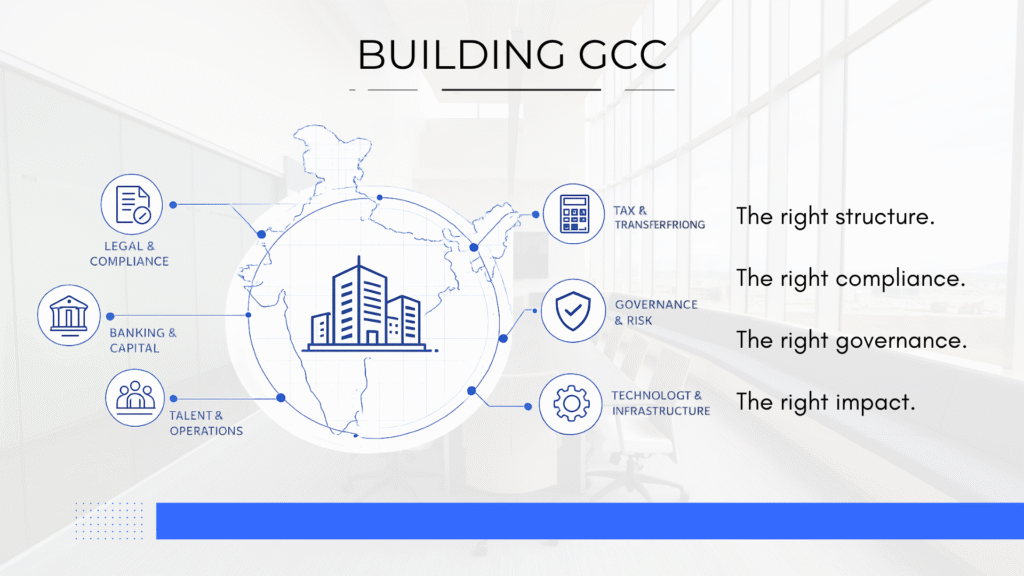
Selecting the right setup vehicle, mastering transfer pricing rules, and embedding strong global governance aren’t just administrative tasks—they form the structural foundation of your center.
By aligning your entry model with your true scale tier, you ensure that your Indian center is built to deliver top-line global impact from day one.
Build Your Scalable GCC with VantageIQ Technologies
Navigating setup vehicles, transfer pricing safe harbours, real estate procurement, and global governance design requires deep local experience. At VantageIQ Technologies, we help global enterprises structure, launch, and scale high-value GCCs that deliver top-line impact.
Ready to architect your entry strategy? Connect with the our team today.
Read the next chapter in the series covering AI-assisted development, engineering talent trends, technical debt, and modern 2026 compensation benchmarks.