Picture the call. Your Series B lead asks for net dollar retention, CAC payback and gross margin by cohort.
Simple enough, you think.
Then your team needs three weeks. Finance sends one spreadsheet. Sales ops sends another. Someone pulls product usage by hand. Nobody’s numbers match.
That’s what scattered data really costs. Not a missing dashboard. A slow answer at the moment it matters most.
In our first post on post-funding problems, we said to centralise your data early. It sounds like overkill at 20 people. Until you’re untangling it at 80.
But “early” doesn’t mean “everything at once.” A data lakehouse for startups is a destination, not a day-one purchase. Here’s how to get there in stages. The headcounts are rough guides, not rules.
What scattered data actually costs
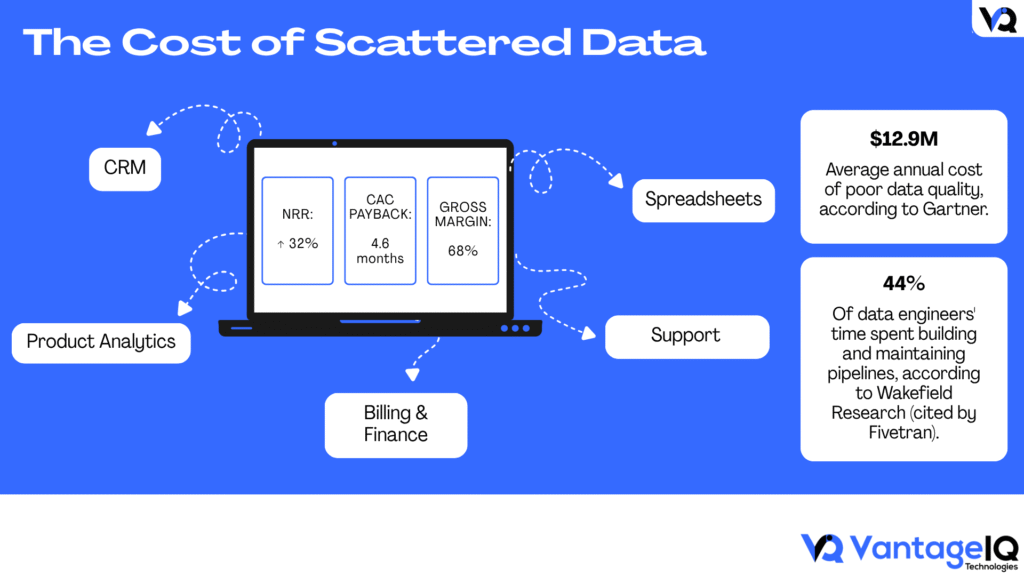
Gartner estimates that poor data quality costs organisations an average of $12.9 million a year. That’s an enterprise number. Startups feel it as slower decisions and shaky board decks.
The bigger cost is people. A Wakefield Research survey, cited by Fivetran, found data engineers spend about 44% of their time building and maintaining pipelines. That’s nearly half of your scarcest talent spent on plumbing.
It spills into AI too.In a 2024 forecast, Gartner predicted that at least 30% of GenAI projects would be abandoned after proof of concept by the end of 2025, citing poor data quality, inadequate risk controls, escalating costs and unclear business value.
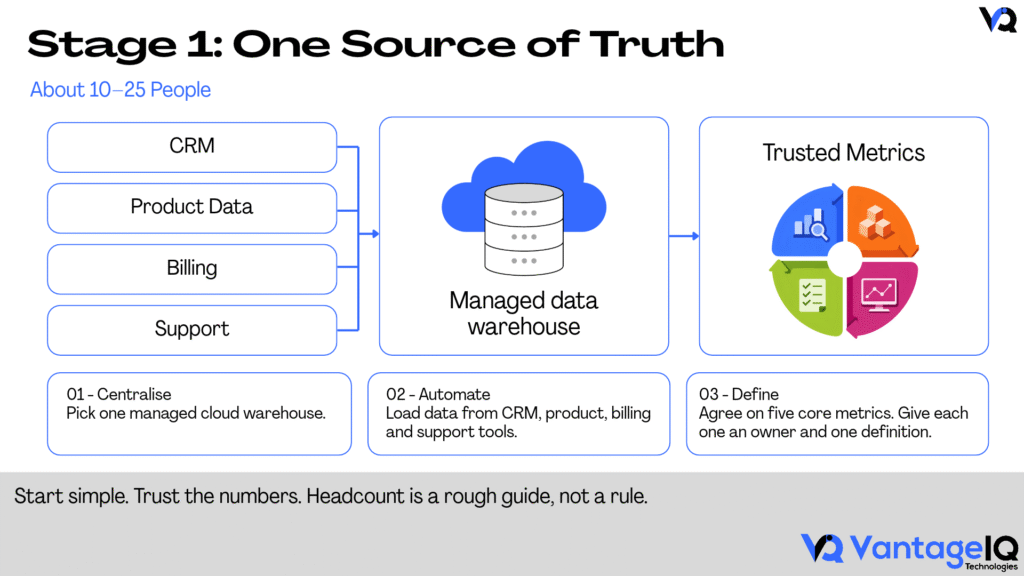
Stage 1 (about 10–25 people): One source of truth, not a lakehouse
At this size, you don’t need a platform. You need one place where the numbers live.
Start here:
- Pick one managed cloud warehouse.
- Automate loads from your CRM, product database, billing tool and support desk.
- Agree on five core metrics. Give each one an owner and one definition.
Skip the heavy architecture. A managed data warehouse is often the sensible first step for a small team. The right time to add complexity depends on reporting needs, data complexity and the cost of maintaining manual processes not headcount alone.
How do you know it’s time? Venture builder Project A lists warning signs, such as analysts spending their week maintaining spreadsheet reports. If that sounds familiar, don’t wait.
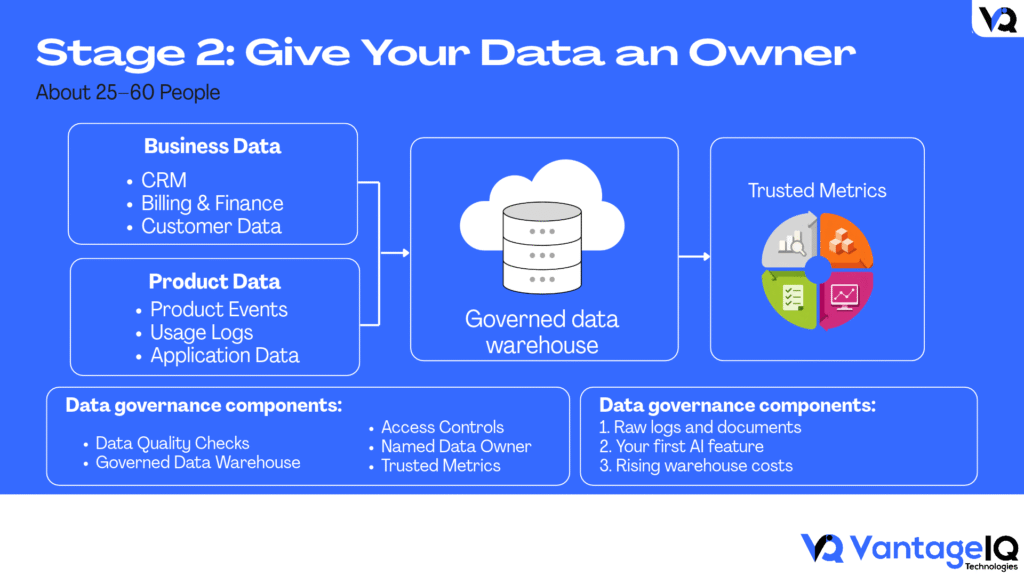
Stage 2 (about 25–60 people): Give your data an owner
Growth breaks informal habits. More tools. More teams. More “which number is right?”
Add three things:
- Product event data, alongside business data.
- Basic quality checks on the tables your board sees.
- Clear access rules and one named owner.
Then watch for triggers. Raw logs and documents your warehouse handles badly. Your first ML or GenAI feature. A warehouse bill growing faster than usage.
Two or three of those and it’s time to plan Stage 3.
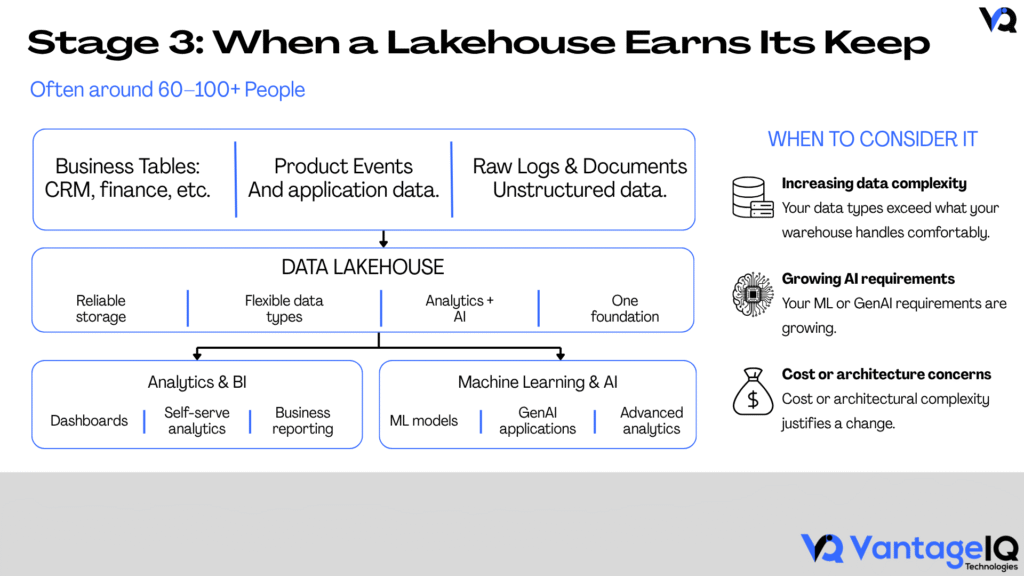
Stage 3 (often around 60–100+ people): When a lakehouse earns its keep
A lakehouse blends a warehouse’s reliability with a data lake’s flexibility. Structured and unstructured data, analytics and AI, on one foundation.
Lakehouses are gaining traction. In Dremio’s late-2023 survey of 500 IT and data professionals at enterprises with 1,000 or more employees, 65% said they ran most of their analytics on lakehouses, while 81% used them to support AI work. It’s a vendor-sponsored survey of larger organisations, so treat it as a signal of adoption—not proof that a startup needs a lakehouse.
Indian companies are already here. During the 2020 IPL, Dream11 needed a centralised ML platform to handle more than 100 million requests per minute. According to Databricks’ customer story, it delivered an IPL personalisation and prediction use case in one week. That illustrates how a mature data and ML foundation can support rapid deployment under heavy demand.
The migration you don’t want to run at 80
Now the “under pressure” part.
Meesho moved multiple petabytes across eight transactional databases to a lakehouse.The migration also had to account for an environment containing more than 2,000 ML models and 400+ BI reports. Data latency dropped from three to four hours to under one hour, with zero downtime.
That’s a success story. It’s also a picture of how much piles up over time.
Meesho is far bigger than most startups. But the principle scales down. Every sprint you postpone adds tables, reports and workarounds that someone must eventually move.
You can’t just hire your way out
If you’re building in India, staffing this is its own challenge. Quess Corp found a 43% supply gap in AI, data and analytics roles across Indian GCCs. Pune is among the anchor hiring cities.
You’re competing with global capability centres for the same people.
That’s where a partner helps. Design the target architecture, build the first pipelines, then hand over to your own team as you hire. We cover this decision in our build, hire or partner guide.
Start small, but start
You don’t need a lakehouse for 20 people. You need five trusted numbers, one warehouse and one owner.
Do that now, and the lakehouse becomes a planned upgrade instead of an emergency.
At VantageIQ Technologies, we help funded teams build a data foundation that grows with their business. We begin by reviewing your existing data sources, reporting gaps and business priorities, then identify the most practical next steps. This may include connecting CRM, billing and product data, automating data pipelines, establishing consistent metrics and quality checks, and building BI dashboards that give leadership a reliable view of performance. As data volumes and AI requirements grow, we can help evaluate and implement lakehouse architecture, optimise cloud infrastructure, and prepare your data for advanced analytics and AI use cases. The goal is to solve today’s bottlenecks without overengineering your platform or investing in complexity before you need it.
Not sure where to start? Talk to our team about a data readiness assessment.