How global tech leaders should think about Employer of Record hiring, IP risk, and the road to a real India presence
Every foreign engineering leader eventually asks the same question: how do we hire in India without spending months setting up a legal entity? The answer, almost always, is an Employer of Record (EOR), a locally incorporated firm that becomes the statutory employer of your India-based hires while you keep control of their day-to-day work. It can be dramatically faster than establishing your own Indian entity, with some providers able to onboard employees within days once documentation is complete.
That speed is real. So are the blind spots. At VantageIQ Technologies, we’ve walked enough clients through this path to know that the companies who get burned aren’t the ones who used an EOR, they’re the ones who treated it as a permanent, zero-risk substitute for a real India strategy.
What an EOR Actually Buys You
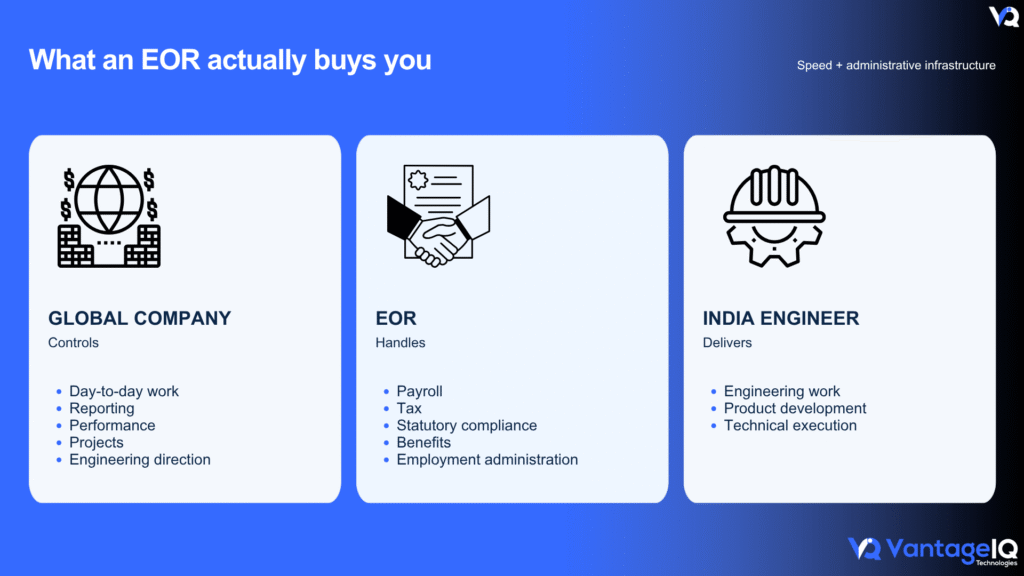
An EOR is the legal employer of record for statutory purposes: payroll, tax withholding, provident fund and insurance contributions, professional tax, and termination compliance. You retain full operational control, reporting lines, performance management, project direction. Compare that to a Professional Employer Organization (PEO), which requires you to already have an Indian entity and shares liability with you, or direct subsidiary incorporation, which gives you full ownership but also brings entity setup, banking, tax, payroll, compliance and ongoing administrative requirements. For testing a market or standing up an initial pod of one to twenty engineers, EOR is usually the right call. It just isn’t the endpoint.
The IP Trap Almost Nobody Reads the Fine Print On
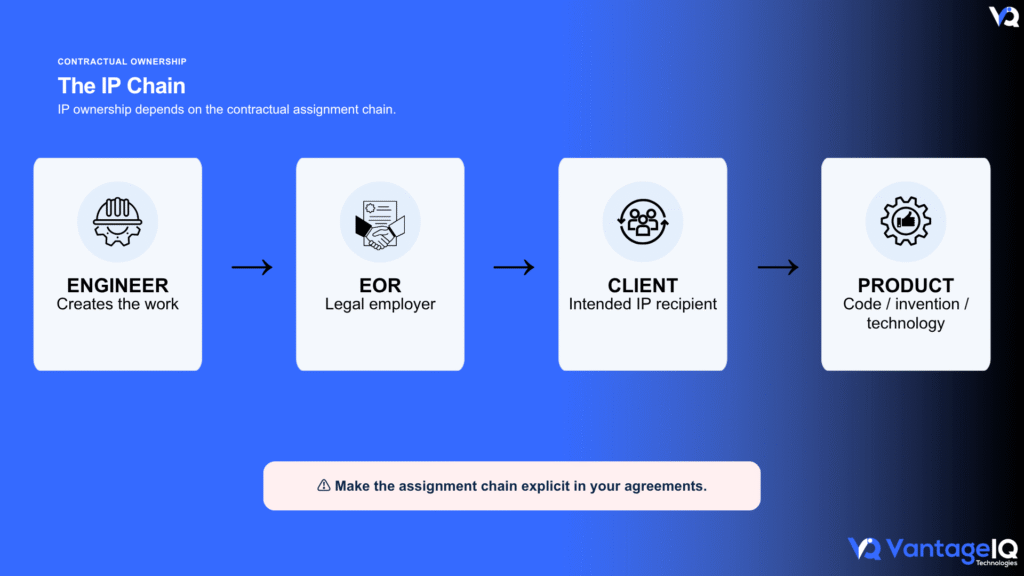
Here’s the issue foreign clients consistently miss: under Section 17(c) of the Indian Copyright Act, 1957, copyright in work created “in the course of employment” vests first in the employer and legally, that employer is the EOR, not your company, because your company has no Indian employment relationship with the developer. As legal commentary on the provision explains, a software engineer who writes code for a company during their employment has copyright ownership governed by the employment relationship, rather than rights automatically vesting in a third party that merely pays for the output. If your Master Services Agreement with the EOR doesn’t clearly establish the IP assignment chain from employee to EOR and from EOR to the client, ownership of software and other works can become much harder to establish or enforce than the client expects.
Patents require even more careful drafting. Unlike copyright, Indian patent law does not contain a simple employer-default rule that automatically transfers every employee invention to the employer. In Darius Rutton Kavasmaneck v. Gharda Chemicals Ltd., the Bombay High Court examined whether the employee was under a duty to invent as part of his employment. The case highlights why invention ownership should be addressed expressly in employment and EOR agreements, rather than assumed. One more thing worth flagging to any legal team drafting these contracts: Section 27 of the Indian Contract Act, 1872 generally makes restraints on lawful trade or profession void, and Indian courts have distinguished between restrictions operating during employment and those continuing after employment ends. Indian courts therefore require careful treatment of post-employment restrictions, so protection should come from appropriately drafted confidentiality, IP assignment, non-solicitation and other protective covenants rather than simply importing a standard US- or UK-style non-compete.
None of this is a reason to avoid EOR hiring. It’s a reason to make sure the assignment chain, worker to EOR to client, is airtight before anyone writes a line of code.
Where EOR Fees Stop Making Sense
The global EOR market is valued at roughly $6.82 billion in 2025, projected to reach $15.89 billion by 2035 at close to a 9.24% CAGR, growth driven largely by IT-sector cross-border hiring, which the same research pegs at around 31% of total EOR demand. That scale reflects real demand, but per-employee EOR fees are a rounding error for a five-person pilot team and a very different number once a team reaches meaningful scale. At that point, companies should model the recurring EOR cost against the cost and benefits of establishing their own Indian entity or Global Capability Center (GCC), which can provide greater direct control over IP, operations and long-term capability.
A Simple Way to Think About the Three Paths
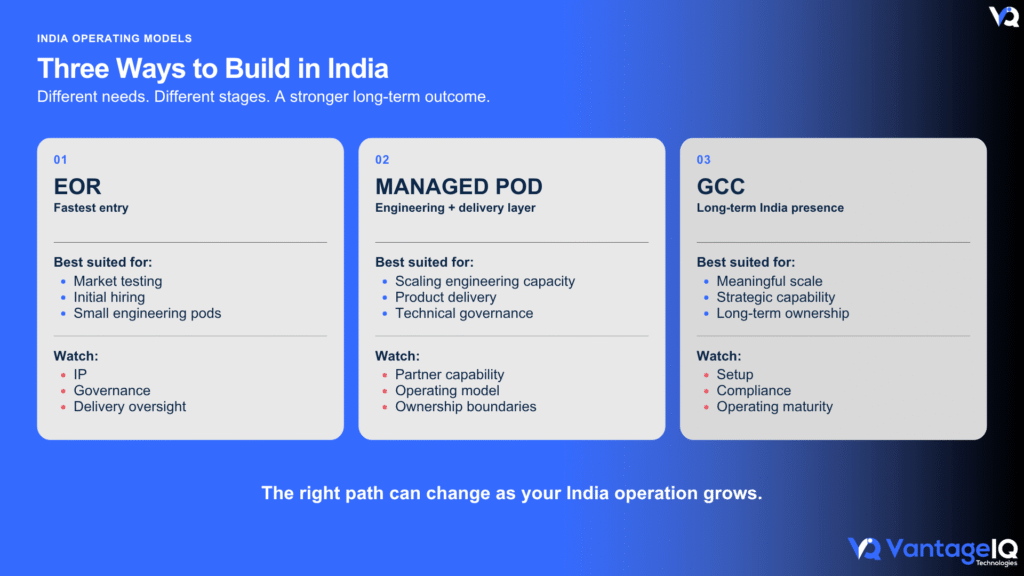
EOR: fastest path in, best for pilots and small pods, but IP ownership and technical delivery quality depend entirely on your contracts and your own technical oversight.
Direct GCC incorporation: slower and more capital-intensive up front, but gives you direct ownership and control over the Indian operation and can offer stronger long-term economics at meaningful scale.
Co-managed technical delivery pods: a middle path where administrative employment is handled by an EOR while a specialist partner like VantageIQ Technologies supplies the engineering leadership and delivery accountability a pure payroll provider was never built to offer.
VantageIQ Technologies doesn’t see EOR, GCC incorporation, and managed delivery pods as competing options, we see them as stages. Most clients start with an EOR to validate the market, add technical governance as the team grows, and transition to a fully-owned GCC once scale justifies it. What matters at every stage is getting the unglamorous parts right early: the IP assignment chain, the DPDP Act, 2023 and its implementing Rules, including the obligations that apply to data fiduciaries and other parties involved in processing personal data, and the compliance that makes the arrangement legally sound in the first place.
If you’re weighing how to bring engineering capacity online in India, a five-person pilot or the early architecture of a sovereign GCC, that’s the conversation VantageIQ Technologies is built to have.