"India has no AI play"
I keep hearing this argument in global financial market and business discussions lately, especially around the stock market rout and declining FII activity.
Their logic sounds simple and believable:
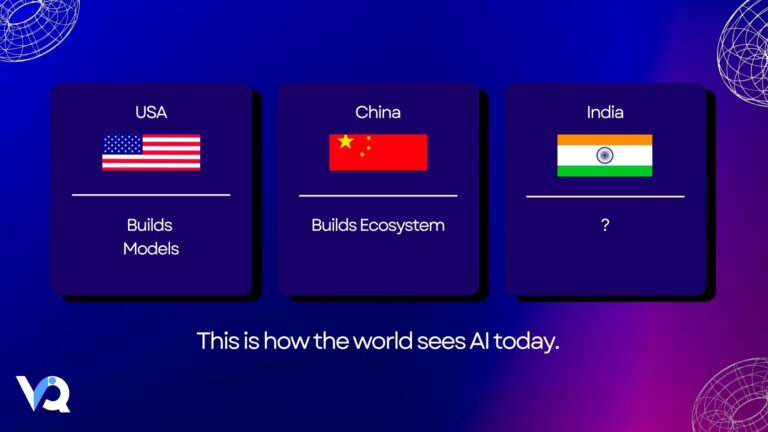
- The US is investing hundreds of billions into AI.
- China is building its own models and infrastructure.
- India isn’t building massive foundational models and hence has no companies to attract investment or capital.
- They also believe AI will disrupt many human jobs, especially manual ones, leading to large-scale job losses here in India.
So their conclusion is: India is spectacularly falling behind.
I think this conclusion ignores how technology waves (hype cycles) have actually played out in the past.
The Internet Era
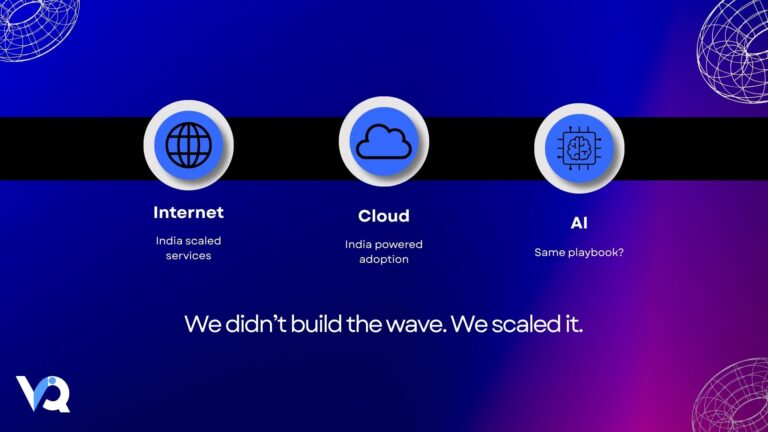
During the late-90s dot-com boom, the US was creating billion-dollar internet companies almost overnight. Amazon, Google, Yahoo, and countless others that dominate the tech world today were born in that era. India had none of them. Yet 25 years later, India became one of the largest technology service ecosystems in the world. Not by inventing internet infrastructure, but by building applications, services, and businesses on top of it.
Companies like Zoho, Freshdesk, Finacle, Druva, Chargebee, Postman and many, many others are great examples of that evolution.
The Mobile and Cloud Playbook
The same pattern repeated with mobile and cloud. India didn’t invent the smartphone or build a native OS. But engineers in India now build and maintain large parts of the mobile apps used by billions globally. Cloud followed a similar story. AWS, Microsoft Azure, and Google Cloud built the infrastructure, India did not, unlike Alibaba in China. But much of the world’s cloud migration, integration, and enterprise modernization has been powered by Indian engineers and IT companies. This year, India’s IT and technology services exports are expected to cross roughly $250–300 billion, contributing around 5–7% of GDP. That entire industry largely exists because India helped the world adopt technology at scale.
Apple Plays the Long Game
Interestingly, even Apple, one of the most valuable companies in the world, has largely stayed away from the cloud infrastructure race and AI hype cycle. Apple rarely rushes into new technology waves. Instead, it waits for the technology to mature and then integrates it deeply into the application layer of its ecosystem. AI in Apple products will likely appear incrementally across devices and software over the next decade, rather than as a standalone AI platform or LLM offering.
Why Hyperscalers Are Expanding in India
Today, companies like OpenAI, Anthropic, Google, and Microsoft are investing enormous sums into AI infrastructure. Most heavy hardware investments, data centers, GPUs, and compute clusters, are still happening in the US. Yet at the same time, these companies are expanding engineering teams and infrastructure presence in India.
One might wonder:
If AI can write code, and infrastructure can be built in the US, why invest in India?
Why?
A few obvious reasons:
- Access to one of the largest engineering talent pools in the world
- Lower cost of scaling engineering and product teams
- A massive and growing digital consumer market
- An ecosystem experienced in global technology implementation
- Most importantly, scale of consumers
- A market where companies can retain IP without significant concerns around reverse engineering
The Real Position
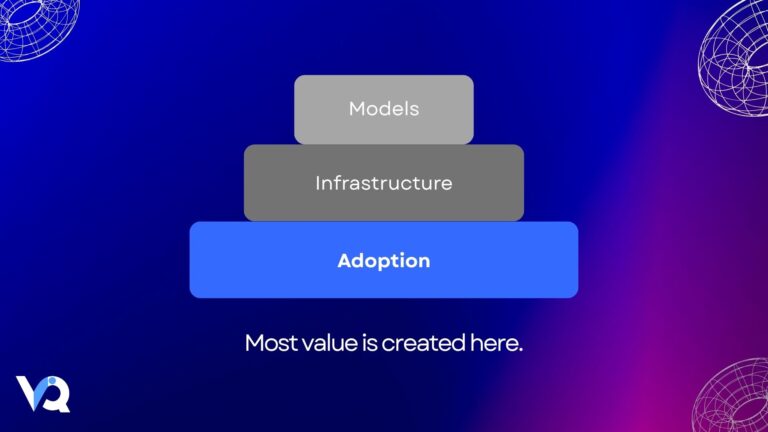
In my view, foundational models may be built by hyperscalers competing to stay relevant. But the global adoption layer requires engineering scale and India provides that at a lower investment base, which aligns with its current strengths and constraints.
Why China Is Taking a Different Route
China’s approach is understandably different. It prefers building its own foundational technology stacks because it does not want to rely on US-led platforms or intellectual property. That’s why China is investing heavily in its own models, chips, and AI ecosystems. Strategically, that makes sense.India’s approach has historically been more open. India has been comfortable building value on top of global platforms, whether they originate in the US or elsewhere. India truly believes in Vasudhaiva Kutumbakam.
And that openness has helped Indian companies integrate deeply into global technology ecosystems. Sometimes, reinventing the wheel isn’t necessary to create value.
The Economic Reality
There’s also a practical reason behind this: THE CONSTRAINTS. Building frontier AI models and infrastructure requires tens or even hundreds of billions of dollars in sustained investment. Countries like the US and China, with much larger GDPs (over $20 trillion), can allocate that kind of capital to a single technology race.
India’s GDP is growing rapidly (around $4 trillion), but it still has competing priorities—basic infrastructure, healthcare, manufacturing, energy, education, and more. Spending hundreds of billions purely to own AI IP may not be the most rational allocation of capital at this stage. But that may change.
If India’s economy grows to $15–25 trillion over the next couple of decades, the scale of available capital will look very different. And with that, ambitions around building foundational technologies could evolve.
The Opportunity Right Now
For now, the world is building incredible AI technologies. And there is enormous opportunity in making those technologies useful for businesses and society. Even in our work at VantageIQ Technologies, most client conversations around AI are not about building complex solutions, but about finding simple, overlooked, or previously infeasible solutions.
For example, Kaushal, an AI skill metric we built for organizations with thousands of employees. These discussions focus on applying AI within real businesses, spending realistic amounts while creating measurable economic impact.
The Bigger Question
Which brings me back to the bigger question: Instead of asking:
“Why isn’t India building the biggest AI models?”
Maybe the more interesting question is: Who will help the world actually use AI?