If your attrition rate dropped this year, you probably felt relieved.
I understand. Fewer resignations. Fewer backfills. A calmer HR dashboard.
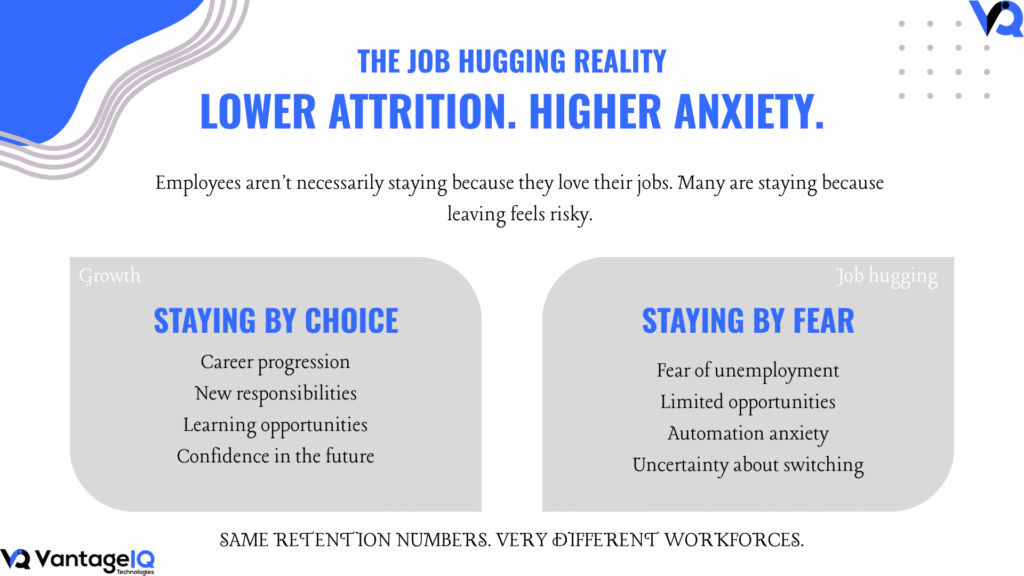
But I’d ask you to look again. Some of that calm isn’t commitment. It’s fear.
There’s a name for it now. Korn Ferry used the phrase “job hugging” in August 2025 to describe people holding onto their jobs for dear life. It started as a consultancy’s phrase, not an academic term. The behaviour behind it is very real.
What job hugging actually looks like
People stay. But they stay quietly.
They do what’s in the job description. They skip the stretch project. They turn down the promotion. They nod in meetings and check out in their heads.
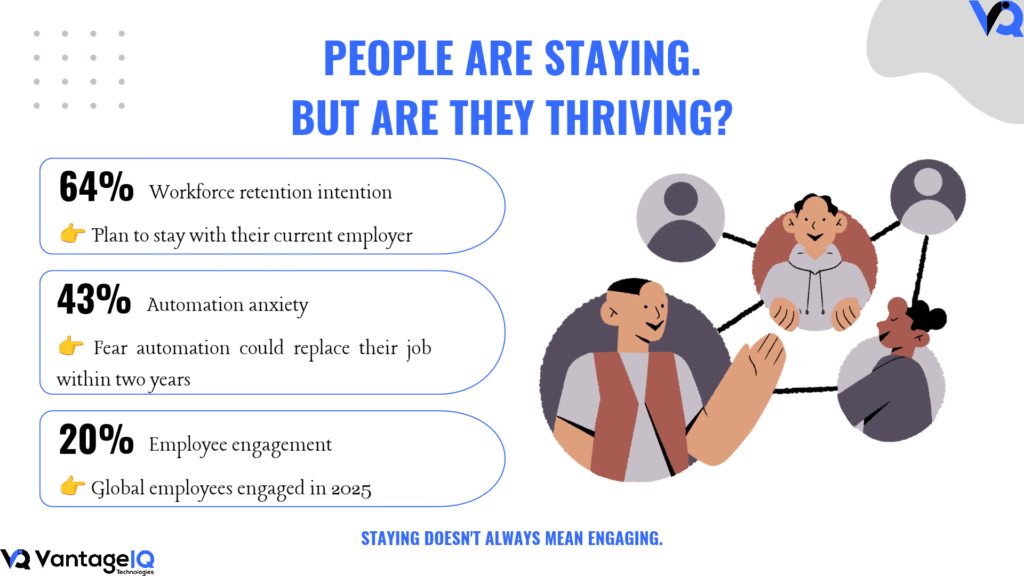
The numbers back this up. ManpowerGroup’s 2026 Global Talent Barometer found that 64% of workers plan to stay with their current employer. It also found that 43% fear automation could replace their job within two years.
Growth is missing too. Korn Ferry, citing SurveyMonkey data, reports that 43% of workers and 48% of experienced professionals say their current job offers few or no growth opportunities.
That isn’t loyalty. It’s people waiting for a safer moment to move.
The market is quiet. The reason matters.
In the US, the quits rate was 1.9% in August 2026, down from a peak of 3.0% in late 2021. People simply aren’t leaving.
The usual explanation is money. Switching jobs stopped paying. In mid-2025, that was true. The Atlanta Fed’s tracker briefly showed switchers and stayers getting almost identical raises.
But the story has moved on. By September 2026, the same tracker showed switchers at 4.7% and stayers at 3.4%. (Monthly readings are noisy, so treat that as a direction.)
So the pay penalty for staying is back. And people still aren’t moving.
My read: this is no longer a maths problem. It’s a confidence problem. People are staying because leaving feels dangerous, not because staying pays.
The hidden cost of job hugging
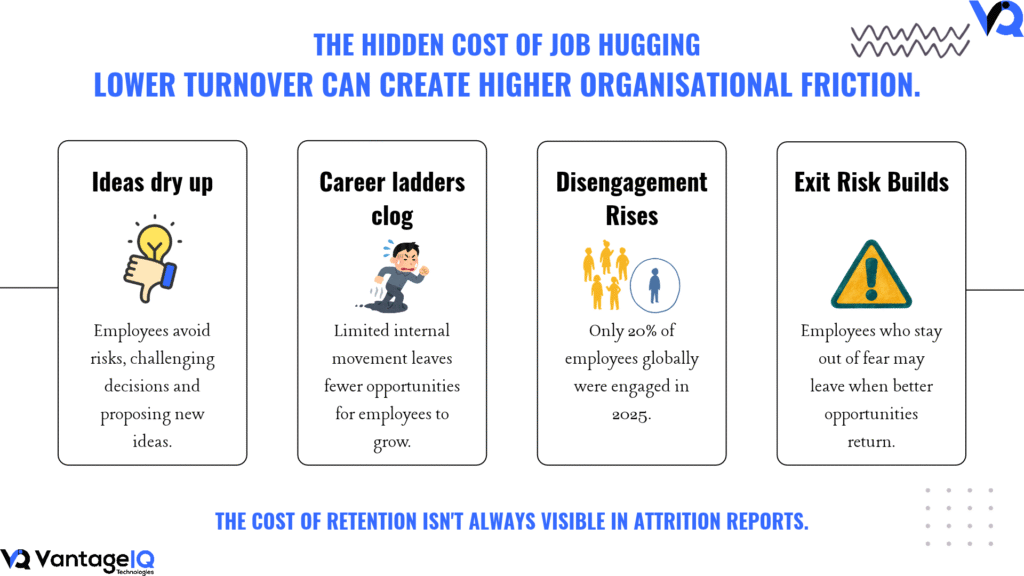
Low turnover looks healthy. It can hide four problems.
Ideas dry up. People protecting themselves don’t challenge the status quo. They don’t pitch the risky idea.
Ladders clog. When nobody moves up or across, the people behind them have nowhere to go.
Disengagement gets expensive. Gallup’s 2026 report found that only 20% of employees worldwide were engaged in 2025, the lowest since 2020, costing an estimated $10 trillion in lost productivity.
The exit wave is coming. Korn Ferry’s Dennis Deans expects voluntary attrition to rise once the job market improves. Fear holds people in place. It doesn’t change how they feel.
Job hugging in India: two problems at once
India doesn’t fit the global script neatly.
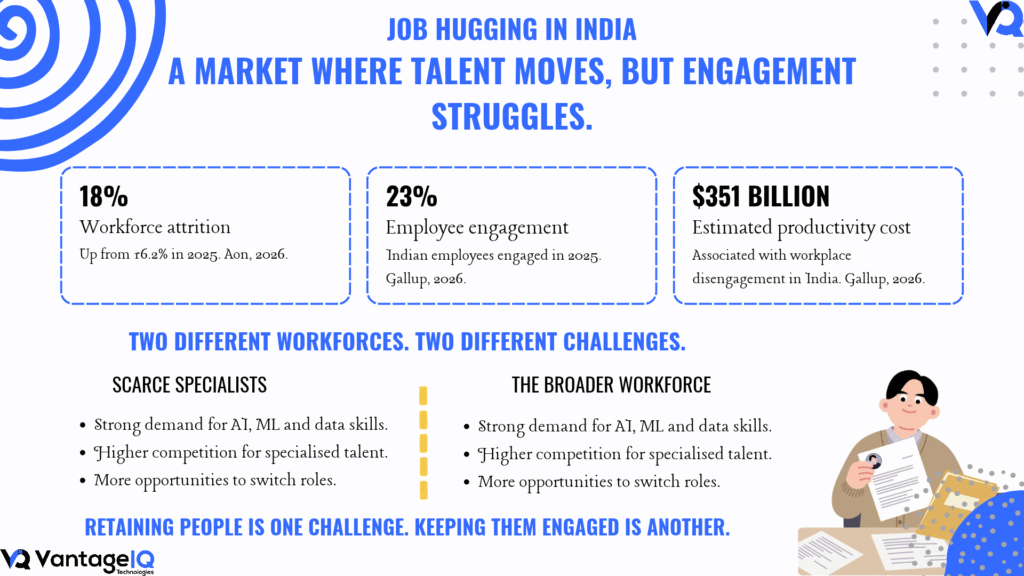
Aon’s 2026 survey found that overall attrition rose to 18%, from 16.2% in 2025. At the same time, AI, machine learning and data science roles command a pay premium of roughly 10%.
On the surface, India doesn’t look like a job-hugging market.
But look closer.
ManpowerGroup’s 2026 India Talent Barometer found that nearly half of India’s workforce is choosing to job hug, even as many continue exploring other opportunities.
Gallup adds another dimension. Just 23% of Indian employees were engaged at work in 2025, a seven-percentage-point decline from the previous three-year rolling average. The estimated annual productivity cost of workplace disengagement in India is $351 billion, nearly 9% of GDP.
These findings measure different aspects of the workforce, but together they point to an uncomfortable reality: high attrition and job hugging can coexist.
Some talent is moving because demand for specialised skills remains strong. Others are staying because uncertainty makes leaving difficult. And many who stay may not be particularly engaged.
That means Indian leaders face two challenges at once: retaining the AI talent they can least afford to lose, while ensuring the rest of their workforce doesn’t quietly disengage.
Attrition numbers alone won’t show you the second problem.
Why AI makes job hugging worse
AI adoption is not just a technology challenge. It’s a workforce confidence challenge.
Here’s the part that matters most to us.
ManpowerGroup found that regular AI use rose to 45% of workers, while their confidence in using technology fell by 18%. People are using AI more and trusting themselves less.
A frightened workforce doesn’t experiment. It doesn’t flag what’s broken. It doesn’t build the new workflow.
I believe this is the real bottleneck in enterprise AI. The best model in the world sits unused if the team meant to use it is quietly worried it’s their replacement.
What leaders can do about job hugging
None of this needs a big programme. It needs honesty and better visibility.
- Track movement, not just exits. Look at long tenure with no lateral or upward move. Look at falling participation in learning. Run stay interviews, not just exit interviews.
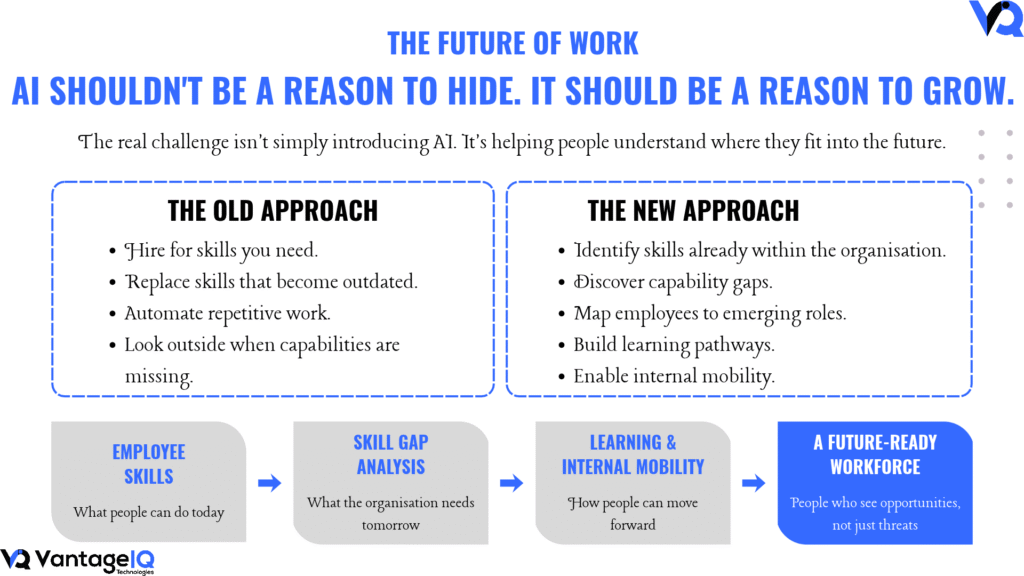
- Make skills visible. You can’t move people you can’t see. Most organisations don’t know what their people can actually do, so mobility stays a matter of who knows whom. That’s where skill intelligence makes a difference. It helps organisations identify existing capabilities, uncover skill gaps, and create clearer internal growth pathways. We’ve explored this in Skill Intelligence: The Missing Layer in Your Talent Strategy.
- Make internal moves safe. Short stretch assignments, cross-team projects, trial periods that don’t put someone’s role at risk. It pays off. LinkedIn reports that employees at companies with high internal mobility stay 60% longer.
- Be honest about AI. Say what’s changing and what isn’t. Train people before you automate, and tie learning to real roles.
Where we stand at VantageIQ Technologies
We build enterprise AI and skill intelligence. So I see job hugging from two sides.
As a business leader, I’d rather have a team that stays because it’s growing than one that stays because it’s afraid. Retention should be earned, not defaulted into.
As a technology partner, I know AI only works when people lean in. That’s why we built Kaushall, our AI-driven skill intelligence platform. It’s designed to give leaders an evidence-based view of skills across thousands of employees, so growth can be spotted, not guessed at.
If we do our job well, the people inside our clients’ organisations should see AI as a ladder, not a threat.
One question to ask this week
If the job market turned tomorrow, who on your team would still choose to stay?
If you can’t answer with confidence, your retention numbers aren’t telling you the whole story.
Want to see where job hugging might be hiding in your organisation?