

Not Everyone Building AI Will Survive It
The graveyard is already filling up. 1,803 enterprise tech startups closed between 2023 and 2025. The next wave of casualties is already determined, we just don’t know the names yet.
Let’s Start with the Uncomfortable Truth
India has over 3,100 AI startups. That sounds like momentum. And it is. But it is also a selection problem in disguise. Because most of these startups are not building anything truly defensible within the AI application layer in India.
They are building wrappers.
Thin interfaces on top of APIs. Chatbots rebranded as enterprise solutions. Productivity tools solving problems that don’t hurt enough to pay for. The market is about to correct this.
And it will not be gentle.
01 - The Graveyard Is Already Filling Up
Between 2023 and 2025, 1,803 enterprise tech startups in India shut down. (Tracxn / Inc42 Startup Shutdown Report 2025)
AI startup funding in India dropped 53% year-on-year — from $305.9 million to $143.6 million, even as global AI funding crossed $110 billion. (Inc42 Indian Tech Startup Funding Report 2025; CB Insights Global AI Funding Data)
- Well-funded companies collapsed.
- YC-backed startups shut down mid-year.
- Even heavily capitalised ventures failed to survive real-world deployment. (Inc42, Economic Times Startups, 2025)
This is not bad news. This is the market doing its job.
It is eliminating ideas that looked good in pitch decks but failed in production, especially in the AI application layer in India, where execution matters more than demos.
The Profile of a Company That Won’t Survive
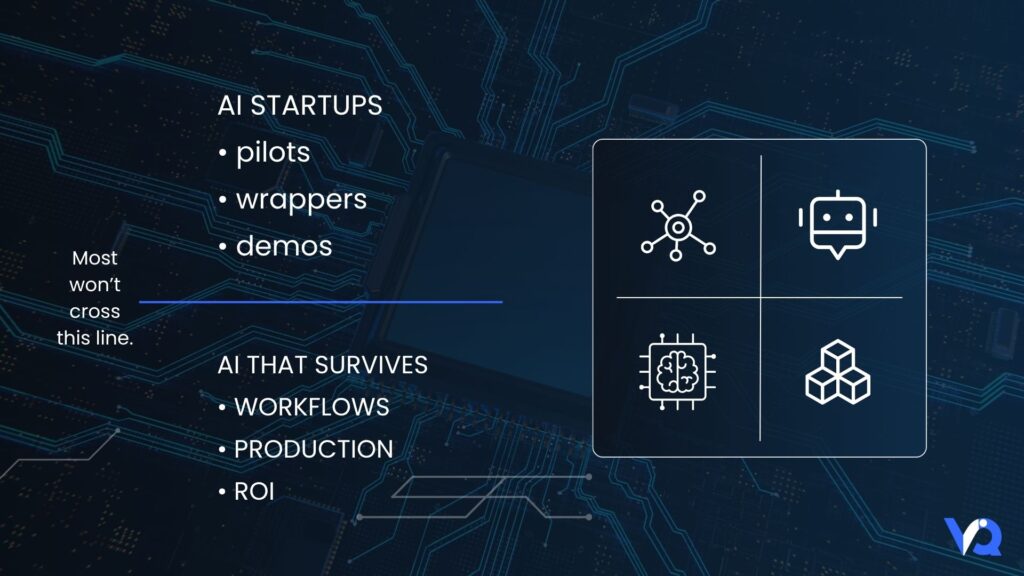
Most failing startups follow a predictable pattern:
- Built an “AI for everything” product with no owned workflow
- Revenue depends on pilots, not production deployments
- Product can be replicated in weeks using the same APIs
- No proprietary data, only prompts on public models
- Cannot prove ROI in customer-specific metrics
- Built in English for a market that thinks in multiple languages
Investors already understand this shift. Capital is no longer chasing demos. It is chasing outcomes, integration, and defensibility.
02 - Why “Pilots” Are the Biggest Red Flag
There is one phrase that should immediately raise concern:
“We have multiple enterprise pilots running.”
A pilot is not revenue.
A pilot is not retention.
A pilot is not dependency.
A pilot is curiosity. And curiosity expires.
The Shift Defining the AI Application Layer in India
India’s enterprise AI spending is expected to grow from $11 billion in 2025 to $71 billion by 2030. (NASSCOM AI Adoption Report 2025; BCG AI in India Outlook)
But that growth is not going toward experimentation.
It is going toward:
- Systems embedded in workflows
- Tools that run daily operations
- Infrastructure that cannot be removed
Enterprises are no longer asking: “Can AI do this?”
They are asking: “Which AI system can we rely on long-term?”
The Reality Most Founders Ignore
95% of enterprise AI pilots never reach production. (MIT NANDA Report on AI in Business, 2025). Not because the technology fails. Because the product never becomes essential. It sits alongside the workflow. Not inside it. And when budgets tighten, it disappears.
03 - The Three Questions That Decide Survival
In the AI application layer in India, survival comes down to three simple but brutal questions. If you cannot answer them, the market will answer for you.
Q1. Do You Own Data Your Competitors Cannot Access?
Not scraped data.
Not API outputs.
Real data:
- Collected from real users
- Embedded in real workflows
- Accumulated over time
This is the only moat that compounds in the AI application layer.
Q2. Are You Inside the Workflow or Just Around It?
If your product stops working tomorrow:
- Does your customer’s work stop?
If not, you are optional. Optional products don’t survive. Infrastructure does.
Q3. Can You Prove ROI in Business Terms?
Not vague improvements. Not generic efficiency claims.
Real impact:
- Fraud reduced by X%
- Processing time reduced from days to hours
- Output increased significantly
If you cannot quantify value, you don’t have a product.
You have a demo.
04 - What Surviving AI Companies in India Will Look Like
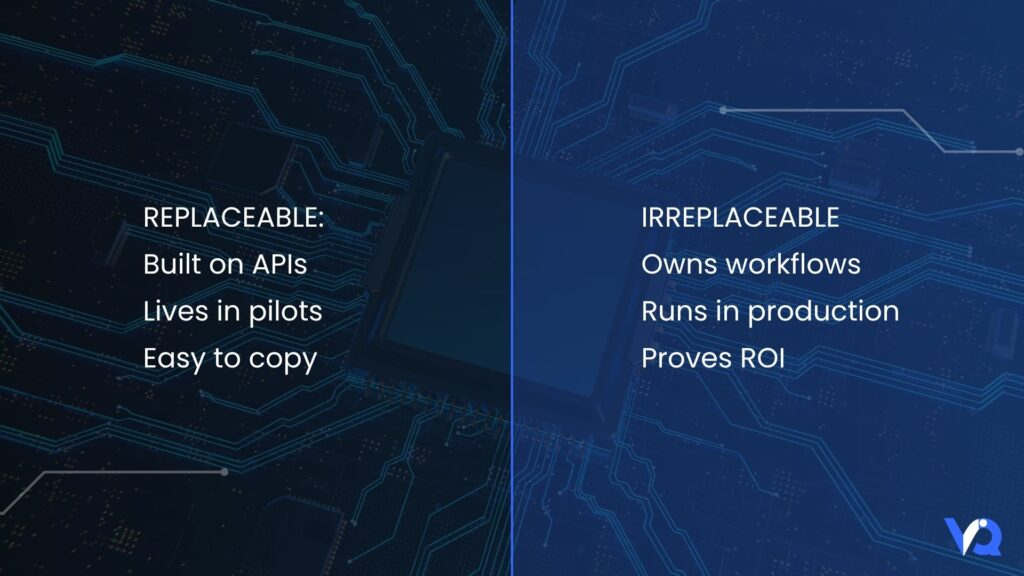
The winners in the AI application layer in India will look very different from today’s majority. They will not be broad. They will be precise.
What Survival Actually Looks Like
01 – Narrow Workflow Ownership
Not “AI for healthcare” → “AI for specific diagnostic workflows in resource-constrained environments”
02 – Proprietary Data That Compounds
Every deployment improves the model. Every customer strengthens the moat.
03 – Production Revenue, Not Pilot Pipelines
Revenue comes from systems already in use, not experiments.
04 – Measurable, Defensible ROI
Clear business impact that decision-makers can justify.
05 – Language-Native Systems
Built for how users actually think, not translated later.
This is especially critical in the AI application layer in India, where linguistic diversity directly impacts adoption.
05 - The Real Opportunity in the AI Application Layer in India
India will not win the AI race by building the most powerful models. It will win by building the most effective applications.
Across:
- Real workflows
- Real industries
- Real constraints
- Real users
At massive scale.
But this opportunity is not guaranteed.
- Market size does not ensure success
- Talent does not ensure execution
- Funding does not ensure survival
The difference comes down to one thing:
The discipline to go narrow, go deep, and build something irreplaceable.
Final Thought
The window for building in the AI application layer in India is open. But not for long. The market won’t remember who built first. It will remember who built something that couldn’t be replaced.
At VantageIQ Technologies, we focus on exactly that. Building AI systems that move beyond pilots, into production, with clear, measurable ROI. Because in the end, AI doesn’t win on demos. It wins when it becomes indispensable.
You can watch the shift.
Or you can build for it.