

Compliance Checker: A reusable enterprise AI accelerator that helps organizations automate compliance validation, reduce regulatory risk exposure, and build transparent, audit-ready compliance processes faster.
Turning compliance from a periodic review into an operational capability.
Regulations are becoming more complex. Businesses are moving faster. And compliance teams are expected to keep pace with both.
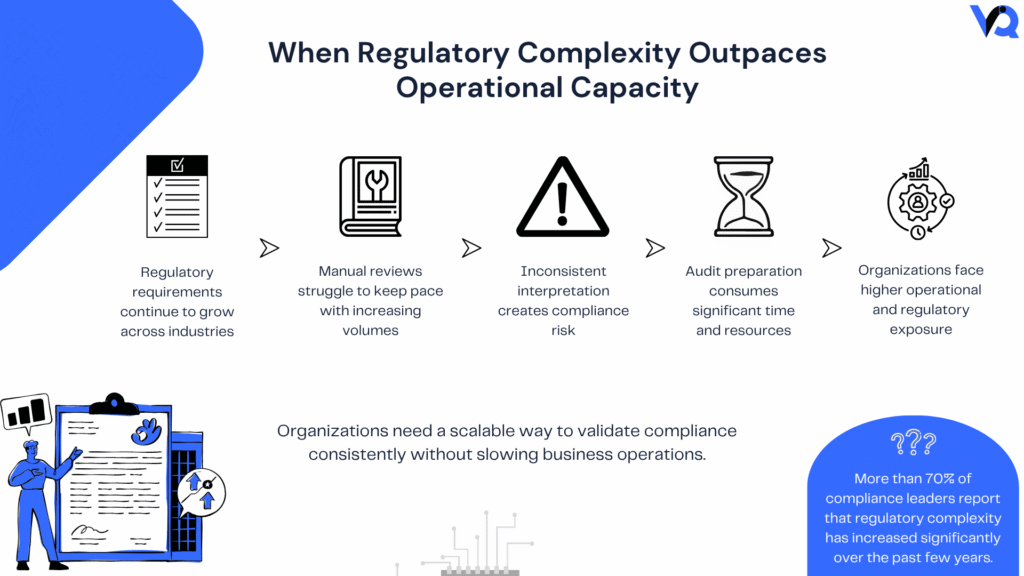
Across industries, organizations must validate thousands of transactions, documents, approvals, certifications, disclosures, and operational decisions every day. Yet many compliance processes still rely on manual reviews, spreadsheets, email approvals, and retrospective audits.
As the volume of regulatory obligations grows, maintaining consistency becomes increasingly difficult. Teams interpret requirements differently, reviews take longer, and audit preparation consumes valuable time and resources.
This is why forward-looking organizations are rethinking compliance. Instead of treating it as a periodic activity, they are embedding compliance validation directly into operational workflows.
What Is “Compliance Checker”?
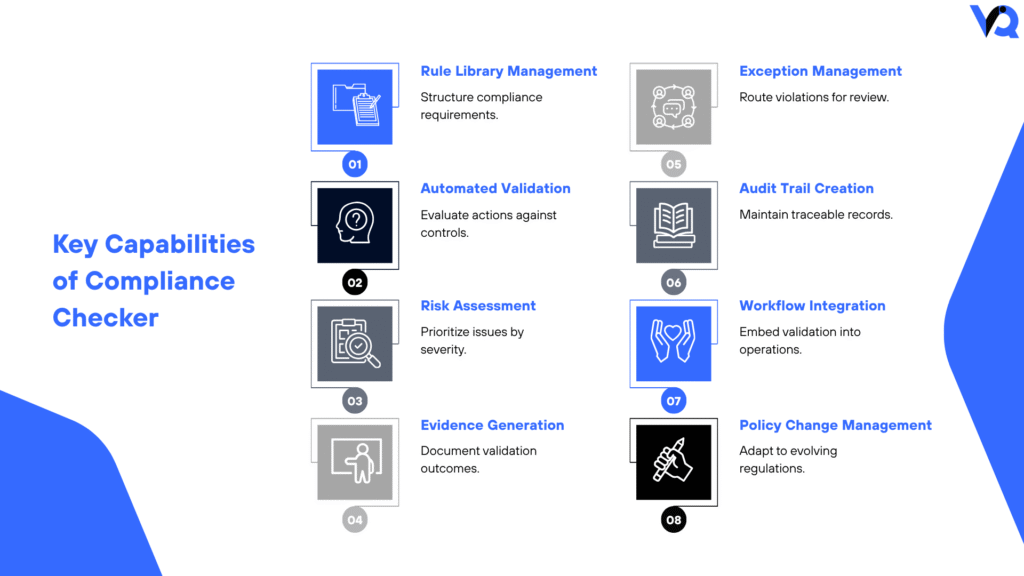
Compliance Checker is a reusable enterprise AI accelerator that helps organizations build automated compliance validation capabilities across documents, transactions, workflows, and operational processes.
Rather than creating compliance validation systems from scratch for every initiative, the accelerator provides pre-engineered architectural patterns, governance controls, workflows, audit mechanisms, and reusable implementation foundations that can be adapted to different regulatory environments.
As part of VantageIQ’s Knowledge Engine layer, Compliance Checker enables organizations to evaluate actions against policies, controls, and regulatory requirements while maintaining traceability, governance, and audit readiness.
Why Traditional Compliance Models Are Under Pressure
Regulatory requirements rarely remain static.
Organizations must continuously adapt to changing regulations, evolving internal policies, new reporting obligations, and increasing scrutiny from regulators, auditors, customers, and stakeholders.
According to Thomson Reuters, regulatory change management continues to be one of the most significant challenges facing compliance functions globally. At the same time, compliance teams are expected to support business growth without slowing operational execution.
This creates several challenges:
- Manual validation processes struggle to scale.
- Compliance reviews become operational bottlenecks.
- Inconsistent interpretation creates risk.
- Audit preparation consumes significant effort.
- Control gaps are often identified after the fact.
As compliance requirements expand, organizations need a more consistent and scalable way to validate adherence across the enterprise.
Turning Regulatory Requirements into Operational Controls
Compliance Checker provides a reusable framework for transforming regulatory requirements and internal controls into operational validation capabilities.
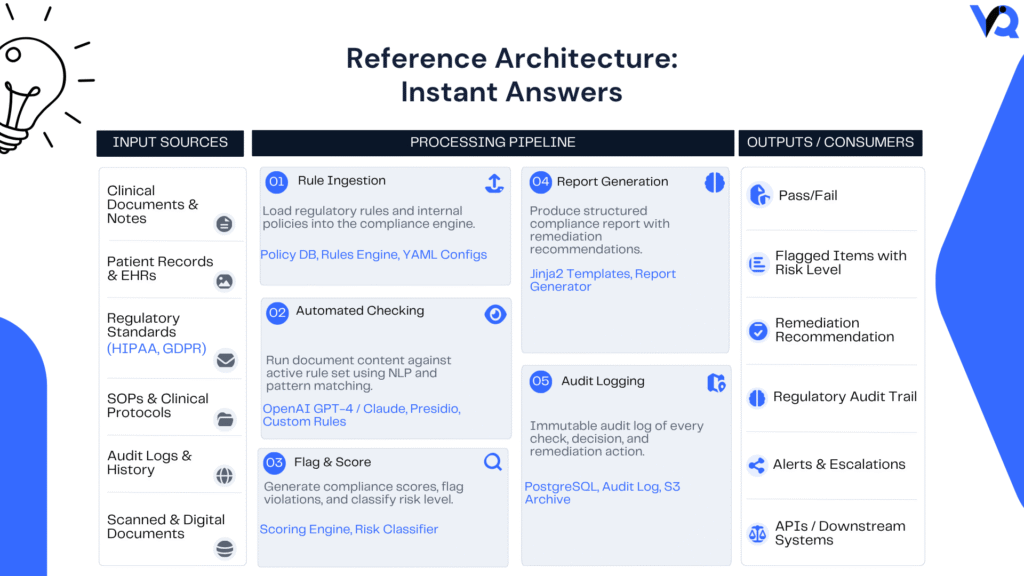
What the Accelerator Enables
- Rule Library Management — Structure regulatory requirements and internal controls into reusable validation frameworks.
- Automated Compliance Validation — Evaluate documents, workflows, approvals, and transactions against defined controls.
- Risk & Severity Assessment — Prioritize findings based on configurable risk thresholds.
- Evidence Generation — Capture validation outcomes and supporting rationale automatically.
- Exception Management — Route warnings, violations, and edge cases for review.
- Audit Trail Creation — Maintain traceable records of validation activities and outcomes.
- Workflow Integration — Connect compliance checks directly into operational systems and business processes.
- Policy Change Management — Support updates as regulations and internal policies evolve.
Real-World Use Cases
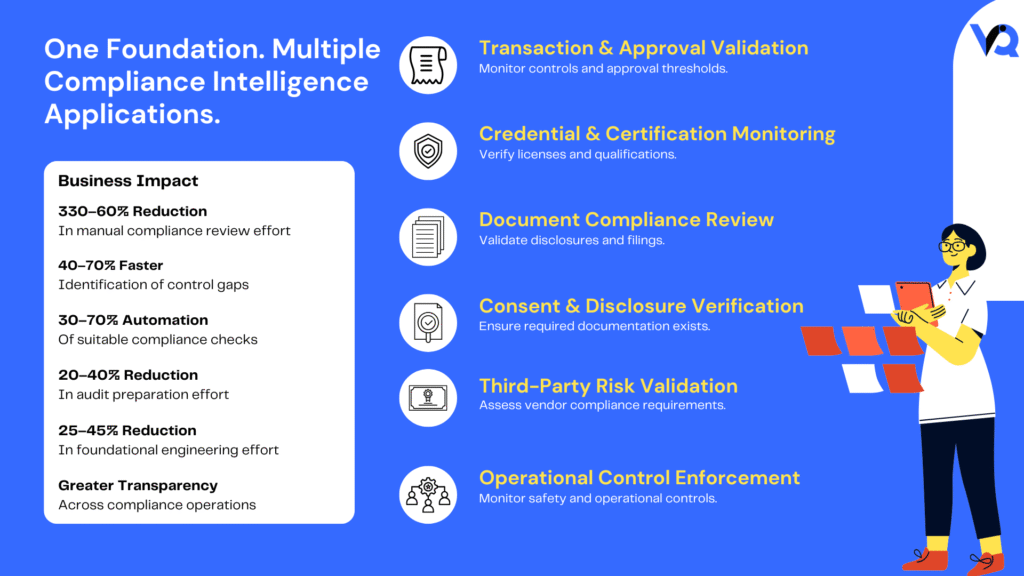
Transaction & Approval Validation
Financial institutions can validate approval limits, segregation-of-duty requirements, and transaction controls before actions are completed, reducing operational and regulatory risk.
Credential & Certification Monitoring
Healthcare providers, consulting firms, and professional services organizations can verify licenses, certifications, and qualifications before critical activities are performed.
Document Compliance Review
Organizations can validate contracts, disclosures, filings, and policy documents against required standards before publication or submission.
Consent & Disclosure Verification
Healthcare, financial services, and insurance organizations can ensure required disclosures, consent forms, and privacy notices are properly executed and documented.
Third-Party Risk Validation
Vendor onboarding processes can automatically validate compliance requirements, contractual obligations, certifications, and risk controls before engagement.
Operational Control Enforcement
Manufacturing, energy, and logistics organizations can validate safety procedures, operational controls, and environmental requirements as part of everyday operations.
The Measurable Outcomes
Organizations implementing policy interpretation capabilities often focus on three goals: reducing manual effort, accelerating policy adoption, and improving consistency across teams.
Indicative outcomes from accelerator-led implementations include:
Metric | Typical Improvement |
Manual compliance review effort | 30–60% reduction |
Time to identify control gaps | 40–70% faster |
Routine compliance checks automated | 30–70% of suitable checks |
Audit preparation effort | 20–40% reduction |
Foundational engineering effort | 25–45% reduction |
Beyond efficiency gains, the larger value comes from consistency and transparency. Compliance validation becomes embedded within business processes, creating a defensible and repeatable approach that scales across teams, systems, and regulatory environments.
Industries Where Compliance Is Mission-Critical
Compliance Checker is particularly valuable for organizations operating in regulated environments where validation, documentation, and governance are critical.
- Financial Services — Internal controls, AML processes, regulatory reporting, and transaction monitoring.
- Healthcare — HIPAA compliance, practitioner credential verification, consent management, and clinical governance.
- Insurance — Claims processing, policy administration, and regulatory oversight.
- Public Sector — Policy enforcement, citizen services, and administrative compliance.
- Legal Services — Filing accuracy, ethical compliance, and matter management controls.
- Manufacturing & Energy — Safety standards, environmental requirements, and operational control validation.
Making Compliance a Business Capability
Organizations that consistently manage regulatory complexity treat compliance as part of operational design rather than a standalone function.
They build systems that validate requirements continuously, generate evidence automatically, and maintain visibility across the compliance lifecycle.
Compliance Checker provides the reusable foundation for building those capabilities faster. By combining automated validation, auditability, governance, and workflow integration, organizations can reduce compliance friction while improving confidence in operational decision-making.
As regulations continue to evolve, the ability to validate compliance consistently and at scale will become an increasingly important competitive advantage.
Related Accelerators
- Policy Translator
- Instant Answers
- Document Intelligence