


In Chapter 2, we dismantled the myth that bigger is always better, introducing the Taxonomy of Scale. We established that value isn’t driven by how many desk chairs you buy, but by the strategic complexity your local team actually owns.
Now let’s look at how this plays out in the wild.
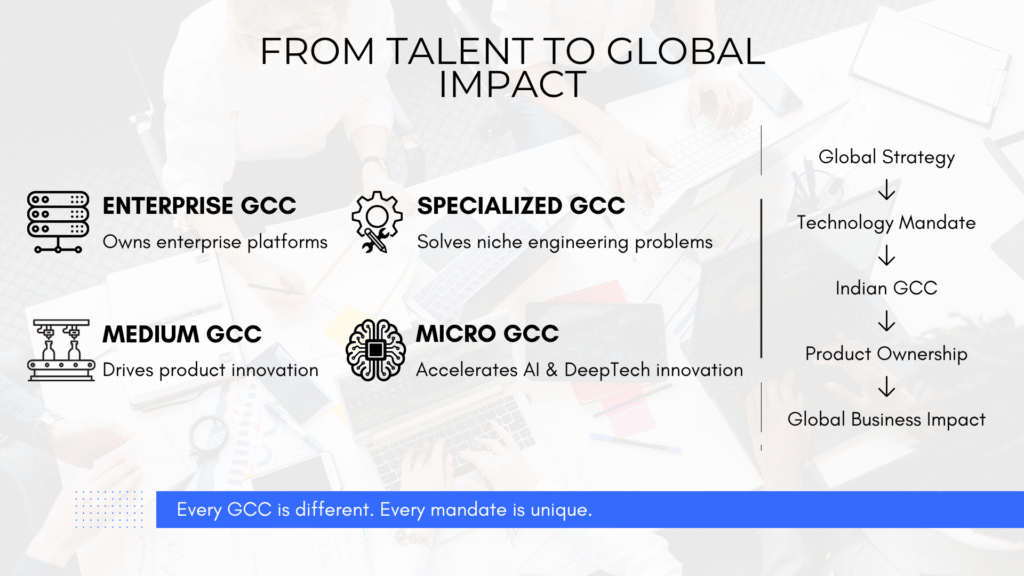
When you strip away glossy recruitment brochures and C-suite PR releases, what does a winning center actually look like across each of the four taxonomy tiers? How do Fortune 100 giants, mid-market innovators, specialized tech firms, and hyper-lean AI labs structure their operations to turn local talent into global business impact?
Here is the real-world playbook of how market leaders execute across all four categories and how they leverage India’s primary tech corridors to get it done.
1. Enterprise GCCs (10,000+ Staff): Owning the Enterprise Core
At the enterprise level, a GCC is no longer a satellite office; it is a co-equal global headquarters. These massive centers run core technological, operational, and financial infrastructure where a single hour of downtime can cost tens of millions of dollars.
Case Studies in Action
- Walmart Global Tech (Retail & Supply Chain Ownership):
- The Strategy: Walmart shifted away from vendor outsourcing to build a direct digital engineering footprint. Its team of over 15,000 tech professionals owns the core platform architecture for Walmart’s global omnichannel checkout, last-mile delivery algorithms, and predictive supply chain engines.
- Execution Footprint: Anchored out of key technology hubs in Bengaluru and Chennai, with specialized supply chain technology teams operating in Gurugram (Delhi-NCR).
- JPMorgan Chase (Global Banking & Risk Infrastructure):
- The Strategy: What started as a transactional processing hub in the early 2000s evolved into JPMorgan’s largest technology and risk footprint in Asia-Pacific. Indian teams build real-time payment rails, quantitative risk models, and automated AI fraud detection systems used globally.
- Execution Footprint: Spans multi-functional campuses across Mumbai, Hyderabad, and Bengaluru.
- Goldman Sachs (High-Frequency Trading & Quantitative Engineering):
- The Strategy: Operating its largest tech hub outside New York, Goldman Sachs relies on local quants and software engineers to develop high-frequency algorithmic trading platforms, ledger systems, and global regulatory engines.
- Execution Footprint: Centered in Bengaluru’s tech corridors, with corporate integration extending through Mumbai.
2. Medium-Sized GCCs (1,000 – 10,000 Staff): The Agile Scale Powerhouses
Medium-sized centers represent high velocity. They avoid the bureaucratic weight of 20,000-person sites while maintaining deep engineering scale. Their primary focus is sector-specific R&D, product ownership, and digital transformation.
Case Studies in Action
- AstraZeneca (The Insourcing Pivot & Life Sciences AI):
- The Strategy: In 2014, AstraZeneca flipped its operating model from 80% outsourced vendor reliance to 70% direct in-house management. Its Indian facility grew into its primary global innovation hub, where data science teams leverage AI protein modeling to speed up early-stage drug discovery by 30% to 40%.
- Execution Footprint: Headquartered out of a primary technology center in Chennai, with strategic software nodes in Bengaluru.
- Uber India (Core Marketplace & Safety Engineering):
- The Strategy: Far from a regional driver-support desk, Uber’s Indian engineering teams own critical components of the global app—including rider safety toolkits, driver onboarding workflows, and real-time surge pricing algorithms used across 70+ countries.
- Execution Footprint: Co-anchored across engineering facilities in Bengaluru and Hyderabad.
- Amdocs India (Cross-Functional Matrix Integration):
- The Strategy: Amdocs ensured that every global business unit—from R&D to active client services—had direct skin in the game in India. Local leads own telecom-specific AI architectures, taking products from initial concept directly into global deployment.
- Execution Footprint: Operates major engineering campuses in Pune and Gurugram (Delhi-NCR).
3. Small & Specialized GCCs (100 – 1,000 Staff): Deep Domain Mastery
Small GCCs prove that domain depth beats headcount every time. These hubs focus on specific technology stacks, cloud modernizations, or proprietary software platforms where specialized talent matters far more than desk volume.
Case Studies in Action
- Collins Aerospace (Avionics & Embedded Flight Systems):
- The Strategy: Collins bypasses generic IT support entirely. Its specialized Indian engineering teams focus on flight control software, cabin systems validation, and next-generation avionics design.
- Execution Footprint: Highly specialized engineering facilities operating in Bengaluru and Hyderabad.
- Wayfair India (Catalog Intelligence & Visual Commerce):
- The Strategy: E-commerce giant Wayfair launched a lean, domain-focused technology center designed to take end-to-end ownership of catalog intelligence systems, supplier onboarding portals, and 3D visual rendering engines.
- Execution Footprint: Embedded within Bengaluru, drawing directly from the region’s deep retail-tech and visual AI talent pools.
- Flutter Entertainment (High-Concurrency Real-Time Analytics):
- The Strategy: The global gaming and sports betting operator established a specialized tech hub focused on low-latency transaction processing, high-concurrency cloud architecture, and automated compliance engines.
- Execution Footprint: Established in Hyderabad, leveraging the region’s strong platform engineering base.
4. Micro & Nano GCCs (Fewer than 100 Staff): The Lean Hyper-Specialists
The fastest-growing segment in the GCC market isn’t the mega-campus—it is the Micro GCC. These compact teams of 15 to 90 specialist engineers allow mid-market firms and scaleups to run high-end R&D, pre-silicon validation, or agentic AI workflows without building massive corporate bloat.
Case Studies in Action
- Pre-Silicon Semiconductor Outposts: DeepTech and hardware scaleups build compact 15-to-30-person engineering teams in Bengaluru and Noida (Delhi-NCR) to handle pre-silicon validation, System-on-Chip (SoC) design, and firmware integration—leveraging the fact that India holds roughly 20% of the world’s chip design talent.
- Offshore FinTech & Treasury Pods: Financial scaleups build hyper-lean 20-person quantitative risk and algorithmic trading pods in GIFT City (Ahmedabad and Gandhinagar, Gujarat), taking advantage of competitive tax safe harbors and zero-capital-control regulations while tapping into talent from nearby Mumbai.
- Industrial IoT & Embedded Software Outposts: European automotive and manufacturing scaleups establish agile 25-person R&D pods in Pune and Chennai focused on digital twin simulation, predictive asset maintenance, and automotive telemetry.
- MedTech Analytics & ECG Engineering Labs: Mid-sized medical device manufacturers run specialized 30-person engineering pods in Hyderabad and Kochi dedicated to real-time telemetry processing, embedded software, and FDA regulatory data pipelines.
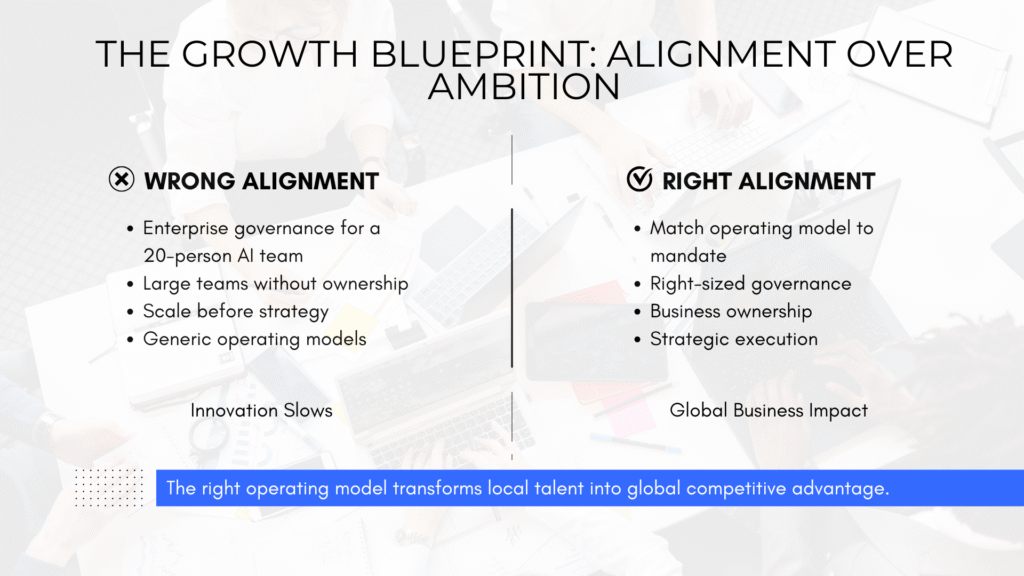
The Growth Blueprint: Alignment Over Ambition
Across all four tiers, the lesson from market leaders is identical: Your operating model must match your strategic intent.
Trying to run a 30-person AI innovation lab using the rigid HR policies of a 15,000-person GBS center will suffocate innovation. Conversely, expecting a lean, unstructured team to manage enterprise-grade multi-cloud security without strict governance is a recipe for disaster.
Once you know which tier your organization belongs in, the real operational journey begins: How do you actually build it on the ground?
Do you establish a Wholly-Owned Subsidiary (Captive), leverage an Employer of Record (EOR), or launch via a Build-Operate-Transfer (BOT) partner?
Whether you are deploying a 20-person hyper-specialized AI pod or architecting a multi-thousand-person engineering center, choosing the right taxonomy tier and operating model is vital. At VantageIQ Technologies, we help global leaders evaluate technology mandates, design right-sized GCC operating structures, and recruit transformational leadership.
Ready to execute your India capability roadmap? Connect with the our team today.
Build Your Right-Sized GCC with VantageIQ Tecgnologies
Whether you are deploying a 20-person hyper-specialized AI pod or architecting a multi-thousand-person engineering center, choosing the right taxonomy tier and operating model is vital. At VantageIQ Technologies, we help global leaders evaluate technology mandates, design right-sized GCC operating structures, and recruit transformational leadership.
Ready to execute your India capability roadmap? Connect with the our team today.
Read the next blog of this series- Groundwork: Navigating Entry Vehicles, Tax Rules, and Governance