

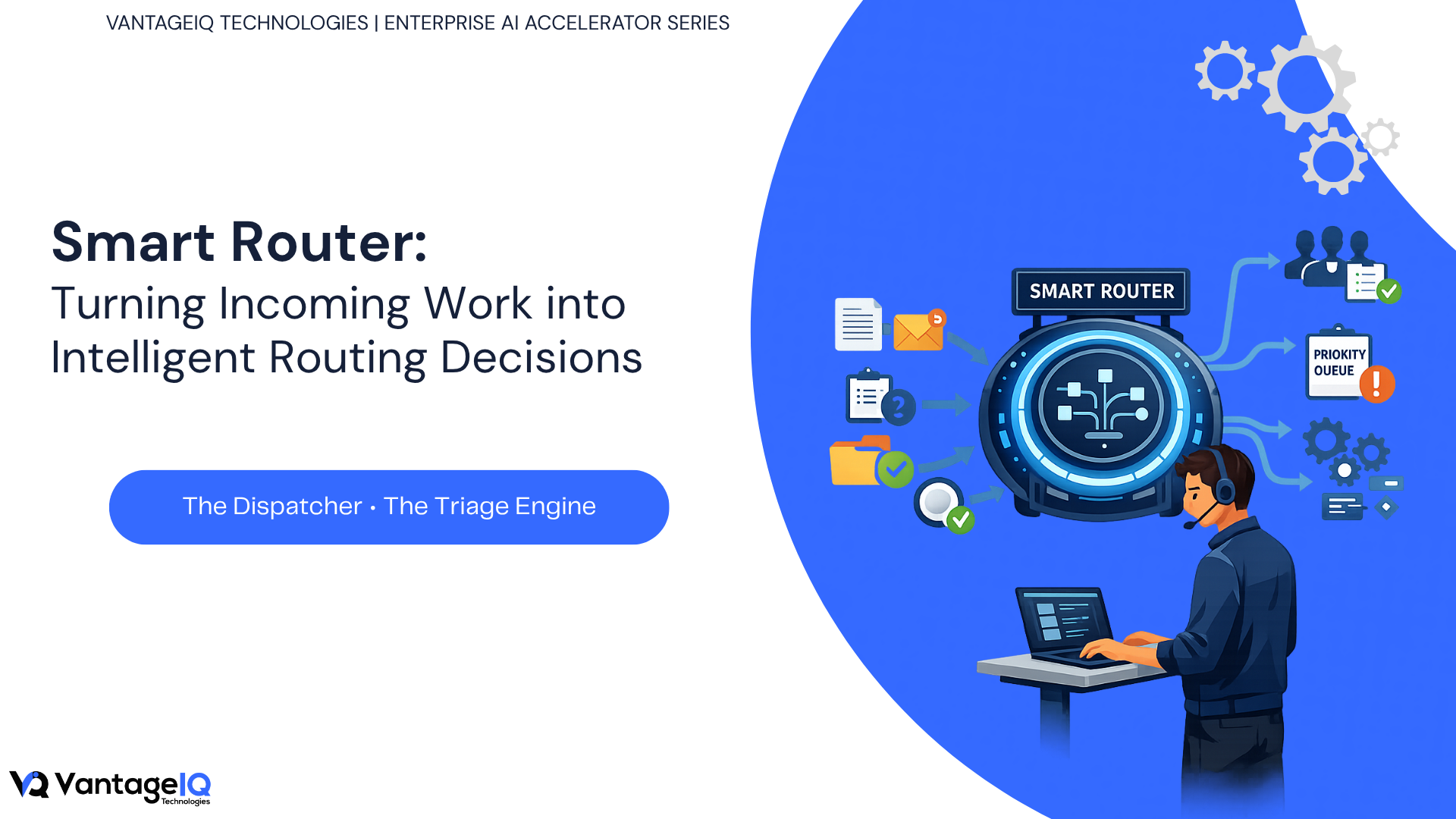
Smart Router: A reusable enterprise AI accelerator that helps organizations classify, prioritize, and route incoming documents, requests, and cases to the right destination.
Helping organizations move every request, case, and document to the right destination, faster and with greater consistency.
Every business process begins with an incoming signal.
A patient referral. An insurance claim. A loan application. A customer complaint. A legal matter. A citizen request.
Before any of these can be resolved, someone, or something—must decide where they should go next.
In many organizations, that decision still depends on employees reading incoming information, determining its category and urgency, and manually forwarding it to the right team or queue. As volumes increase, this seemingly simple step becomes a major operational bottleneck.
Items are misclassified. Urgent requests wait behind routine work. Cases reach overloaded teams. Employees spend time redirecting work that should have reached the right destination the first time.
The problem is not always how work gets completed. Sometimes, it is how long the work takes to reach the right place.
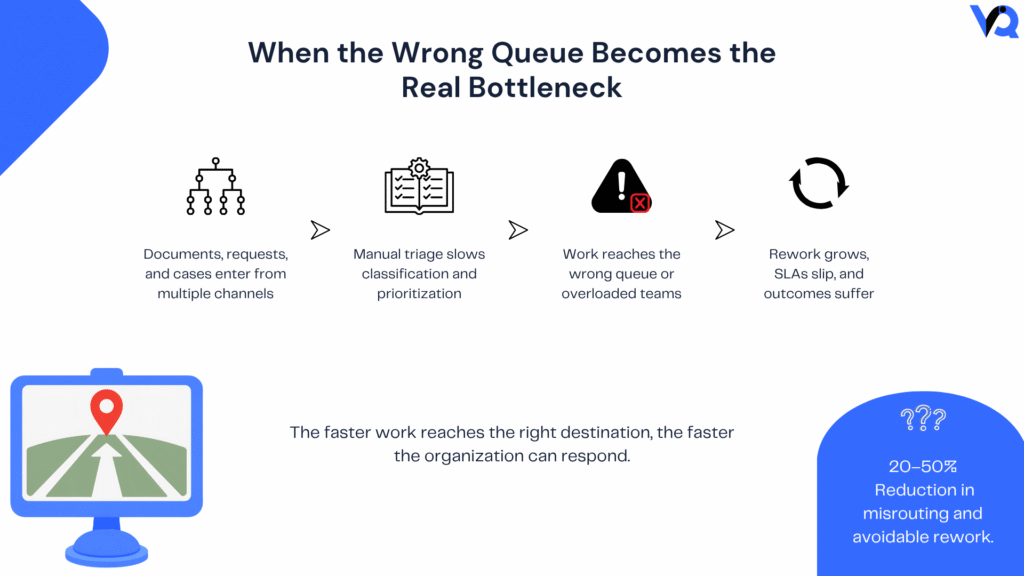
When the Wrong Queue Becomes the Real Bottleneck
Routing decisions influence everything that follows.
A loan application sent to the wrong underwriting queue creates rework. A customer complaint assigned to the wrong team risks an SLA breach. A legal matter sent to an overloaded specialist delays resolution. In healthcare, delayed referrals can have far more serious consequences.
Research published through PMC found that 47.2% of patients in the studied acute myocardial infarction cohort experienced delayed referral, with delays associated with poorer clinical outcomes, longer hospital stays, and higher costs.
The same operational pattern appears across industries:
Misclassification → Wrong Destination → Rework → Delays → Poorer Outcomes
Traditional routing systems struggle because they often depend on static rules, predefined keywords, or manual decisions. They may understand where a document came from but not what it contains, how urgent it is, or which team currently has the right capacity and expertise to handle it.
As incoming volumes grow, intelligent routing becomes more than a back-office improvement. It becomes essential infrastructure for responsive operations.
Moving Beyond Manual Triage
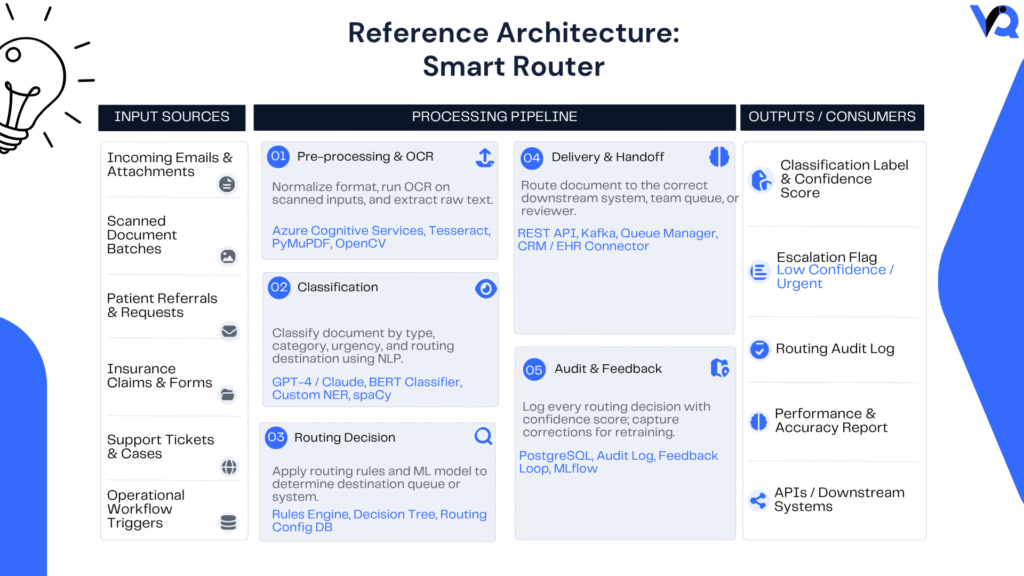
Smart Router is a reusable enterprise AI accelerator that enables organizations to build intelligent triage and routing capabilities without creating separate classification and assignment logic for every workflow.
Rather than functioning as a simple rules engine, the accelerator provides reusable foundations for intelligent intake, multi-dimensional classification, priority scoring, business-rule evaluation, capacity-aware routing, exception handling, auditability, and performance monitoring.
Operating within VantageIQ‘s Processing Engine layer, Smart Router analyzes incoming work and determines what it is, how urgent it is, where it should go, and what should happen next.
Its role within the accelerator framework is distinct. Data Parser transforms documents into structured data. Digital Typist converts voice and handwriting into usable records. Smart Router takes incoming work and decides the right destination.
From Incoming Work to the Right Destination
Smart Router provides a reusable foundation for turning high-volume intake into consistent, explainable routing decisions.
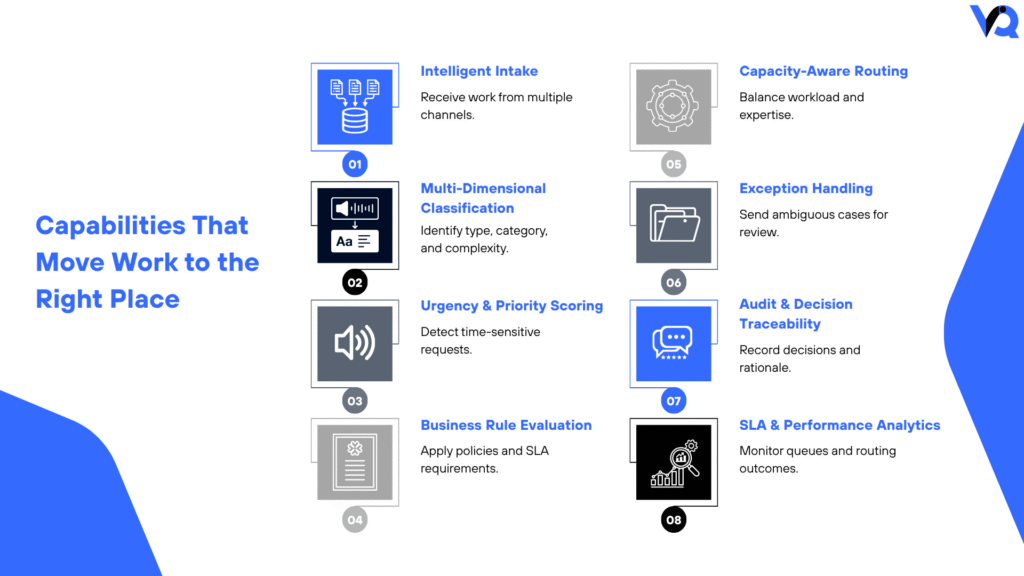
Capabilities That Move Work to the Right Place
- Intelligent Intake — Receive work from email, portals, APIs, and enterprise systems.
- Multi-Dimensional Classification — Identify type, category, complexity, and context.
- Urgency & Priority Scoring — Detect time-sensitive and high-impact requests.
- Business Rule Evaluation — Apply policies, SLAs, and operational requirements.
- Capacity-Aware Routing — Consider workload, expertise, and team availability.
- Exception Handling — Route ambiguous cases for targeted human review.
- Audit & Decision Traceability — Record routing decisions and their rationale.
- SLA & Performance Analytics — Monitor queues, delays, and routing outcomes.
Human oversight remains important for ambiguous or high-risk cases. Clear, high-confidence items can move automatically, while uncertain requests can be directed to the appropriate reviewer without slowing down the entire intake process.
Where Intelligent Routing Creates Business Value
Because almost every organization manages incoming work, Smart Router supports a wide range of enterprise workflows.
Healthcare
Classify patient referrals by specialty, urgency, and acuity before routing them to the appropriate department or clinical team.
Insurance
Sort claims and cases by type, complexity, severity, and priority, then assign them based on adjuster expertise and workload.
Financial Services
Categorize loan applications, onboarding documents, and compliance requests before routing them to the appropriate review or underwriting queue.
Customer Operations
Identify complaint type, severity, customer impact, and regulatory exposure before assigning each case to the right resolution team.
Legal & Professional Services
Route new matters, client requests, and engagements based on expertise, jurisdiction, complexity, and team capacity.
Public Sector
Classify citizen requests, permit applications, and administrative cases before directing them to the appropriate department or service channel.
The Measurable Outcomes
Organizations implementing intelligent triage typically focus on reducing manual sorting while improving speed, accuracy, and service performance.
Typical outcomes include:
Metric | Typical Improvement |
Manual triage effort | 40–80% reduction |
Priority routing speed | 50–90% faster |
Misrouting and rework | 20–50% reduction |
SLA compliance | 5–20% improvement |
Workload distribution | More balanced and consistent |
Actual results depend on intake complexity, classification requirements, routing rules, system integration, and operational readiness.
Beyond measurable efficiency gains, the larger benefit is consistency. Every incoming item can be evaluated against the same priorities, policies, and routing logic instead of depending entirely on who happens to review it first.
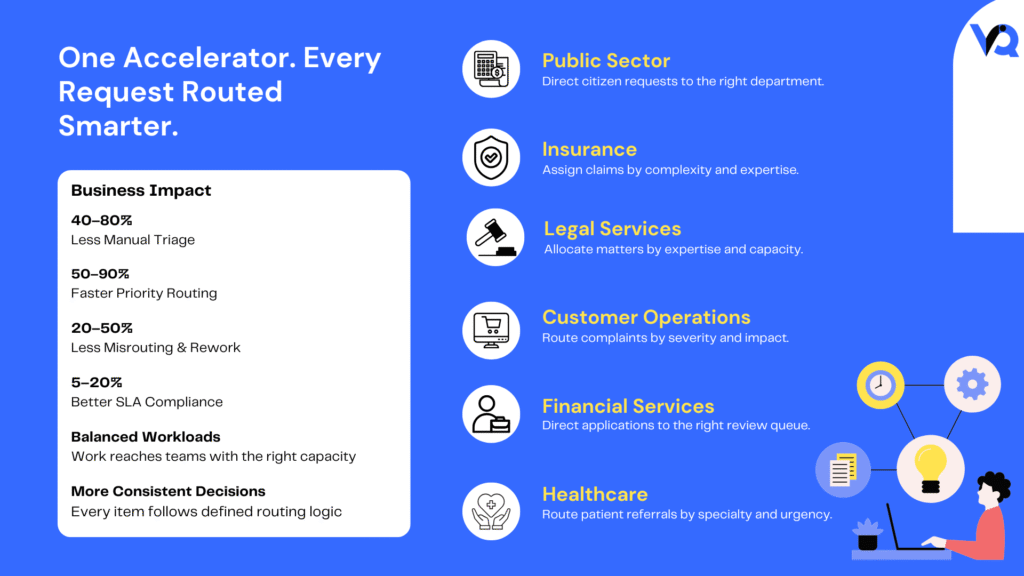
Industries Where Every Routing Decision Matters
Smart Router is particularly valuable for organizations managing high volumes of requests, documents, applications, and cases.
- Healthcare — Patient referrals and clinical intake.
- Insurance — Claims and case assignment.
- Financial Services — Applications and underwriting queues.
- Customer Operations — Complaints and service requests.
- Legal Services — Matter intake and specialist allocation.
- Public Sector — Citizen requests and administrative cases.
Making Every Incoming Request Actionable
Intelligent operations depend on more than understanding incoming information. They also depend on deciding what should happen next.
Smart Router provides the reusable foundation for making that decision faster. By combining classification, priority scoring, business rules, capacity awareness, exception handling, and continuous performance monitoring, organizations can move work to the right destination with greater speed and consistency.
As enterprise workloads continue to grow, the ability to intelligently route every request, case, and document will become a foundational capability for faster service, better resource utilization, and more responsive operations.