

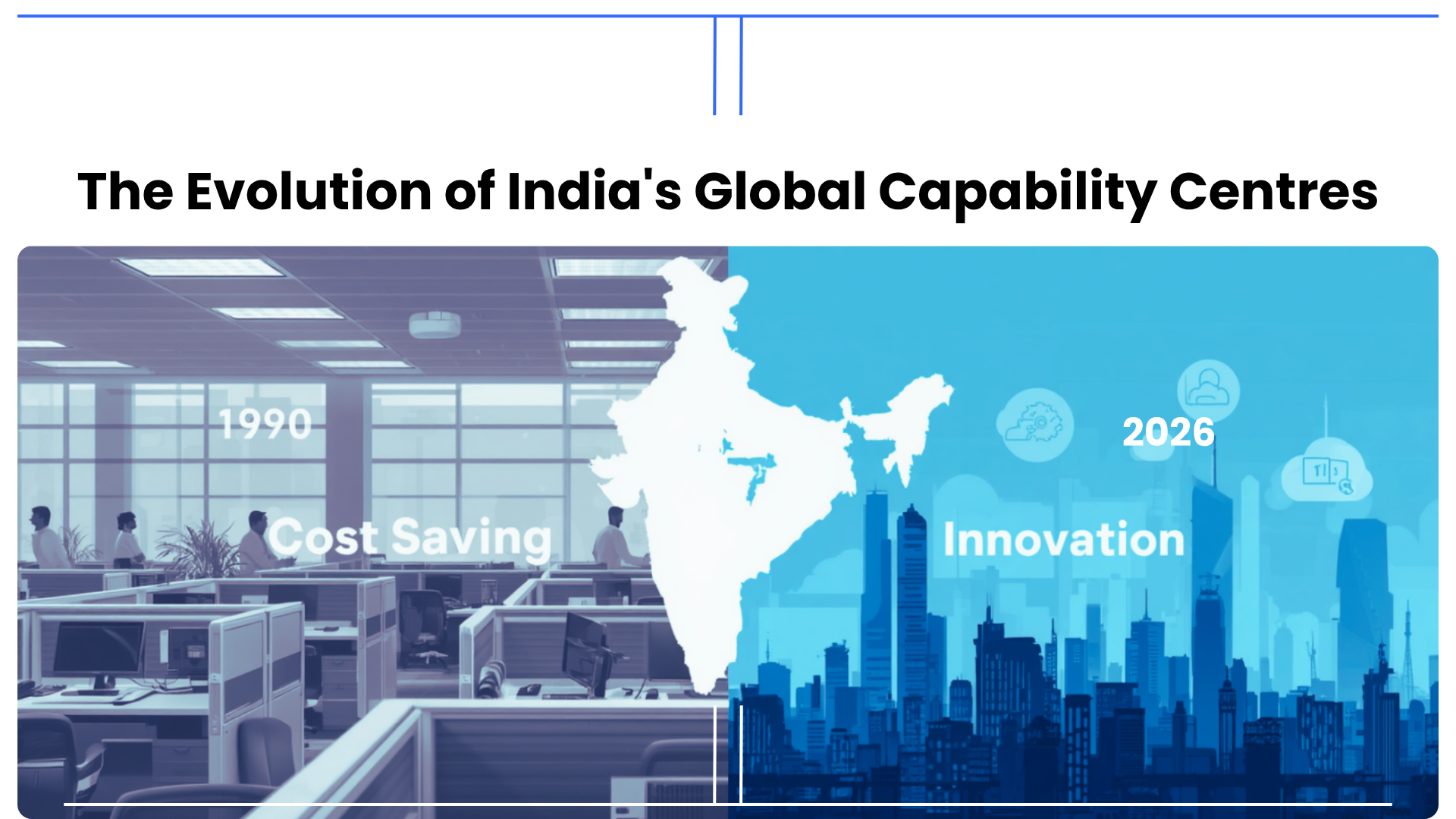
For decades, the global perception of India’s role in international business was stuck in a 1990s time capsule. Mention “offshoring to India,” and most executives pictured a giant call center or a quiet back office handling repetitive IT tickets.
But over the last ten years, that old playbook has been completely rewritten. What started as a hunt for cheap labor has quietly evolved into the strategic engineering engine of the Fortune 500.
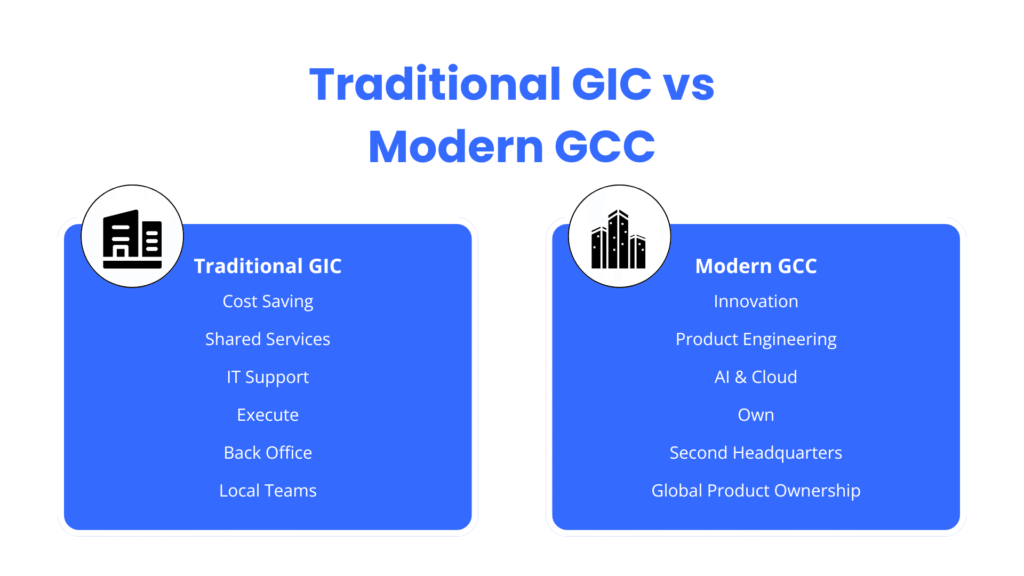
Today, we are witnessing the final days of the traditional Global In-house Center (GIC) and the rise of the modern Global Capability Center (GCC).
To understand how deep this shift goes, you have to look at the work of Lalit Ahuja, widely considered the pioneer of India’s GCC ecosystem. From launching LG Electronics’ first India center back in 1995 to building the massive Target India model, Ahuja has watched this space grow from basic R&D outposts to high-stakes global nerve centers.
The consensus today is clear: the conversation has shifted from “How much money can we save?” to “How fast can we innovate?”
How Did We Get Here? The Evolution of India's GCCs
This transition into a strategic digital brain didn’t happen overnight. It was built in waves, with each decade bringing a higher level of trust, autonomy, and complexity.
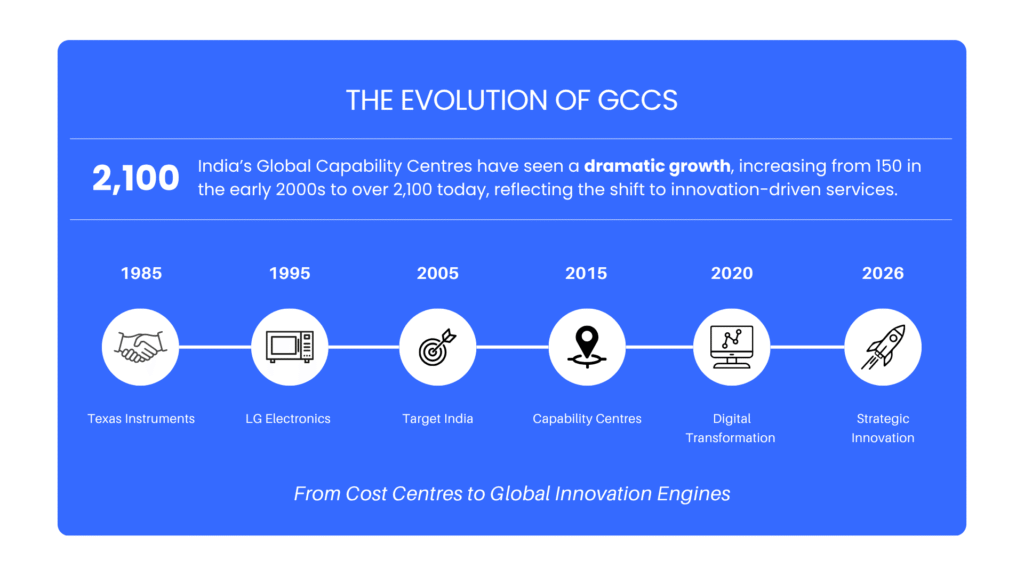
The Back-Office Roots: 1985–1999
Pioneers like Texas Instruments (1985) and GE arrive in Bengaluru. In 1995, Lalit Ahuja sets up LG Electronics‘ center. These early outposts focus strictly on transactional IT tasks, basic software maintenance, and simple data processing.
Standardisation and GICs: 2000–2009
The internet boom and ERP systems change the game. The “Global In-house Center” (GIC) model takes off. Companies standardize their global operations. In 2005, Target India launched, proving that an Indian office can run as an integrated “second headquarters” rather than an isolated outpost.
The Capability Shift: 2010–2019
The industry formally pivots from GICs to GCCs. Enterprises realize India offers exceptional “capability and competency arbitrage,” not just cheap labor. Spurred by cloud computing and big data, these centers become hubs for digital transformation.
The Strategic Digital Brain: 2020–2026
The pandemic accelerates everything. New GCCs bypass the slow maturity curve entirely, launching as full-scale innovation hubs on day one. Today, over 2,100 active GCCs in India own the core product roadmaps and tech architectures of global parents.
Shifting from Cost Saving to Capability
The core motivation for building teams in India has fundamentally changed. While early captives were set up to trim operational budgets, modern GCCs are built to design “what’s next.”
These centers are where the real work of digital transformation happens. They house the highly specialized expertise in generative AI, cybersecurity, and cloud architecture that companies in London, New York, or Minneapolis struggle to find locally.
Lalit Ahuja perfectly captures this mindset shift when reflecting on how Target built its presence in India:
“In three words how Target happened in India: it’s not what you do but how you do what you do. India is not a cost arbitrage play but rather a very strong capability center and a lot of products can be shipped directly or built from here and shipped globally.”
The "Second Headquarters" vs. The Remote Outpost
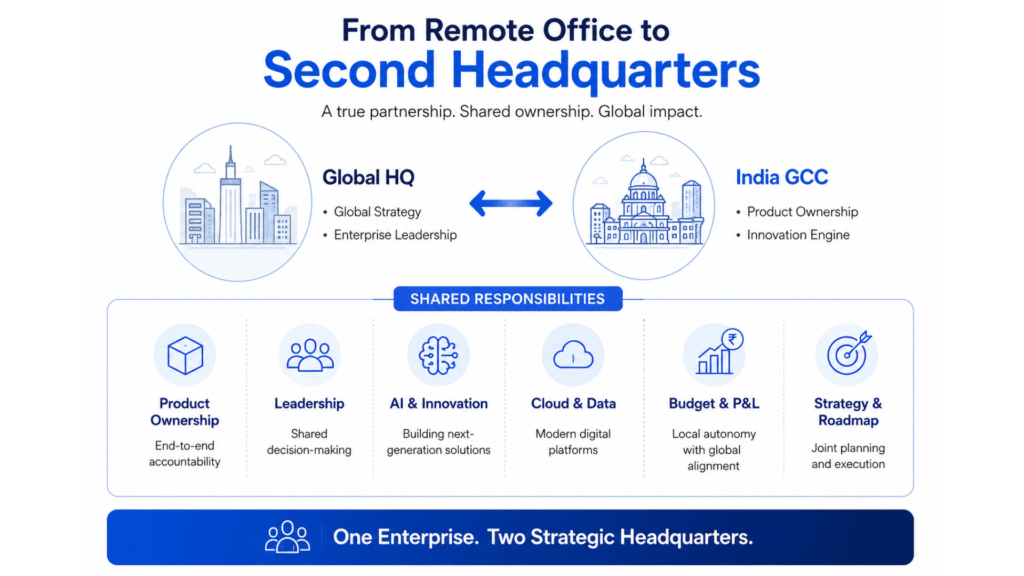
The most successful GCCs have abandoned the old “outpost” mentality in favor of a “Second Headquarters” approach.
In this setup, the Indian team is a peer, not a subordinate. They have direct executive sponsorship, local budget control, and end-to-end ownership of major products.
In fact, the term “GCC” itself is starting to feel outdated. The ultimate goal for a mature center is simply to become “The Company in India” think Target India, rather than “Target’s Indian GCC.”
By removing master-servant hierarchies and operational silos, companies ensure that talent feels a true sense of ownership. When a developer in Bengaluru has the same decision-making power as their counterpart in the home office, the enterprise becomes truly borderless.
The Secret Sauce: India’s Cultural "Edge " in Tech
India’s dominant position in the global tech landscape isn’t just a numbers game of how many STEM graduates enter the workforce each year. It’s driven by a distinct cultural “Edge ” , a unique blend of adaptability, resilience, and a personal drive to solve tough problems.
Ahuja points out that the GCC model aligns beautifully with the Indian tech community’s desire for real impact:
“GCCs are also a very Indian thing… we feed on the recognition that goes by doing truly impactful work… we feed on the empowerment that is given to us to solve complex problems… we make it very personal and we’ll do all it takes to solve that problem.”
Skipping the Slog: The Late-Mover Advantage
Historically, building a GCC was a slow, linear process that took years:
- Experiment: Test the local talent market with low-risk projects.
- Optimize: Refine management structures and team setups.
- Scale: Expand the center’s reach across different business units.
- Innovate: Finally earn the trust to lead global strategy.
Today, new entrants are skipping the first three steps. Thanks to a highly mature local ecosystem, companies can hire veteran GCC leaders who have already built successful hubs elsewhere. They “import” trust and operational frameworks on day one, launching directly as Innovation Centers.
This momentum is backed by a highly active “Startup-Corporate Corridor.” Modern GCCs in India don’t live on isolated corporate islands anymore. They actively partner with agile local startups, running paid Proof of Concepts (PoCs) to bring cutting-edge innovations, like custom LLMs or specialized blockchain security—into the enterprise.
The Relocated Dream: Impact from a Desk
For years, the “American Dream” meant packing up and moving to Silicon Valley. Today, shifting Western visa policies and H-1B bottlenecks have flipped the talent flow. Work is coming to the people, rather than people going to work.
As Ahuja points out, top-tier talent looks for three main things: living well, making competitive money, and doing high-impact work.
The GCC revolution has made it possible to check all three boxes without leaving India. Professionals can earn globally competitive salaries and solve complex, high-scale engineering challenges for companies like Goldman Sachs or Amazon right from Bengaluru, Mumbai, Gurgaon, etc
. The historic “brain drain” is turning into a brain gain, directly supporting the Viksit Bharat (Developed India) initiative.
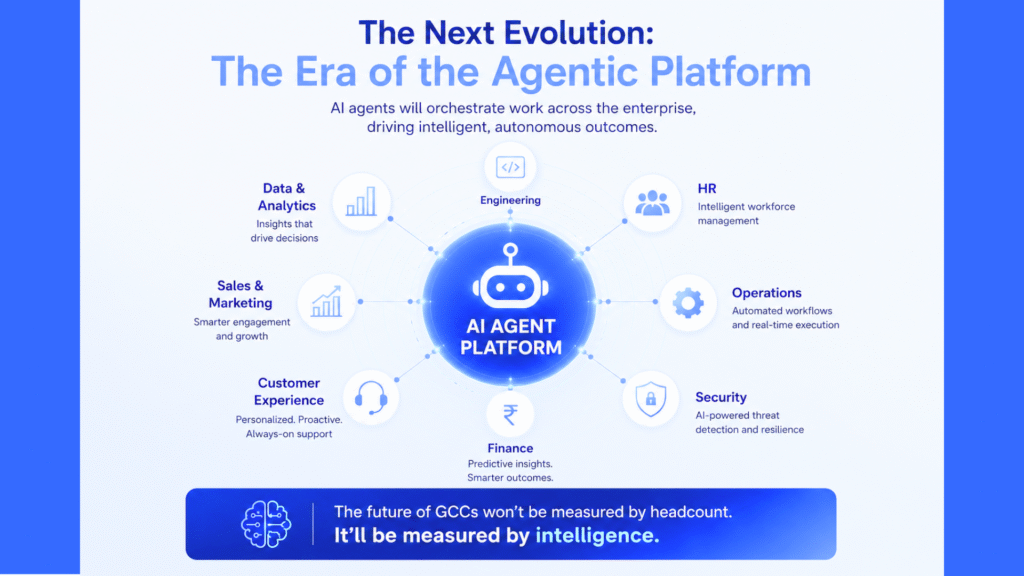
What Lies Ahead: The Era of the "Agentic Platform"
As we look to the horizon, the next phase of GCC evolution won’t be measured by headcount. Instead, it will be driven by Work Reconstruction and the rise of the Agentic Platform.
Rather than focusing on linear team growth, the next generation of GCCs will leverage coordinated AI agent networks that are deeply integrated with the parent company’s operational DNA.
Because India’s GCCs are often unburdened by the legacy technical debt and slow-moving processes of global headquarters, they are the ideal testbeds for these AI-first workflows. AI here isn’t just a tool to write code slightly faster—it is the foundation of a highly agile, modern business structure.
The Obsolete Headquarters?
The journey that began in 1985 with a single Texas Instruments office in Bengaluru has reached a critical turning point. Today, the GCC model is completely industry-agnostic. Whether you run a luxury fashion brand, a global airline, a pharmaceutical giant, or a manufacturing company, setting up a highly integrated strategic tech hub in India is highly accessible.
As the concept of the “back office” officially dies, we are left with a fascinating question: If the core digital breakthroughs of the next decade are designed, built, and scaled by empowered hubs 10,000 miles away, is the very concept of a “home office” already a relic of the past?
Explore the next chapters of our GCC Blog Series: How Modern GCCs Structure Teams, Win Markets, Grow and Prevent Operational Failures.
Much of the perspective presented in this article is inspired by the podcast conversation featuring Mr. Lalit Ahuja. If you’re interested in exploring the ideas in greater depth, we encourage you to listen to the full podcast below: