

Cross-Checker: A reusable enterprise AI accelerator that helps organizations compare related documents, records, and datasets to detect discrepancies, validate information, and route exceptions for review.
Helping organizations compare critical information, detect inconsistencies, and validate data before errors move downstream.
An invoice says 500 units. The purchase order says 450.
A claim requests coverage that does not appear in the policy.
A shipping manifest does not match the inventory received.
A signed contract contains a clause that was not in the approved version.
In each case, the problem is not missing information. The problem is that related information does not agree.
Across enterprises, finance teams, operations analysts, claims specialists, compliance officers, and supply chain teams spend countless hours comparing records manually. They move between spreadsheets, documents, and business systems, searching for mismatches before those discrepancies create larger problems.
As transaction volumes grow, manual reconciliation becomes increasingly difficult to scale. Small differences are overlooked. Review queues expand. Exceptions take longer to resolve. Errors move into payments, claims, contracts, inventory records, and regulatory reports.
The challenge is not simply comparing more data. It is identifying which differences matter before they move forward.
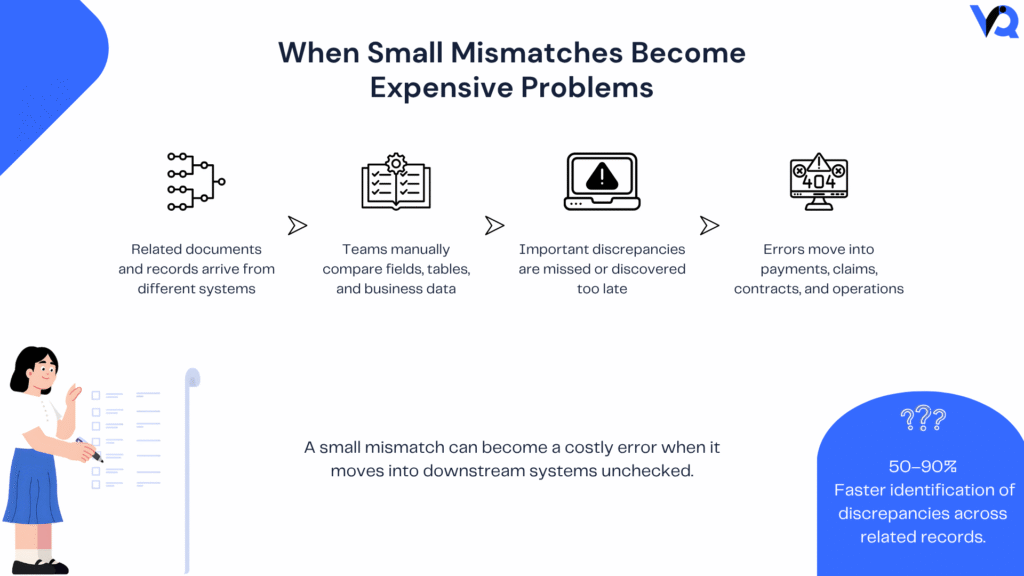
When Small Mismatches Become Expensive Problems
Reconciliation is one of the most important control points in enterprise operations.
A pricing mismatch can trigger an incorrect payment. A missing policy condition can lead to a flawed claims decision. An inventory discrepancy can disrupt fulfilment. An unauthorized contract change can introduce legal or compliance risk.
The operational pattern is often the same:
Related Records → Manual Comparison → Missed Discrepancy → Downstream Error → Financial or Compliance Risk
Traditional reconciliation methods struggle because enterprise information rarely arrives in identical formats. One system may record a supplier name differently from another. Dates, currencies, quantities, and identifiers may follow different standards. Some differences are acceptable. Others require immediate investigation.
Simple exact-match rules cannot always understand that distinction.
As organizations operate across more systems, partners, and data sources, intelligent validation becomes a strategic requirement rather than a back-office task. The goal is not to flag every difference. It is to identify meaningful discrepancies, understand their risk, and focus human attention where it matters most.
Moving Beyond Manual Reconciliation
Cross-Checker is a reusable enterprise AI accelerator that enables organizations to build intelligent reconciliation and validation capabilities without creating separate comparison engines for every workflow.
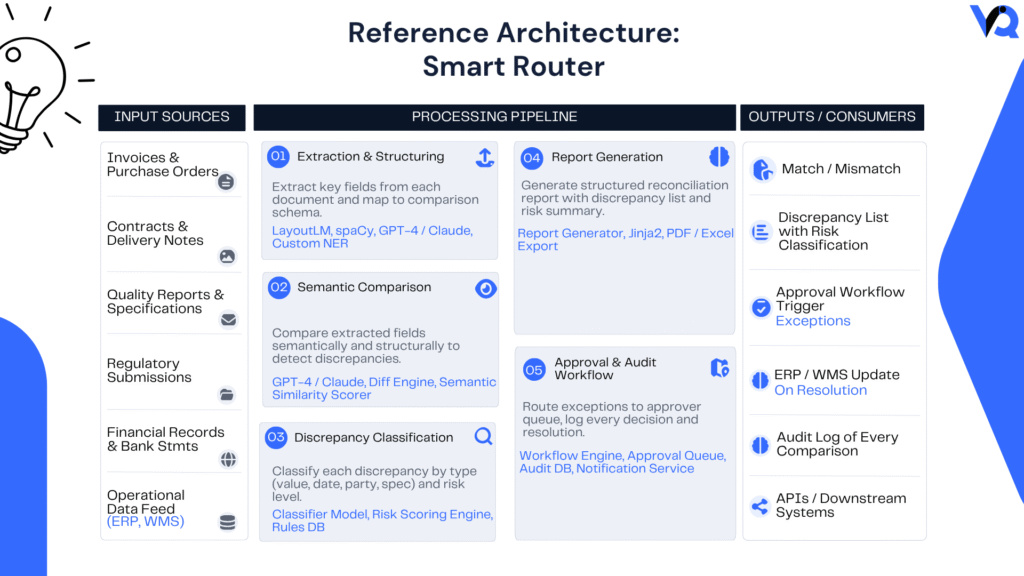
Rather than functioning as a basic matching tool, the accelerator provides reusable foundations for multi-source ingestion, intelligent record pairing, data normalization, exact and semantic comparison, tolerance evaluation, discrepancy scoring, exception routing, and evidence traceability.
Operating within VantageIQ‘s Processing Engine layer, Cross-Checker compares related information and determines whether records agree, whether differences fall within acceptable limits, and which exceptions require further action.
Its role within the accelerator framework is clear. Data Parser extracts and structures information. Digital Typist digitizes human-generated content. Smart Router decides where incoming work should go. Cross-Checker verifies whether related information agrees.
From Related Records to Trusted Validation
Cross-Checker provides a reusable foundation for turning comparison into a consistent enterprise control.
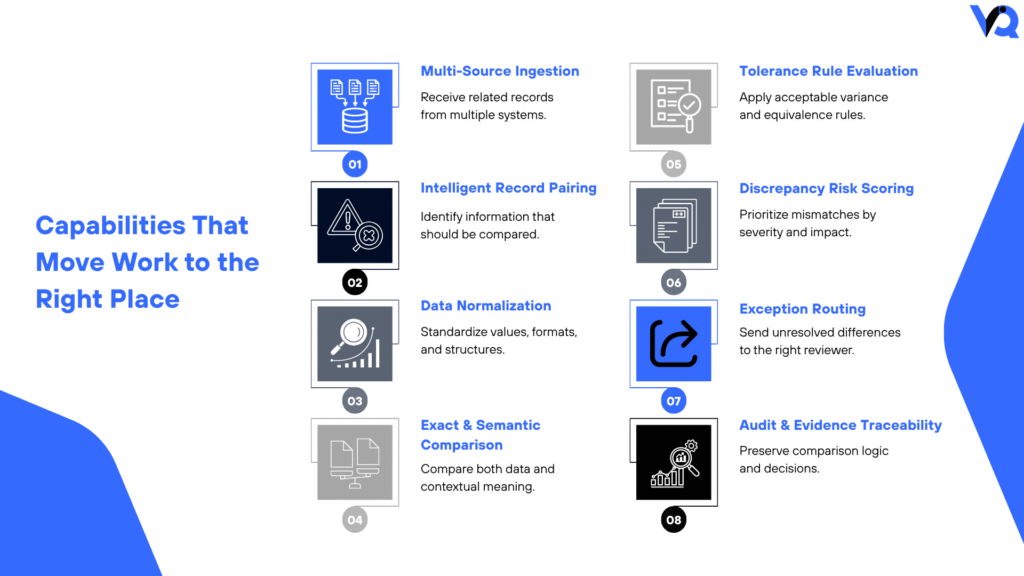
Capabilities That Turn Comparison into Control
- Multi-Source Ingestion — Receive related documents, records, and datasets.
- Intelligent Record Pairing — Identify information that should be compared.
- Data Normalization — Standardize formats, values, and structures.
- Exact & Semantic Comparison — Compare both values and contextual meaning.
- Tolerance Rule Evaluation — Apply acceptable variance and equivalence rules.
- Discrepancy Risk Scoring — Classify mismatches by type, severity, and impact.
- Exception Routing — Send unresolved differences to the right reviewer.
- Audit & Evidence Traceability — Preserve comparison logic, evidence, and decisions.
This combination is important because not every difference is an error. A small rounding variance may be acceptable. A changed payment amount may not be. Cross-Checker applies business-specific rules so valid matches can move forward while meaningful exceptions receive attention.
Where Intelligent Validation Creates Business Value
Because related information must agree across almost every enterprise function, Cross-Checker supports a broad range of workflows.
Finance & Procurement
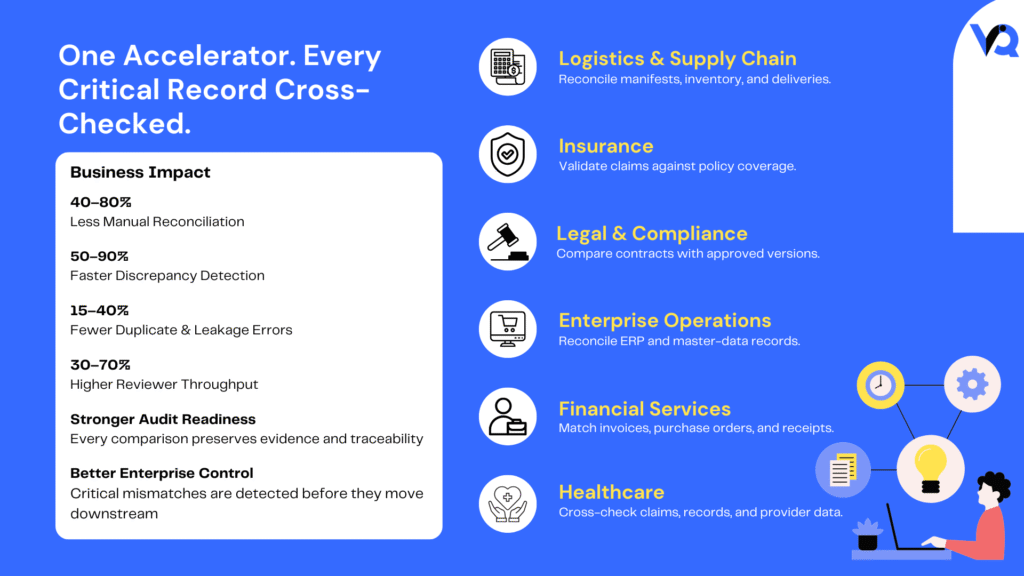
Compare invoices, purchase orders, and goods receipts to identify quantity, pricing, tax, and payment discrepancies before approval.
Insurance
Validate claims against policy terms, coverage limits, supporting documents, and customer records before decisions move forward.
Logistics & Supply Chain
Reconcile shipping manifests, warehouse inventory, delivery records, and ERP data to detect shortages, overages, and misclassifications.
Legal & Compliance
Compare executed contracts against approved templates or previous versions to identify changed clauses, missing terms, and unauthorized deviations.
Healthcare
Cross-check claims, patient records, provider information, and supporting documents to identify inconsistencies before processing.
Enterprise Operations
Reconcile master data, intercompany records, and information across ERP systems to improve consistency and reduce downstream errors.
The Measurable Outcomes
Organizations implementing intelligent reconciliation typically focus on reducing manual comparison while improving discrepancy detection and reviewer productivity.
Typical outcomes include:
Metric | Typical Improvement |
Manual reconciliation effort | 40–80% reduction |
Discrepancy identification speed | 50–90% faster |
Duplicate and leakage errors | 15–40% reduction |
Reviewer throughput | 30–70% improvement |
Audit readiness | Stronger evidence and traceability |
Actual results depend on data quality, document complexity, tolerance rules, integration readiness, and review requirements.
Beyond measurable efficiency gains, the larger benefit is control. Organizations can validate information consistently before discrepancies become payments, decisions, compliance issues, or operational failures.
Industries Where Every Discrepancy Matters
Cross-Checker is particularly valuable for organizations where accuracy, reconciliation speed, and traceability directly affect business outcomes.
- Financial Services — Transaction and regulatory reconciliation.
- Insurance — Claims and policy validation.
- Manufacturing & Logistics — Inventory and shipment reconciliation.
- Healthcare — Claims and provider-data validation.
- Legal Services — Contract and document comparison.
- Enterprise Operations — ERP and master-data reconciliation.
Making Validation a Built-In Enterprise Control
Reconciliation should not begin only after something goes wrong.
The strongest enterprise processes validate critical information before payments are released, claims are approved, contracts are finalized, inventory is moved, or records enter downstream systems.
Cross-Checker provides the reusable foundation for building that control faster. By combining intelligent pairing, normalization, semantic comparison, tolerance rules, risk scoring, exception routing, and complete evidence traceability, organizations can turn reconciliation from a manual bottleneck into an intelligent, auditable process.
As enterprise data continues to spread across documents, systems, and partners, the ability to identify meaningful discrepancies before they move forward will become a foundational capability for trusted operations.