

Privacy Filter: A reusable enterprise AI accelerator that helps organizations detect, classify, and protect sensitive information across documents, images, records, and datasets.
Helping organizations detect sensitive information and apply the right protection before data is shared, analyzed, or released.
As information volumes grow, manual privacy review becomes slower, harder to scale, and increasingly difficult to apply consistently.
The challenge is no longer simply findinA patient record is shared with a research partner.
A legal document is released during discovery.
A financial report is sent to an external auditor.
A public agency responds to an information request.
Each file may be ready to move forward. The sensitive information inside it may not be.
Names, account numbers, medical details, addresses, confidential clauses, and personal identifiers can appear anywhere inside enterprise information. Before that information is shared, organizations must identify what is sensitive, understand why it needs protection, and apply the right privacy action.
In many organizations, this still depends on manual review. Employees search documents page by page, apply redactions, check outputs, and repeat the process across thousands of files.
g sensitive data. It is protecting the right information, in the right way, before it moves forward.
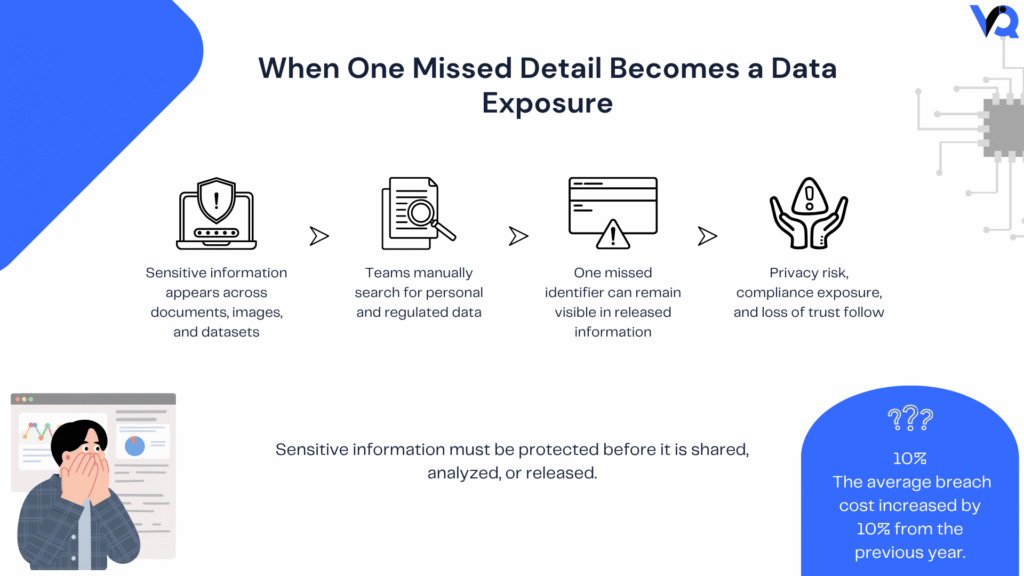
When One Missed Detail Becomes a Data Exposure
Privacy failures do not always begin with sophisticated cyberattacks.
Sometimes, they begin with one overlooked identifier.
A patient name remains visible in a shared record. An account number appears in an audit document. Confidential information is missed during legal discovery. Personal data enters an AI training dataset without proper de-identification.
The operational pattern is often the same:
Sensitive Data → Manual Review → Missed Identifier → External Release → Privacy Risk
The financial consequences can be significant. IBM’s 2024 Cost of a Data Breach Report placed the global average cost of a data breach at $4.88 million, a 10% increase from the previous year.
At the same time, privacy obligations continue to expand across industries and jurisdictions. Organizations must manage different requirements for personal information, health data, financial records, confidential business information, and regulated content.
The difficulty is that not every sensitive value requires the same treatment. Some information must be permanently removed. Some can be partially hidden. Some needs to remain usable for analytics while no longer revealing identity.
Privacy protection must become contextual, consistent, and built into the workflow itself.
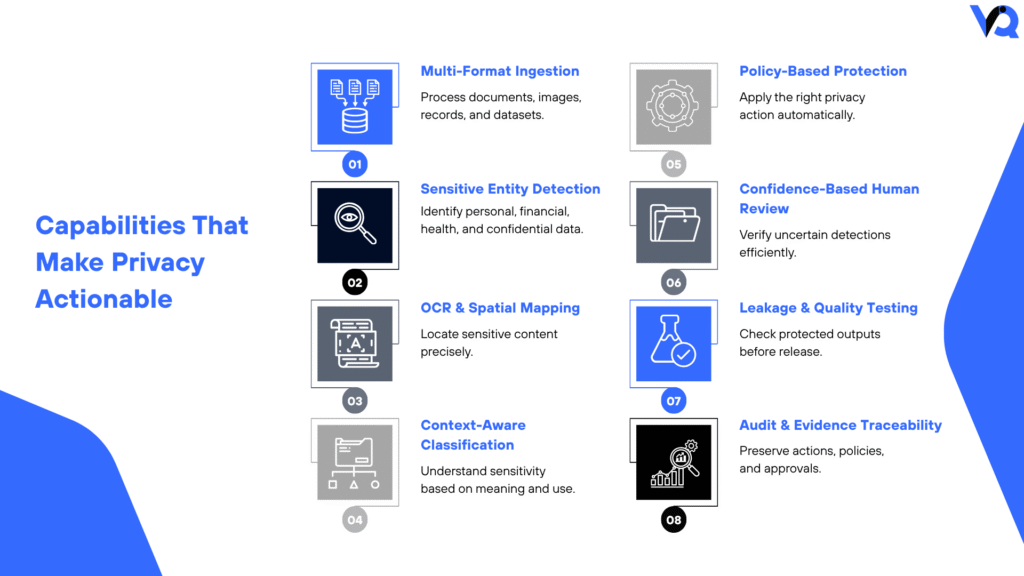
Moving Beyond Manual Redaction
Privacy Filter is a reusable enterprise AI accelerator that enables organizations to build intelligent privacy-preserving capabilities without creating separate detection and protection pipelines for every use case.
Rather than functioning as a basic redaction tool, the accelerator provides reusable foundations for sensitive-data detection, contextual classification, policy evaluation, protection actions, human review, leakage testing, secure delivery, and complete auditability.
Operating within VantageIQ‘s Processing Engine layer, Privacy Filter identifies sensitive information and determines what should happen to it before the content is shared, analyzed, stored, or released.
Depending on the context, the accelerator can:
- Redact information that must be permanently removed.
- Mask sensitive values while preserving limited visibility.
- Tokenize data by replacing it with a secure reference.
- Pseudonymize identities while retaining controlled data utility.
- Escalate uncertain or high-risk cases for human review.
This flexibility turns privacy from a single redaction step into an intelligent decision layer.
From Sensitive Content to Privacy-Safe Information
Privacy Filter provides a reusable foundation for protecting sensitive information across enterprise workflows.
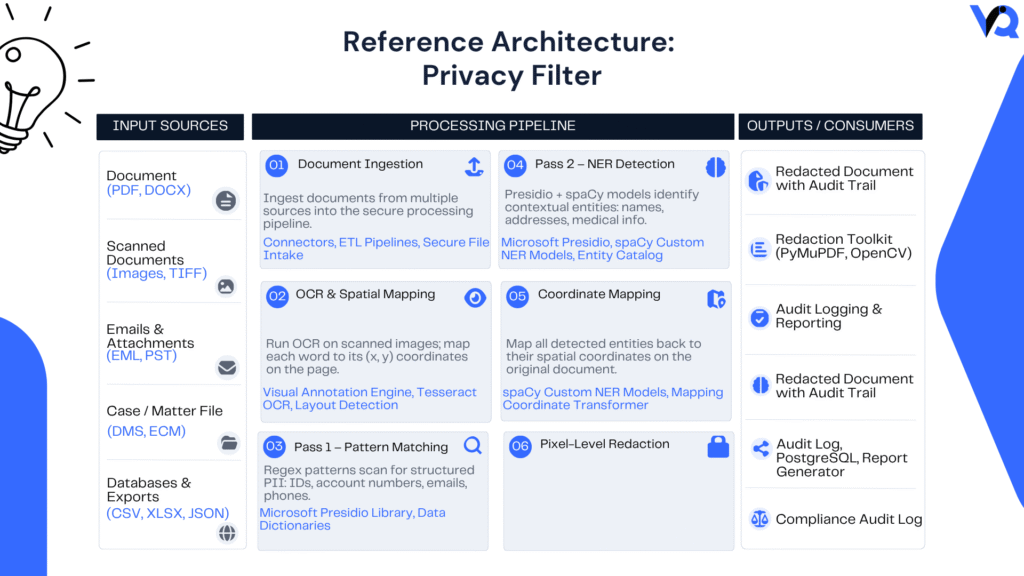
Capabilities That Make Privacy Actionable
- Multi-Format Ingestion — Process documents, images, records, and datasets.
- Sensitive Entity Detection — Identify personal, financial, health, and confidential information.
- OCR & Spatial Mapping — Locate sensitive content precisely within scanned files and images.
- Context-Aware Classification — Understand sensitivity based on meaning and use.
- Policy-Based Protection — Apply redaction, masking, tokenization, or pseudonymization rules.
- Confidence-Based Human Review — Route uncertain detections for targeted verification.
- Leakage & Quality Testing — Check protected outputs before release.
- Audit & Evidence Traceability — Preserve actions, policies, approvals, and processing history.
Human oversight remains important for ambiguous and high-risk content. Clear cases can move forward automatically, while uncertain information is sent to the appropriate reviewer instead of forcing every file through the same manual process.
Where Intelligent Privacy Protection Creates Business Value
Because sensitive information exists across almost every industry, Privacy Filter supports a broad range of enterprise workflows.
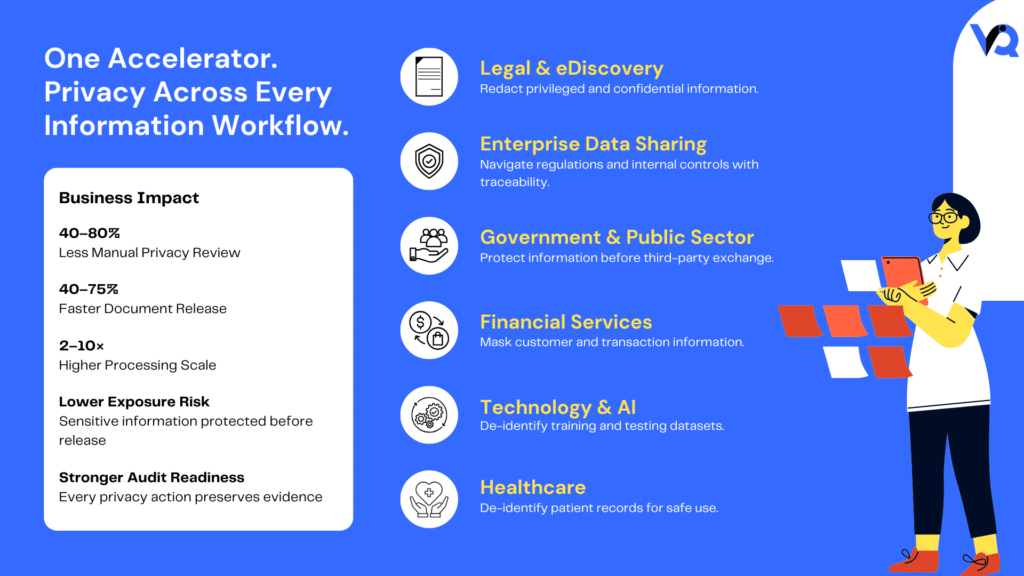
Legal & eDiscovery
Identify and redact privileged, confidential, and personal information before documents are produced or shared.
Healthcare
De-identify patient records for research, referrals, analytics, and collaboration while preserving useful clinical information.
Financial Services
Protect account numbers, transaction details, customer identifiers, and confidential information in statements and reports.
Government & Public Sector
Prepare privacy-safe public-record responses by identifying information that must be withheld before release.
Technology & AI
De-identify training, testing, and evaluation datasets before information enters AI and analytics environments.
Enterprise Data Sharing
Protect sensitive information before documents and datasets are exchanged with vendors, partners, auditors, or other third parties.
The Measurable Outcomes
Organizations implementing intelligent privacy protection typically focus on reducing manual review while accelerating safe information use.
Typical outcomes include:
Metric | Typical Improvement |
Manual privacy-review effort | 40–80% reduction |
Document release turnaround | 40–75% faster |
Sensitive-data exposure risk | Meaningful reduction |
Processing throughput | 2–10× scalability |
Audit readiness | Stronger evidence and traceability |
Actual results depend on content complexity, data quality, policy requirements, review thresholds, and integration readiness.
Beyond efficiency, the larger benefit is confidence. Organizations can move information through business processes with stronger assurance that sensitive content has been identified, protected, and documented.
Industries Where Privacy Must Move at the Speed of Data
Privacy Filter is particularly valuable for organizations handling high volumes of sensitive or regulated information.
- Healthcare — Patient records and clinical data.
- Financial Services — Customer and transaction information.
- Legal Services — Discovery and confidential documents.
- Government — Public records and citizen information.
- Technology — AI training and testing datasets.
- Enterprise Operations — Third-party and internal data exchange.
Building Privacy Into Every Information Workflow
Privacy protection should not begin only when information is ready to leave the organization.
It should be embedded wherever sensitive content is processed, analyzed, shared, or released.
Privacy Filter provides the reusable foundation for building that capability faster. By combining sensitive-data detection, contextual classification, policy-based protection, human review, leakage testing, and evidence traceability, organizations can transform privacy from a manual bottleneck into an intelligent enterprise control.
As data continues to move across systems, partners, analytics platforms, and AI environments, the ability to protect sensitive information before it moves forward will become a foundational capability for trusted digital operations.