

Digital Typist: A reusable enterprise AI accelerator that helps organizations transform voice, handwriting, and scanned content into accurate, structured records for faster business processing.
Helping organizations capture valuable information before it becomes another inaccessible file, recording, or handwritten note.
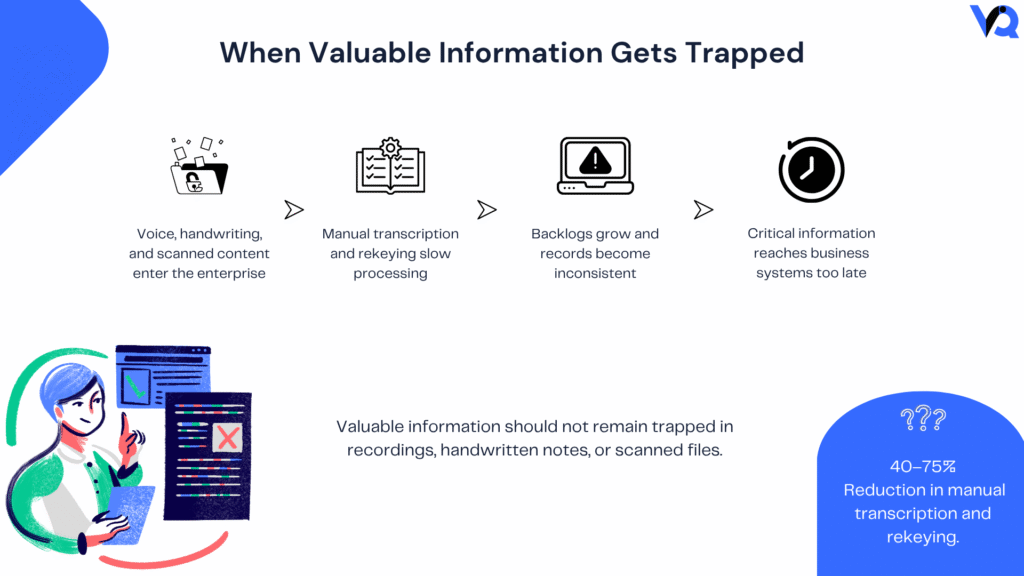
A physician dictates clinical notes after a consultation. A field technician records observations after a site visit. A legal team captures hours of testimony. An operations team receives hundreds of handwritten applications.
All of this information matters. Yet much of it remains trapped in formats that enterprise systems cannot use directly.
Audio recordings wait to be transcribed. Handwritten forms require manual rekeying. Meeting recordings sit untouched in shared drives. Scanned notes remain difficult to search, analyze, or connect with downstream workflows.
The problem is not a lack of information. It is the gap between capturing information and making it usable.
When that gap depends on manual transcription, organizations face growing backlogs, slower decisions, inconsistent records, and employees spending valuable time converting one format into another.
When Valuable Information Gets Trapped in the Wrong Format
Enterprise information does not always begin inside a database.
It often begins as a conversation, a voice note, a handwritten form, a scanned page, or a recorded meeting. These formats are natural for people but difficult for enterprise systems to process at scale.
The demand for better capture technologies reflects this challenge. The global speech and voice recognition market is projected to grow from $9.66 billion in 2025 to $23.11 billion by 2030, at a 19.1% CAGR. (MarketsandMarkets)
The opportunity goes beyond transcription. Enterprises increasingly need systems that can identify speakers, understand document structure, extract important facts, map information to approved templates, and create records that can move directly into operational systems.
The competitive advantage is not simply capturing more information. It is making captured information usable faster.
Moving Beyond Traditional Transcription
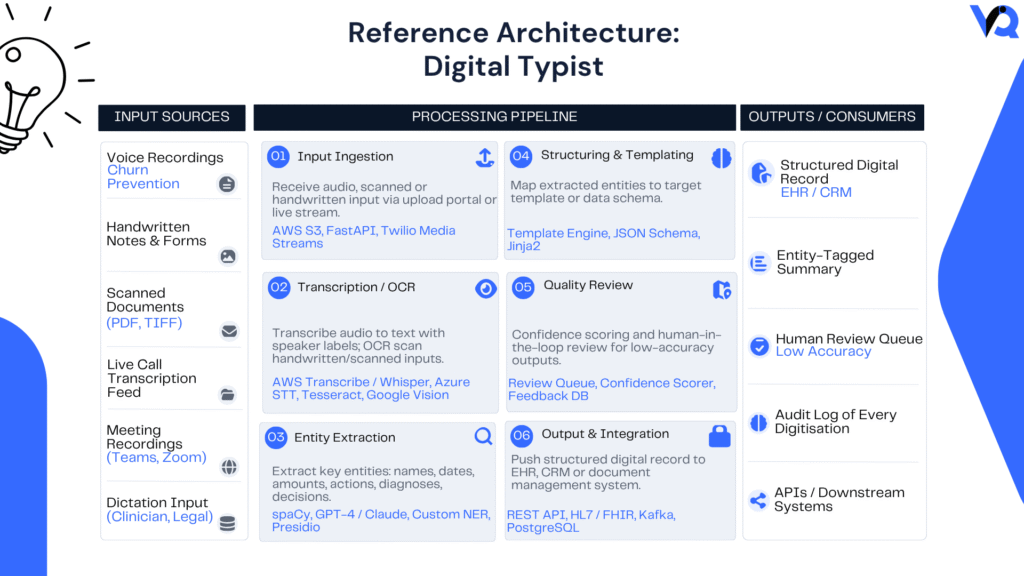
Digital Typist is a reusable enterprise AI accelerator that enables organizations to build intelligent content-digitization capabilities without creating separate processing pipelines for every use case.
Rather than functioning as a basic speech-to-text or OCR tool, the accelerator provides reusable foundations for multimodal ingestion, transcription, handwriting recognition, speaker identification, entity extraction, schema mapping, human review, enterprise integration, and auditability.
Operating within VantageIQ’s Processing Engine layer, Digital Typist transforms audio, handwriting, scans, and mixed unstructured inputs into clean, searchable, and system-ready records.
This positioning is especially important for enterprise workflows. A transcript alone is rarely the final outcome. The information often needs to become a clinical note, service record, case document, claim record, meeting summary, or structured form that another system can immediately use.
From Unstructured Signals to Usable Enterprise Records
Digital Typist provides a reusable foundation for converting human-generated content into structured information.
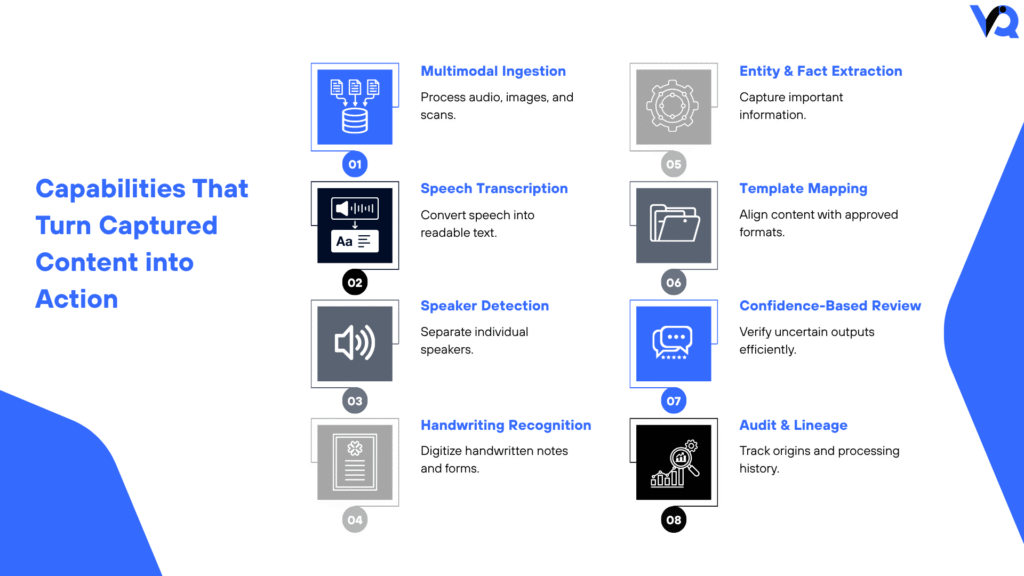
Capabilities That Turn Captured Content into Action
- Multimodal Ingestion — Process audio, images, scans, and mixed content.
- Speech Transcription — Convert spoken content into machine-readable text.
- Speaker Detection — Separate and identify individual speakers.
- Handwriting Recognition — Digitize handwritten forms and notes.
- Entity & Fact Extraction — Capture important domain-specific information.
- Template Mapping — Align content with approved record formats.
- Confidence-Based Review — Route uncertain outputs for human verification.
- Audit & Provenance — Track content origins and processing history.
The human-review layer is particularly important in high-stakes environments. Clear, high-confidence content can move forward automatically, while uncertain names, numbers, terms, or handwritten fields can be flagged for targeted verification.
Where Intelligent Digitization Creates Business Value
Because valuable information is captured in many forms, Digital Typist supports a wide range of enterprise workflows.
Healthcare
Transform physician dictations and patient encounters into structured clinical records, reducing documentation effort and supporting faster updates to electronic health systems.
Legal Services
Convert depositions, interviews, and proceedings into searchable records with speaker separation, timestamps, and case-specific structure.
Field Service
Turn technician voice notes into structured service reports, maintenance records, and asset updates without requiring manual rekeying after every visit.
Insurance
Digitize recorded interviews, handwritten applications, claims notes, and supporting information for faster downstream processing.
Sales & Customer Success
Convert calls and meetings into structured summaries, decisions, commitments, and follow-up actions that can be added to CRM workflows.
Public Sector & Operations
Process handwritten applications, surveys, inspection notes, and administrative records while reducing manual entry queues.
The Measurable Outcomes
Organizations implementing intelligent content digitization typically focus on reducing manual transcription while accelerating the journey from capture to usable record.
Typical outcomes include:
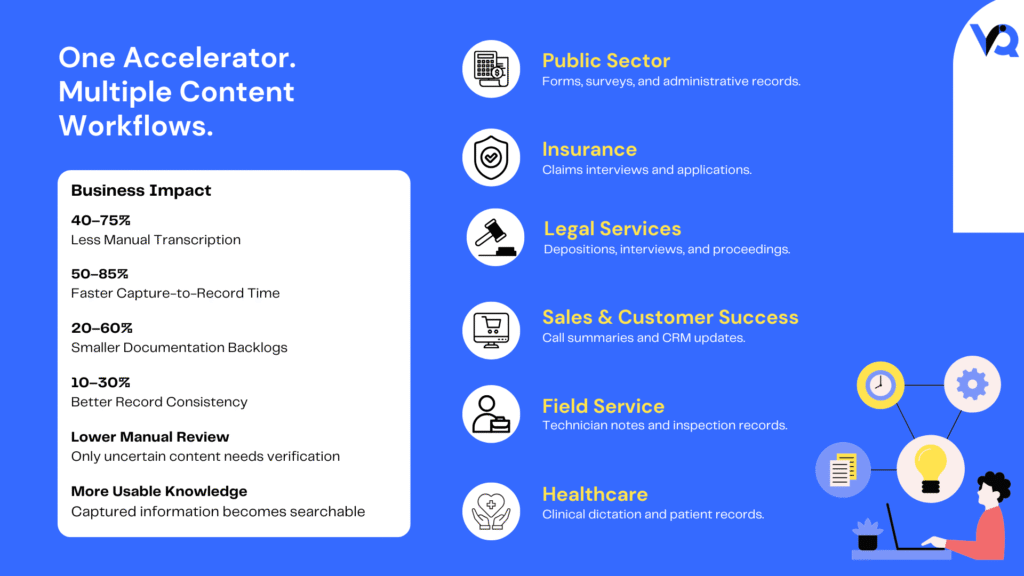
Metric | Typical Improvement |
Manual transcription and rekeying | 40–75% reduction |
Capture-to-record time | 50–85% faster |
Documentation backlog | 20–60% reduction |
Record consistency | 10–30% improvement |
Manual review effort | Significantly reduced |
Actual results depend on audio quality, handwriting clarity, domain complexity, review requirements, and integration readiness.
Beyond productivity gains, the larger benefit is making previously inaccessible information searchable, structured, and available for downstream automation. In healthcare, for example, AI-powered transcription is increasingly being used to convert spoken interactions into structured clinical documentation and reduce documentation burden.
Industries Where Every Captured Detail Matters
Digital Typist is particularly valuable for organizations where important information is still created through speech, handwriting, and semi-structured records.
- Healthcare — Clinical dictation and patient documentation.
- Legal Services — Depositions, interviews, and proceedings.
- Insurance — Claims interviews and application processing.
- Field Service — Technician notes and inspection records.
- Sales & Customer Success — Call summaries and CRM updates.
- Public Sector — Forms, surveys, and administrative records.
Turning Captured Content into Enterprise Intelligence
Unstructured content should not become a dead end.
Every voice note, handwritten form, recorded conversation, and scanned document can contain information that supports better decisions and faster operations. The challenge is converting that content into a format the enterprise can actually use.
Digital Typist provides the reusable foundation for building that capability faster. By combining transcription, handwriting recognition, speaker detection, entity extraction, template mapping, human review, and enterprise integration, organizations can transform raw human-generated content into reliable records at scale.
As enterprise information continues to grow across formats, the ability to capture it accurately and make it operational will become a foundational capability for intelligent automation.