


In Chapter 4, we mapped out the operational blueprints, demystifying legal entry vehicles, 15.5% transfer pricing safe harbours, and global matrixed governance.
Now, we turn to the most volatile line item on every GCC balance sheet: the engineering talent market.
The 2026 hiring playbook in India looks fundamentally different than it did even two years ago. On one hand, generative AI tools and LLM coding assistants have dramatically accelerated software development, spawning an era of AI-assisted rapid application development, often referred to in the industry as “vibe coding,” where developers can prompt entire modules into existence in minutes. On the other hand, this perception of instant velocity is creating a growing challenge: unvetted technical debt, security vulnerabilities, and architectural inconsistencies that experienced engineers must ultimately resolve.
At the same time, competition across India’s 2100+ GCC hubs has driven engineering compensation into distinct, highly specialized tiers. If you are still budgeting based on 2023 salary guides or treating all engineering disciplines equally, you are either mispricing your offers or severely underbudgeting your expansion.
Here is the unvarnished reality of AI-assisted engineering velocity, hidden technical risk, and current 2026 compensation benchmarks across India’s primary technology corridors.
1. The "Vibe Coding" Trap: Velocity vs. Technical Debt
AI coding copilots have undeniably transformed software development. Developers no longer start from blank screens; they prompt, iterate, and accept AI-generated boilerplate code in seconds.
However, modern enterprise GCCs are discovering the hidden operational cost of this rapid code generation: technical debt velocity.
When engineers rely heavily on AI tools to generate production code without fully understanding the underlying platform architecture, several systemic bottlenecks emerge:
- Architectural Fragmentation: AI copilots generate code localized to a specific prompt, often overlooking enterprise architecture, shared abstractions, domain models, or microservice boundaries.
- Refactoring Bottlenecks: Senior engineers frequently spend significantly more time reviewing, refactoring, and validating AI-generated code before it reaches production, reducing the productivity gains promised by AI-generated code.
- The Senior Scarcity Shift: While AI handles repetitive syntax and boilerplate development, demand has surged for systems architects, platform engineers, principal developers, and domain specialists capable of evaluating resilience, scalability, concurrency, observability, and security.
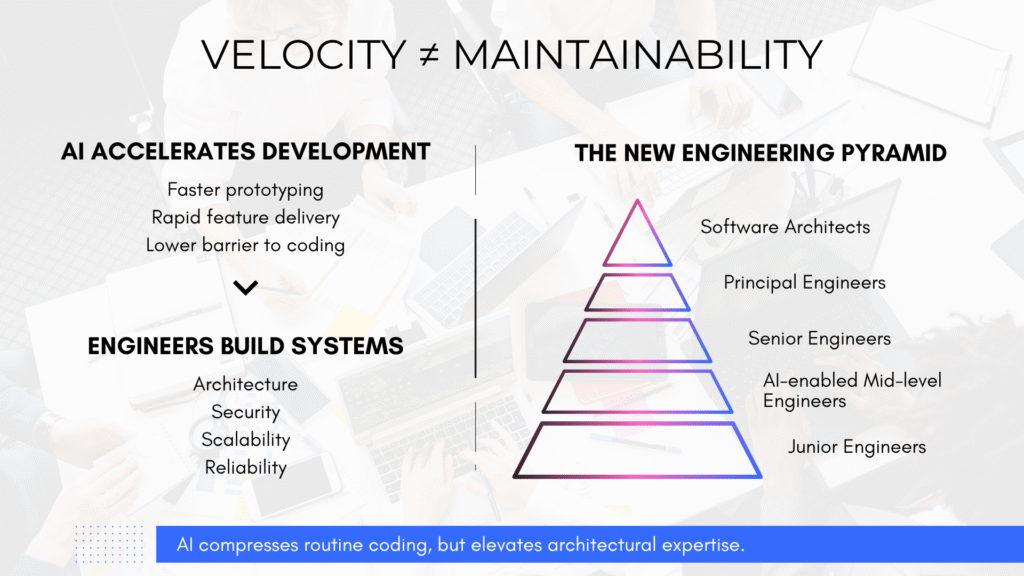
The New Engineering Pyramid
AI is reshaping engineering teams, but not by replacing them equally.
Rather than eliminating engineering jobs, AI is compressing routine development work while increasing the strategic importance of architecture, systems thinking, and technical leadership.
Key Takeaway: AI tools don’t reduce the need for elite engineering talent, they raise the bar for what senior talent must know. Your India strategy cannot rely on mass junior hiring powered by AI prompts; it requires experienced architects who ensure code generated at speed remains secure, maintainable, and production-ready.
2. The 2026 GCC Salary Benchmarks: What Talent Actually Costs
Driven by intense competition among Fortune 500 technology hubs, product companies, and AI-first engineering centres, compensation has become increasingly specialized.
Recent GCC compensation studies place median engineering compensation in the high-teens LPA range, with significant variation depending on role, city, specialization, and company maturity. Senior engineering, AI, and product leadership positions continue to command substantial premiums.
Below are indicative 2026 compensation benchmarks for key engineering, AI, and product management roles in Bangalore, which remains India’s benchmark technology market.
Engineering & Infrastructure Salary Bands (CTC in INR Lakhs Per Annum)
Role | Mid-Level (3–5 yrs) | Senior (6–9 yrs) | Lead / Principal (10+ yrs) |
Backend Engineer | ₹19–30 LPA | ₹32–48 LPA | ₹50–75 LPA |
Full Stack Engineer | ₹18–28 LPA | ₹30–44 LPA | ₹46–68 LPA |
DevOps / SRE Engineer | ₹20–32 LPA | ₹35–52 LPA | ₹55–80 LPA |
Cloud / Platform Engineer | ₹22–34 LPA | ₹36–55 LPA | ₹58–85 LPA |
Software Architect | — | ₹48–70 LPA | ₹80–120+ LPA |
The AI & Data Science Premium
Engineers with production-grade Machine Learning, GenAI, and LLM platform experience continue to command a significant compensation premium. Across many GCCs, AI-focused engineering roles often attract 40–60% higher compensation than equivalent backend engineering positions, although premiums vary by specialization, demand, and organization.
AI & Specialized Data Roles | Mid-Level (3–5 yrs) | Senior (6–9 yrs) | Lead / Principal (10+ yrs) |
AI / LLM Engineer | ₹28–45 LPA | ₹48–72 LPA | ₹78–120+ LPA |
Machine Learning Engineer | ₹26–42 LPA | ₹45–68 LPA | ₹72–115 LPA |
MLOps Specialist | ₹24–38 LPA | ₹40–62 LPA | ₹65–100 LPA |
Data Engineer | ₹20–32 LPA | ₹34–52 LPA | ₹55–82 LPA |
Product Management Leadership Bands
As GCCs increasingly own global product strategy rather than support functions alone, product leadership compensation has risen accordingly.
- Product Manager (3–5 yrs): ₹22–36 LPA
- Senior Product Manager (6–9 yrs): ₹38–58 LPA
- Group Product Manager / Director of Product (10+ yrs): ₹60–130+ LPA
3. Geographic Differentials & the True Cost of Employment
Setting a competitive compensation strategy requires understanding regional market differences and budgeting for the full cost of employment rather than salary alone.
CITY COMPENSATION INDEX (Bangalore = 100 Baseline)
- Bangalore: 100% (Highest competition, deepest AI pool)
- Hyderabad: 88–92% (Strong cloud & enterprise engineering talent)
- Pune: 78–84% (Automotive, embedded systems & SaaS ecosystem)
- Chennai: 74–80% (Enterprise platforms & infrastructure expertise)
- Delhi NCR: 90–94% (FinTech, product & corporate leadership talent)
The True Cost of Employment
Budgeting purely on stated Cost-to-Company (CTC) often understates the actual first-year investment. In practice, the total deployment cost of an engineer may exceed stated CTC by 35–45%, depending on hiring model and role complexity.
Key cost components include:
- Employer Statutory Contributions (13–15%)
EPF, gratuity provisions, health insurance, and statutory benefits. - Recruitment & Search Fees (10–18%)
Particularly for AI specialists, architects, and niche engineering leadership. - Joining Bonuses & Notice Buyouts (5–15%)
Common in competitive hiring for experienced engineering talent. - Annual Compensation Adjustments (8–15%)
Required to remain competitive in India’s technology talent market and reduce attrition risk.
4. Winning the Talent War: Beyond Compensation
Competing solely on salary creates an expensive and ultimately unsustainable hiring strategy.
The highest-performing GCCs differentiate themselves through long-term career value rather than short-term cash incentives.
- End-to-End Product Ownership: Engineers increasingly choose GCCs where they own complete products and platforms rather than isolated delivery tasks.
- Global Mobility & Leadership Exposure: Direct collaboration with global executives and international mobility opportunities remain powerful retention drivers.
- Modern AI Infrastructure: Access to enterprise AI platforms, GPU infrastructure, experimentation budgets, and R&D time signals a commitment to innovation rather than cost arbitrage.
- Engineering Culture: Strong technical leadership, architecture ownership, and opportunities to influence global roadmaps often outweigh incremental salary increases for senior engineers.
AI has fundamentally changed how software is built, but it has not reduced the need for exceptional engineering talent.
Instead, AI is shifting competitive advantage toward organizations that combine AI-assisted development with strong architectural governance, experienced technical leadership, and market-aligned compensation strategies.
Organizations that optimize only for speed risk accumulating technical debt. Those that invest in architecture, platform engineering, and engineering culture will build GCCs capable of delivering sustained innovation for years to come.
Now that we’ve explored GCC evolution, operating models, governance, and talent economics, one final question remains:
Why do some GCCs still fail to deliver strategic value, and what separates high-performing global capability centres from those that plateau?
Build a High-Performance GCC Talent Strategy with VantageIQ Technologies
Building a world-class GCC requires far more than filling open positions. It demands accurate compensation benchmarking, intelligent workforce planning, strong engineering leadership, and hiring strategies aligned with long-term business objectives.
At VantageIQ Technologies, we help global enterprises design high-performing engineering organizations, benchmark compensation across India’s technology markets, and recruit the executive leadership required to scale sustainable Global Capability Centres.
Ready to future-proof your GCC talent strategy? Connect with the VantageIQ advisory team today.
Read the next in the series – The Graveyard: Why Captives Fail & How to Prevent Collapse focusing on why GCCs underperform, root causes of failure, trust gaps, leadership hiring mistakes, and historical case studies.