


In Chapter 4 and Chapter 5, we walked through the architectural blueprints of building a high-impact Indian GCC, from navigating entry vehicles and 15.5% transfer pricing safe harbours to managing the 2026 talent market and technical debt.
Now comes the sober finale: The unvarnished story of why centers underperform, stall, or quietly get divested.
For every high-profile success story like Walmart Global Tech or AstraZeneca’s GITC, the enterprise graveyard holds stories of GCCs that failed to deliver. They didn’t collapse because India lacked software developers or office space; they failed because of strategic blindness, governance disconnects, and cultural arrogance at headquarters.
When an Indian center underperforms, it rarely crashes in a single dramatic moment. Instead, it suffers from a slow, painful operational decline.
Here is an analysis of why GCCs underperform, why some early captive models were restructured or divested, and the strategic guardrails that separate resilient GCCs from those that quietly fade away:
The Anatomy of Failure: 4 Fatal Root Causes
When a global C-suite decides to shut down or sell off its Indian center, the official press release usually blames “shifting corporate priorities” or “vendor consolidation”. In reality, the breakdown almost always stems from four systemic operational errors:
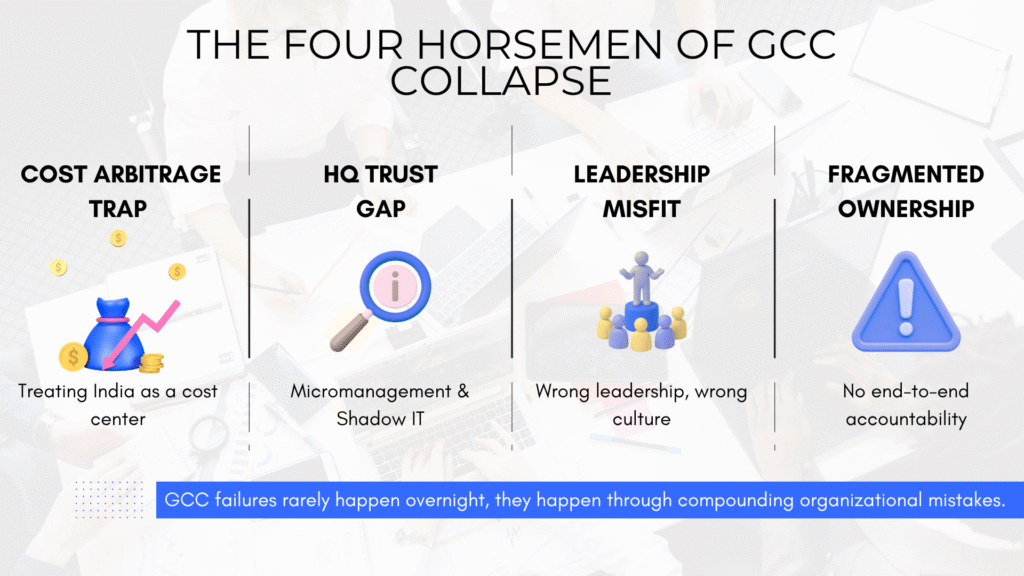
Root Cause #1: The Cost-Arbitrage Trap
If your sole business case for launching in India is saving 60% on payroll, your center is doomed from Day 1. Treating an Indian team as a cost-cutting measure leads to low-value work allocation. When local teams are limited to handling repetitive ticket queues or basic QA maintenance, two things happen:
- Top local engineering talent resigns within 6 months, leaving behind underperforming teams.
- HQ teams view the center as a low-cost, disposable resource rather than a strategic partner.
Root Cause #2: The HQ Trust Gap & “Shadow IT”
The most toxic dynamic in a global organization is the Trust Gap. When overseas business units feel forced by the board to send work to India, they often resist.
Instead of empowering local engineering leads, HQ managers micro-manage every commit, hold back core product codebases, and create “shadow engineering teams” back home to double-check the Indian team’s output. This duplication destroys operational efficiency, inflates costs, and frustrates local teams.
Root Cause #3: The Leadership Misfit
A major cause of GCC underperformance is appointing the wrong India Managing Director. Companies often make one of two hiring mistakes:
- The Retired Vendor Manager: Hiring a legacy IT services executive who excels at tracking SLA spreadsheets but has zero experience building high-velocity product engineering cultures.
- The Disconnected Expat: Parachuting in a long-time HQ insider who understands corporate politics back home but has no understanding of India’s talent ecosystem or local execution nuances.
Root Cause #4: Fragmented Process Ownership
When an Indian team is given responsibility for only isolated pieces of a process, such as writing frontend code while HQ handles backend architecture, testing, and deployment, accountability breaks down. When a production bug occurs, both teams point fingers. Without end-to-end product or platform ownership, the GCC cannot deliver measurable business value.
Historical Case Studies: What the Divestitures Taught Us
The history of Indian captives contains clear lessons from major global brands that struggled, restructured, or divested their local centers when their operating models broke down.
Historical Captive / Divestiture | Primary Root Cause | Strategic Lesson Learned |
America Online (AOL)Early Contact Hubs (Mid-2000s) | Process isolation and weak integration with core product teams | Low-cost support operations without ownership of core platforms become difficult to sustain over the long term. |
Citigroup Global Services(Operations later outsourced to Wipro, 2008) | Operated primarily as a transactional back-office cost center | Financial operations without deep integration into global business strategy are more vulnerable to restructuring or outsourcing. |
UBS India Service Centre(Operations transitioned to Cognizant, 2009) | Limited global matrix integration and insufficient local leadership autonomy | Transaction-focused delivery models are more likely to be outsourced during periods of business restructuring or economic downturns. |
The AOL & Early Captive Divestitures
In the mid-2000s, pioneer captives like AOL, Citigroup Global Services, and UBS India Service Centre built large operational footprints. However, many of these early hubs were structured purely as transactional back-office support factories.
When global financial crises hit or corporate growth slowed, HQ leadership realized they had built massive remote overhead without deep strategic integration into core product platforms. The result? Millions of dollars in capital expenditure ended up being divested or sold off to third-party IT service vendors.
The Modern Contrast: Today’s enterprise leaders learned from these early divestitures. Modern GCC success stories, like Walmart, JPMorgan Chase, and AstraZeneca, do not operate as isolated back offices. They ensure Indian engineering leads sit on global executive committees and directly control core technology platforms.
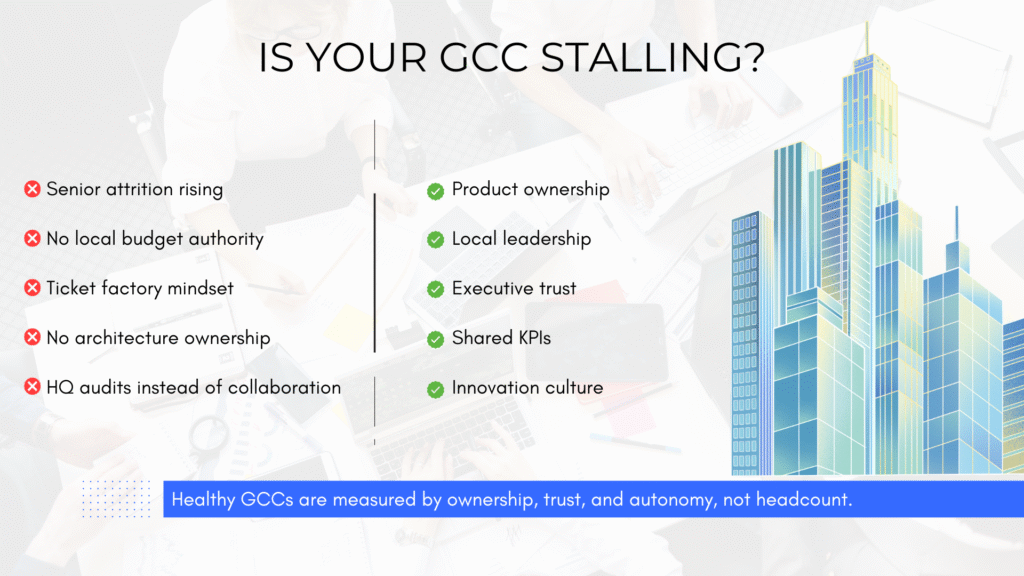
The GCC Health Audit: 5 Red Flags Your Center Is Stalling
How do you know if your Indian capability center is heading toward failure? Run your operations against this 5-point health check:
[ RED FLAG 1 ] ──> High Senior Attrition (>20% annual turnover among Lead+ engineers)
[ RED FLAG 2 ] ──> Zero Local Budget Autonomy (HQ approves expenses down to $1,000)
[ RED FLAG 3 ] ──> The “Ticket Factory” Mandate (India team receives work only via JIRA tickets)
[ RED FLAG 4 ] ──> Absence of Local Architecture (India leads execute; HQ leads design)
[ RED FLAG 5 ] ──> Asymmetric Executive Visits (HQ visits India for audits, not strategy)
If your center checks three or more of these red flags, your GCC is operating as a remote vendor under an expensive internal banner, rather than a true capability center.
The Prevention Playbook: Building a Resilient GCC
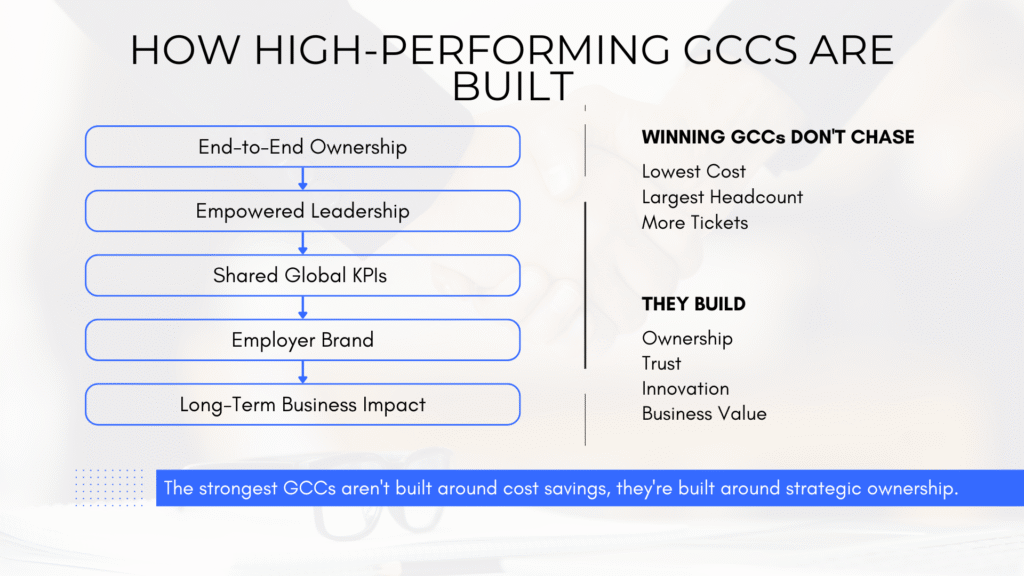
To ensure your center delivers long-term enterprise value, follow these four strategic principles:
- Mandate End-to-End Ownership: Transfer full ownership of entire product lines, platform microservices, or AI pipelines to India. The local team should own the code from architectural design to 24/7 production monitoring.
- Hire Transformational Local Leaders: Recruit an India Managing Director who has built and scaled high-velocity product engineering teams. Empower them with direct P&L control and a seat at the global executive table.
- Embed Joint KPIs: Tie the performance metrics of HQ executives directly to the success of the Indian hub. When global VPs share accountability for local execution, corporate friction disappears.
- Invest in Employer Brand: Treat your Indian site as an employer of choice. Build a local talent brand focused on innovation and career progression—not just competitive salaries.
The Ultimate Paradox of Scale
The ultimate paradox of building a Global Capability Center in India is simple: The more you treat your center as a cost-saving initiative, the more expensive and inefficient it becomes. But when you treat it as an empowered strategic partner, the financial returns follow naturally.
Building a successful GCC isn’t about renting office floors or hiring developers at scale. It’s about designing an operating model that connects global vision with local execution.
Secure Your GCC Strategy with VantageIQ Technologies
Preventing strategic misalignment, structuring effective governance, and hiring transformational site leadership requires experienced guidance. At VantageIQ Technologies, we help global enterprises audit underperforming hubs, redesign operating models, and build resilient GCCs that deliver long-term impact.
Connect with the VantageIQ Technologies advisory team to future-proof your India strategy today.