

Building on our exploration of the $725B AI capex trap and the initial wave of U.S. tech realignments in Episode 7, this blog examines how organizations are restructuring for long-term sustainability. The realization that artificial intelligence functions as a productivity amplifier rather than a wholesale human replacement has fundamentally redefined enterprise technology strategy. As the operational gaps of premature automation, most notably the “AI substitution deficit” became clear, global technology organizations shifted away from pure headcount reduction toward building integrated Human + AI Orchestration Frameworks.
In this evolving paradigm, Global Capability Centers (GCCs) in India are no longer offshore support satellites. They have matured into sovereign transformation hubs that own core intellectual property, manage global product roadmaps, and direct enterprise AI strategies.
Here is an analysis of the shifting talent landscape, leadership decentralization, geographic expansion, and the long-term outlook for Indian GCCs through 2030.
The Human + AI Orchestration Model: From Creators to Orchestrators
The software engineering function is undergoing a structural shift. Instead of manually writing boilerplate code, technical talent is increasingly transitioning from code production toward AI orchestration, governance, architecture, and validation.
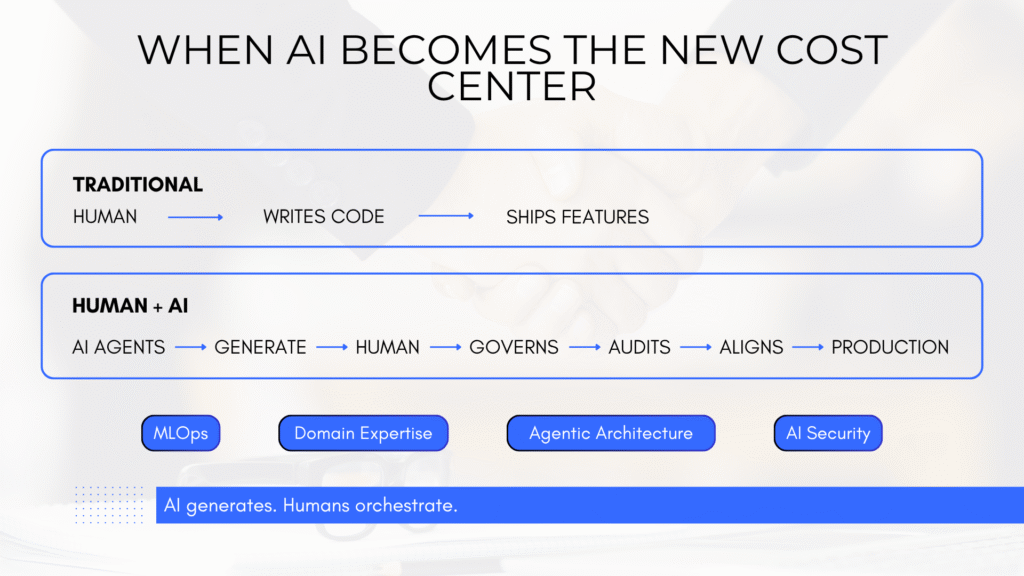
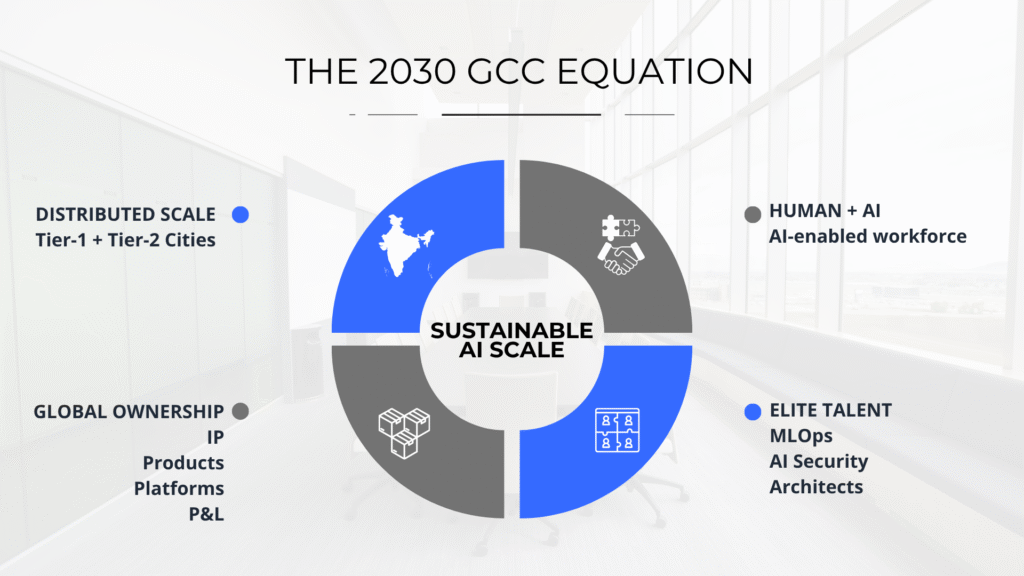
Because autonomous systems struggle with architectural complexity, zero-day vulnerabilities, and legacy refactoring, human judgment remains indispensable. Consequently, hiring priorities have pivoted toward highly specialized “Human + AI” roles:
- MLOps Engineers: Responsible for deploying, fine-tuning, and maintaining large language models (LLMs) in live production environments. Candidates with verified expertise command base salary premiums of 20% to 40%, with recruitment time-to-fill stretching to 75–90 days due to candidate scarcity.
- Agentic Framework Architects: Systems developers focused on multi-agent orchestration, tool-calling, and retrieval-augmented generation (RAG).
- AI Security Engineers: Specialists dedicated to prompt injection defense, model red-teaming, and automated data privacy enforcement.
- Domain Process Specialists (“Insiders”): Veteran subject-matter experts hired to codify tacit, undocumented institutional knowledge into automated enterprise workflows.
The implication is clear: AI does not eliminate the need for technical expertise; it changes where that expertise creates the most value.
Leadership Decentralization: The Rise of "Corporate Co-Headquarters"
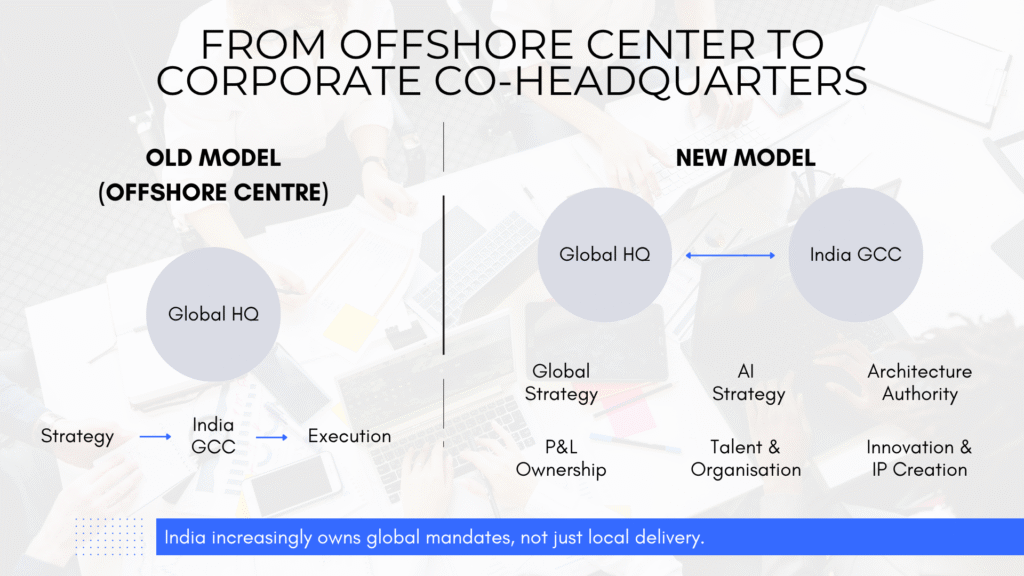
The distinction between a Western corporate headquarters and an Indian “offshore center” is rapidly dissolving. Executive authority is permanently decentralizing toward India-based leaders.
THE DECENTRALIZATION OF EXECUTIVE AUTHORITY
• 6,500+ global executive roles currently anchored in India
• Projected to surpass 30,000 global leadership positions by 2030
• End-to-end P&L management and architectural authority from India
• Growing ownership of global engineering, AI, and product functions.
Over 44% of Indian GCCs now operate as Portfolio Hubs or Transformation Hubs. In these mature tiers, local leaders hold direct hiring, budget, and architectural authority over global divisions, effectively bypassing traditional Western management layers.
The result is a structural shift in how multinational enterprises think about India: not simply as an execution location, but increasingly as a second center of global decision-making and technology leadership.
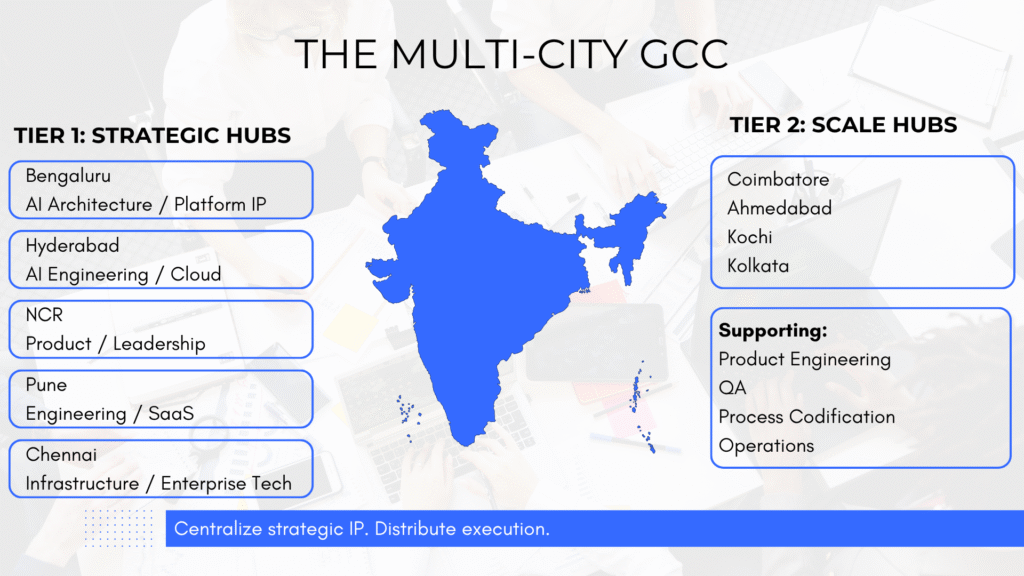
This multi-city model allows global enterprises to maintain core architectural direction in Tier-1 tech hubs while building stable, cost-effective development centers in regional markets.
The strategic advantage is no longer simply cost arbitrage. It is the ability to combine specialized metropolitan talent with scalable regional engineering capacity.
The 2026–2030 Long-Term Outlook: Scaling Value Over Volume
As the sector advances toward 2030, macroeconomic metrics governing Indian Global Capability Centers reflect rapid expansion. According to EY and NASSCOM industry projections, the market is on track to cross $110 Billion in direct value, driven by software exports, core IP ownership, and global P&L management.
REVENUE TRAJECTORY — 2030
110 Billion Market Size
Driven by high-value IP & P&Ls
TALENT TRAJECTORY — 2030
2.8M-4.5M PROFESSIONALS
AI multiplies per-capita output
While traditional baseline forecasts project India’s GCC workforce expanding from 1.9 million to 4.5 million professionals across ~2,500 centers, the rapid integration of enterprise AI is changing how that growth materializes:
- The Linear Baseline (Volume Model): Traditional macro forecasts project 4.5 million employees by 2030, driven by ~115 new capability centers setting up operations in India annually.
- The AI-Augmented Model (Productivity Decoupling): As multi-agent AI frameworks absorb routine software development and operational tasks, per-employee output increases exponentially. Even if net headcount stabilizes closer to 2.8 million to 3.0 million specialists, their combined output will equal or exceed legacy volume projections.
Revenue growth is no longer tied strictly to linear headcount expansion, but to per-capita output (revenue per employee), core platform ownership, and sovereign P&L direction.
Build Your 2030 Capability Architecture with VantageIQ Technologies
Scaling MLOps talent, establishing multi-city hub architectures, and driving global P&L management from India requires strategic foresight. At VantageIQ Technologies, we partner with global enterprise leaders to build, optimize, and scale sovereign Transformation Hubs.
Connect with the VantageIQ Technologies team to design your enterprise’s long-term India strategy.
