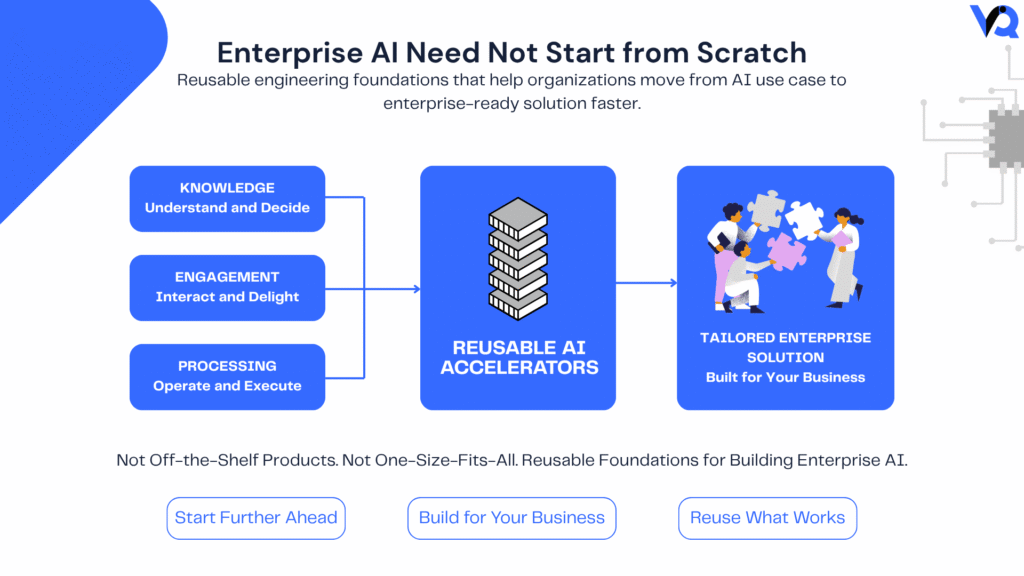
Why reusable engineering foundations can help organizations move from AI use case to enterprise-ready solution faster.
A bank wants an AI assistant for policy questions. A healthcare provider wants to automate document intake. A retailer wants intelligent product recommendations.
The business problems are different. But beneath them, engineering teams often end up building many of the same foundations again.
Documents must be ingested. Data must be cleaned and structured. Knowledge must be indexed and retrieved. Access must be controlled. Outputs must be evaluated. Actions must be logged. Enterprise systems must be integrated.
And too often, every new AI project starts by rebuilding these foundations from scratch.
Enterprise AI accelerators change that equation.
Every AI Project Starts Differently. The Foundations Often Do Not.
The most visible part of an AI solution is usually the business use case.
An employee asks a policy question. A claims team processes incoming documents. A customer receives a product recommendation. An operations team validates information across multiple records.
But behind each experience sits substantial engineering work.
For an enterprise knowledge solution, documents may need to be ingested, cleaned, chunked, indexed, secured, retrieved, cited, and scored. A workflow solution may require integrations, orchestration, permissions, exception handling, audit trails, and human review.
When every project begins from a blank page, teams can spend months building the foundation before reaching the actual business problem.
The result is repeated engineering effort, longer delivery cycles, inconsistent controls, and valuable knowledge trapped inside individual projects.
So, What Exactly Is an Enterprise AI Accelerator?
An enterprise AI accelerator is a reusable engineering foundation for solving a recurring class of business problems.
It may combine internal frameworks, architectural blueprints, delivery patterns, AI pipelines, pre-built components, integration approaches, governance controls, evaluation frameworks, and implementation experience.
Once an organization identifies a use case, policy Q&A, compliance support, onboarding assistance, intelligent routing, document validation, customer engagement, or operational decision support—the relevant accelerator provides common building blocks that can be adapted to the organization.
The simplest way to understand it is this:
An accelerator is not the final solution. It is the foundation that helps build the final solution faster.
What an Accelerator Is and What It Is Not
This distinction matters because an accelerator can easily sound like another name for a software product.
It is not.
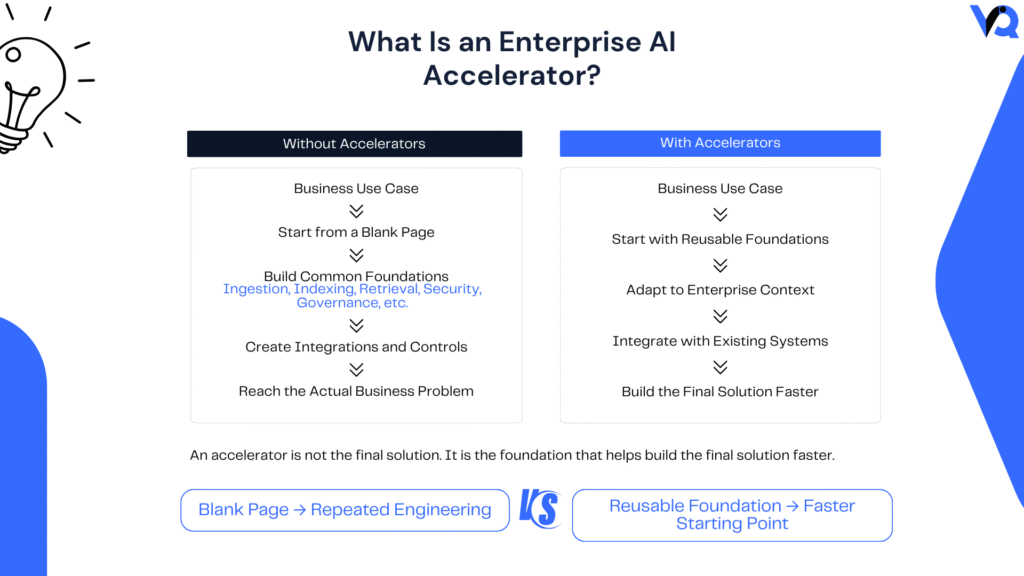
The final solution still needs to reflect the organization using it: its data, workflows, policies, users, technology environment, and security requirements.
The accelerator simply means the team does not have to rediscover and rebuild every common capability along the way.
The 16 Accelerators: Three Engines Across the Enterprise
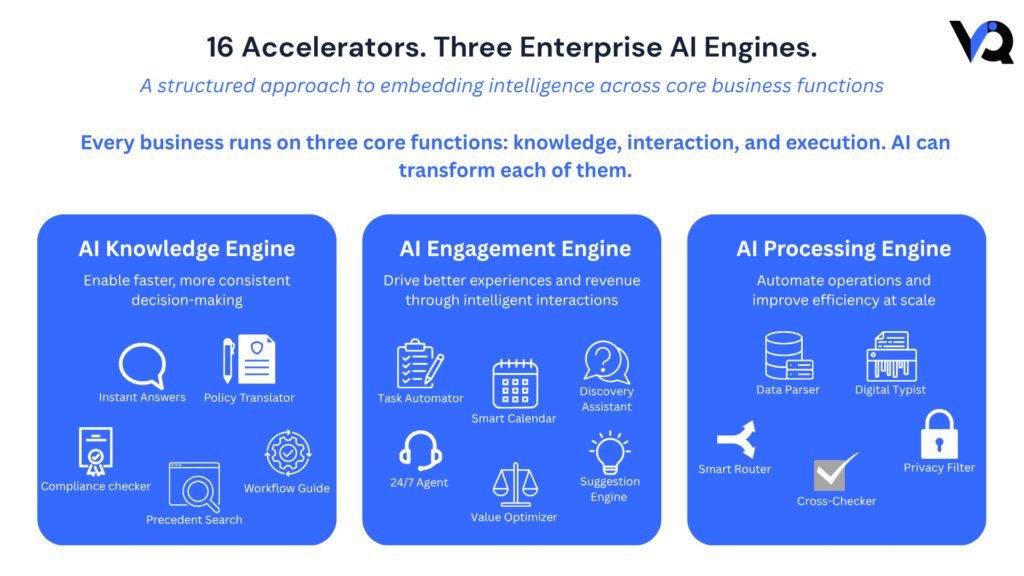
At VantageIQ, we have organized 16 accelerators around three core areas of enterprise activity: knowledge, engagement, and processing.
AI Knowledge Engine
The AI Knowledge Engine helps people find, understand, and act on enterprise knowledge more effectively.
Instant Answers retrieves trusted answers from enterprise knowledge. Policy Translator turns complex policies into clear guidance. Compliance Checker evaluates information against defined requirements. Precedent Search finds relevant prior cases and decisions. Workflow Guide helps users navigate complex procedures step by step.
AI Engagement Engine
The AI Engagement Engine supports intelligent interactions, task execution, discovery, personalization, and customer-value decisions.
Task Automator executes repetitive tasks and workflows. Smart Calendar coordinates scheduling and appointments. Discovery Assistant helps users find the right products, services, or information. 24/7 Agent enables always-on conversations. Value Optimizer identifies opportunities for retention, cross-sell, and growth. Suggestion Engine generates relevant next-best recommendations.
AI Processing Engine
The AI Processing Engine turns incoming information into structured, validated, protected, and actionable outputs.
Data Parser extracts and structures information. Digital Typist converts voice, handwriting, and scanned content into usable records. Smart Router classifies and routes incoming work. Cross-Checker compares related information and detects discrepancies. Privacy Filter protects sensitive information before it moves forward.
These are not 16 isolated products. They are reusable engineering foundations that can be selected, combined, and adapted around the business problem being solved.
One Accelerator Solves a Problem. Several Create a Solution.
Real enterprise solutions rarely depend on only one capability.
An intelligent employee-support solution might combine:
Instant Answers + Policy Translator + Workflow Guide
A document-operations solution might combine:
Data Parser + Smart Router + Cross-Checker + Privacy Filter
A customer-engagement solution might combine:
Discovery Assistant + Suggestion Engine + Value Optimizer
The value is not only in the individual building blocks. It is in how they can be composed around a specific business outcome.
Consider an insurer that wants to automate incoming claims. Without reusable foundations, the team may need to design document ingestion, extraction, routing, validation, privacy controls, exception handling, audit trails, and integrations.
With an accelerator-based approach, the flow can begin with reusable foundations:
Extract → Route → Validate → Protect
The insurer still receives a solution adapted to its claims processes, policies, systems, risk thresholds, and review requirements.
The difference is the starting point.
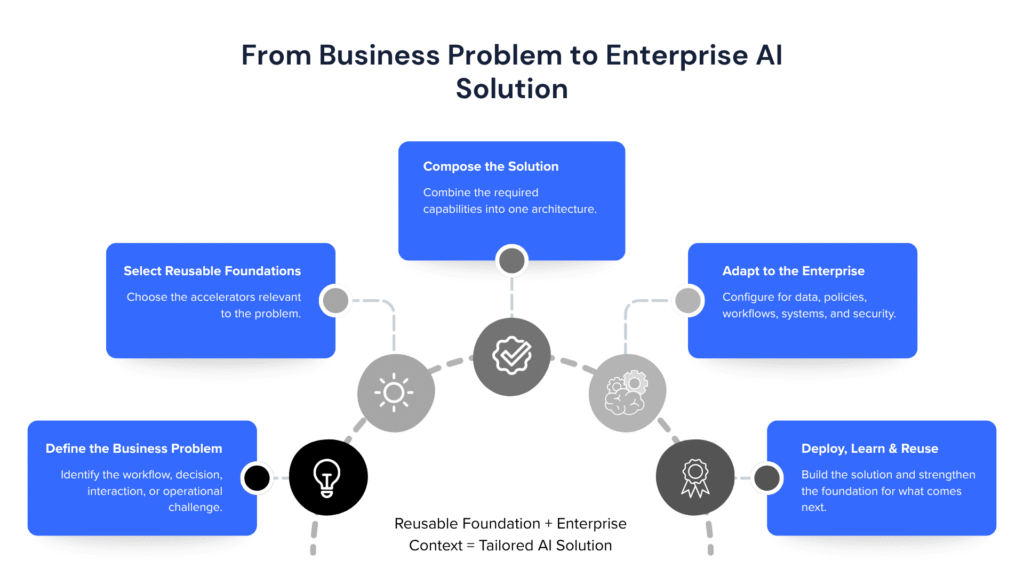
Enterprise AI Should Get Faster Every Time You Build
The first AI project should not make the second one start from zero.
Every implementation should leave behind stronger foundations, proven patterns, reusable components, and practical delivery knowledge for what comes next.
That is the larger idea behind VantageIQ’s Enterprise AI Accelerators.
Not shortcuts. Not one-click AI. Not finished products waiting to be switched on.
They are a way to make enterprise AI delivery more reusable, composable, governed, and ready to evolve.
Because as organizations move from isolated experiments to multiple AI-enabled workflows, the question is no longer only:
What can we build with AI?
It is also:
Why are we rebuilding the same foundations every time?
Enterprise AI should get faster every time you build.
That is what accelerators are designed to make possible.